Luxman L-505F: The Pinnacle of Analog Refinement
In the late 1980s, Japanese high-fidelity audio reached a zenith of craftsmanship, innovation, and sonic excellence. Among the elite brands leading this golden era, Luxman stood apart—not merely for technical prowess, but for a philosophy that blended artistry with engineering. The Luxman L-505F, introduced in 1988, is a quintessential expression of that philosophy: a line preamplifier that embodies the warmth, musicality, and meticulous build quality for which Luxman remains revered today.
While Luxman produced a range of integrated and power amplifiers during this period, the L-505F was designed for the discerning audiophile seeking ultimate control and purity in signal path management. As a preamplifier, it doesn’t drive speakers directly, but instead serves as the command center of a high-end audio system—routing sources, adjusting volume, and preserving the integrity of the audio signal before it reaches the power amplifier. In this role, the L-505F excels with a rare combination of transparency, tonal richness, and analog grace.
Technical Specifications
The L-505F was engineered during a transitional period when solid-state reliability met the lingering influence of tube-era design ideals. While fully transistorized, it incorporates circuit philosophies that emulate the smoothness and harmonic richness of vacuum tubes—a hallmark of Luxman’s “analog-first” approach.
| Specification | Detail |
| Model | L-505F |
| Year Introduced | 1988 |
| Manufacturer | Luxman Corporation, Japan |
| Type | Line Preamplifier |
| Inputs | 4 Line Level (RCA), 1 Moving Magnet (MM) Phono |
| Outputs | 1 Main Out (RCA), 1 Tape Out (RCA) |
| Frequency Response | 10Hz – 100kHz (±1dB) |
| Total Harmonic Distortion | < 0.01% (1kHz, rated output) |
| Signal-to-Noise Ratio | > 90dB (IHF-A weighted) |
| Gain | Line: 12dB, Phono (MM): 40dB |
| Power Supply | Dual-mono regulated power supply |
| Power Consumption | 30W |
| Dimensions (W×H×D) | 440 × 146 × 360 mm |
| Weight | 11.5 kg (25.3 lbs) |
| Finish | Silver or Black (brushed aluminum front panel) |
One of the standout engineering choices in the L-505F is its discrete component design—avoiding integrated circuits in critical signal paths. Luxman employed high-grade resistors, polypropylene capacitors, and precision stepped attenuators for volume control, ensuring minimal signal degradation. The dual-mono power supply further isolates left and right channels, reducing crosstalk and enhancing stereo imaging.
Sound Characteristics and Performance
The sonic signature of the Luxman L-505F is often described as "liquid," "organic," and "musically engaging." Unlike some preamps of the era that leaned toward clinical accuracy, the L-505F imparts a subtle warmth—particularly in the midrange—that brings vocals and acoustic instruments to life. This is not coloration in the negative sense, but rather a carefully tuned balance that mimics the natural resonance of live music.
Bass response is tight and well-controlled, never bloated, while the treble remains smooth and detailed without harshness—a trait that makes the L-505F exceptionally forgiving with lesser recordings or bright-sounding sources. Its wide frequency response and low distortion ensure that microdynamic nuances—such as the decay of a piano note or the breath behind a singer’s phrase—are preserved with remarkable fidelity.
Paired with high-quality power amplifiers like the Luxman M-05 or contemporary models from Accuphase or Audio Research, the L-505F forms the heart of a system capable of transporting the listener into the recording space. Its phono stage, while designed for MM cartridges, is notably quiet and dynamic—rare for a preamp of its class that includes built-in phono support.
Notable Features and Innovations
The L-505F was not merely a functional component—it was a statement of design intent. Among its most admired features:
- Stepped Attenuator Volume Control: Unlike potentiometers, which can wear and degrade over time, the L-505F uses a precision rotary switch with discrete resistors for each volume level. This ensures consistent channel balance and long-term reliability.
- High-Impedance Input Buffering: The input stage is designed to accept signals from a wide range of sources without loading them down, preserving the integrity of delicate preamp outputs or vintage gear.
- Luxman’s “Parallel Push-Pull” Circuit Topology: Though fully solid-state, the amplifier circuitry uses a symmetrical push-pull configuration with parallel devices to lower output impedance and improve current delivery—contributing to its dynamic ease and authority.
- Luxurious Build Quality: The thick aluminum front panel, heavy steel chassis, and hand-inspected assembly reflect a level of craftsmanship that is increasingly rare. Even the knob feel—smooth, damped, and precise—speaks to attention to detail.
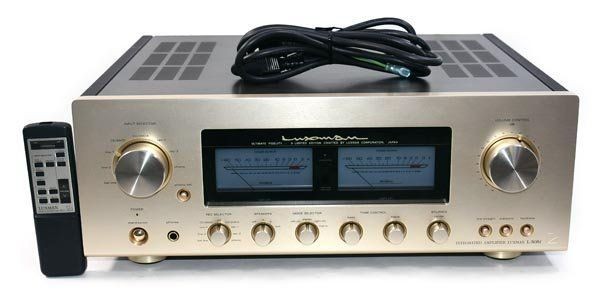
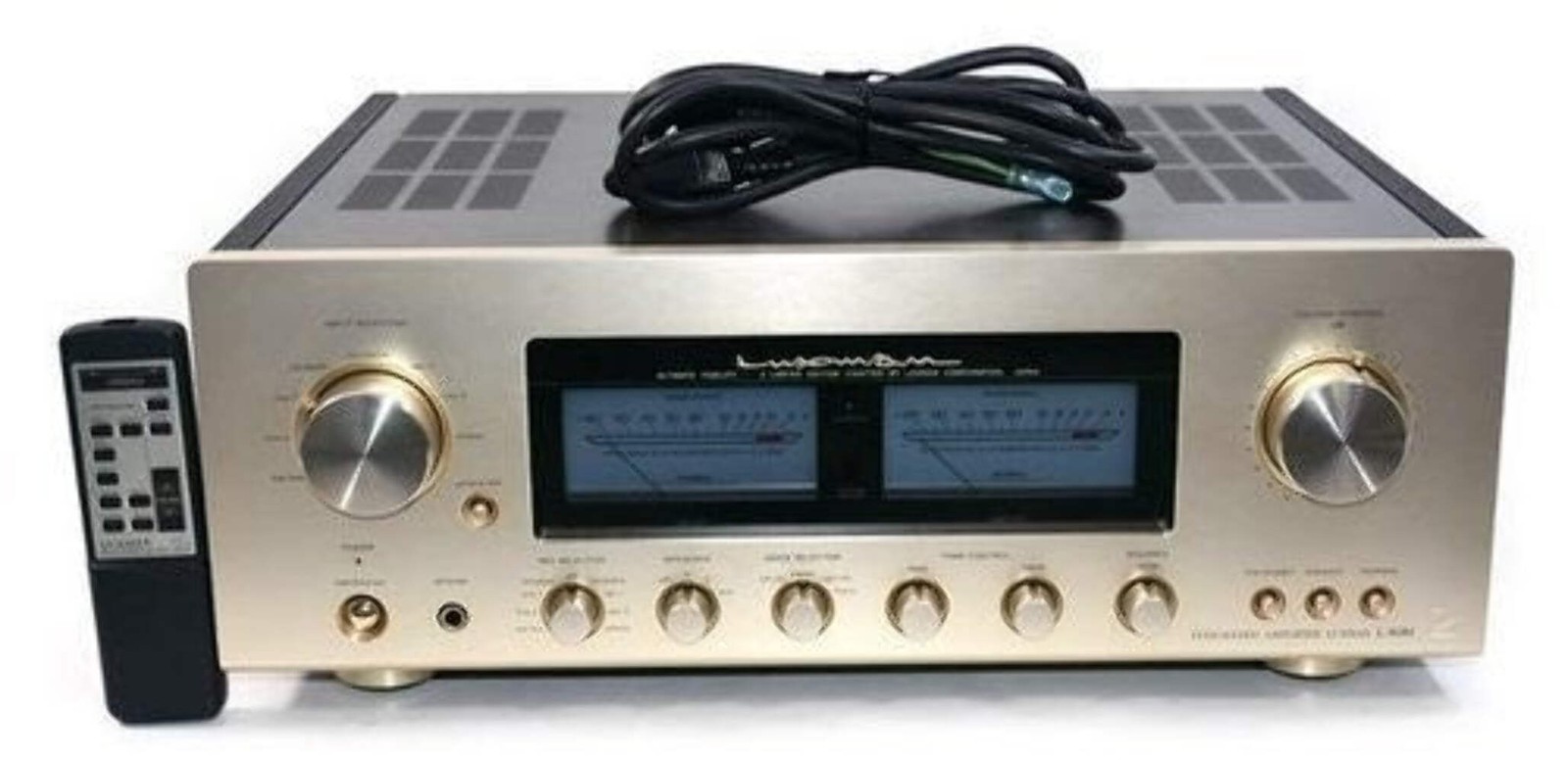
- Aesthetic Timelessness: With its minimalist faceplate, blue VU-style meters (optional on some variants), and elegant script logo, the L-505F remains visually striking decades later. It’s a component that belongs in a living room as much as a dedicated listening space.
Common Issues and Maintenance
While the L-505F is renowned for its durability, age-related issues can arise after more than three decades of service:
- Capacitor Aging: Electrolytic capacitors in the power supply and signal path may degrade, leading to hum, channel imbalance, or reduced performance. A professional recapping by a technician familiar with vintage Luxman gear is often recommended for units that haven’t been serviced in 15+ years.
- Oxidized Switches and Pots: The selector switches and balance control can develop crackling or intermittent contact. Regular use and occasional cleaning with contact cleaner can mitigate this, but disassembly and cleaning are sometimes necessary.
- Tube Confusion (Myth Clarification): Despite its warm sound, the L-505F is not a tube amplifier—it uses all-transistor circuitry. However, its sonic character is so reminiscent of tube gear that some mistakenly believe it contains valves. This is a testament to Luxman’s circuit design philosophy.
- Power Supply Stability: The regulated dual-mono supply is robust, but voltage regulators can fail over time. Checking output voltages during servicing is prudent.
Given its build quality, most well-maintained L-505F units still perform exceptionally today. Finding one in good condition often means it has been cherished by its owner—a common trait among Luxman equipment.
Current Market Value and Collectibility
The Luxman L-505F has steadily grown in reputation and value among vintage audio collectors. While not as widely known as some of its contemporaries from Marantz or Sansui, it is highly sought after by Luxman enthusiasts and analog purists.
In today’s market (2024), a fully functional L-505F in good cosmetic condition typically sells for $800–$1,400 USD, depending on region, included accessories, and service history. Units with original packaging, manuals, or rare finishes (such as the black variant) may command premiums. Fully restored models with recapped power supplies and cleaned controls often sell toward the higher end of the range.
Its collectibility is bolstered by Luxman’s limited production runs and reputation for longevity. Unlike mass-market receivers of the era, the L-505F was built in smaller numbers for a niche audience—making well-preserved examples increasingly rare.
Conclusion and Legacy
The Luxman L-505F is more than a preamplifier—it’s a testament to a philosophy of audio reproduction that values musical engagement over technical showmanship. In an era increasingly dominated by digital streaming and compact systems, the L-505F reminds us of the beauty of analog signal flow, meticulous engineering, and the emotional resonance of well-crafted sound.
It represents the quiet confidence of Japanese high-end audio at its peak: understated in appearance, profound in performance. For the collector, the restorer, or the listener seeking that elusive “you are there” quality, the L-505F remains a compelling choice—a bridge between eras, and a timeless standard of analog refinement.
If you’re fortunate enough to encounter one in the wild, power it up, cue a great LP, and prepare to be reminded why we fell in love with high-fidelity audio in the first place.
eBay Listings

As an eBay Partner, we earn from qualifying purchases. This helps support our independent vintage technology research.
Related Models
- Luxman L-530 (1975)
- Luxman R-404 (1975)
- Luxman RV-371 (1975)
- Luxman SQ-38U (1975)
- Luxman T-14 (1972)
- Luxman T-530 (1975)
- Luxman TX-101 (1975)
- Denon DRA-800 (1985)
- Denon PMA-350Z (1980)
- Denon POA-1500 (1979)