Luxman L-3B: The Soul of Japanese Tube Preamplification
In the mid-1960s, as high-fidelity audio began to flourish in Japan, Luxman emerged as a pioneer in crafting refined, sonically transparent tube electronics that balanced Western engineering principles with meticulous Japanese craftsmanship. Among their early standouts was the Luxman L-3B, a vacuum tube preamplifier introduced in 1965 that exemplified the brand’s commitment to musicality, build quality, and understated elegance. Though not as widely documented as some of its contemporaries, the L-3B holds a cherished place among vintage audio enthusiasts for its warm, natural sound and its role in establishing Luxman’s reputation for excellence.
Historical Context: Luxman in the 1960s
By the mid-1960s, Luxman—founded in 1925 as Lux Corporation—had already built a strong reputation for producing high-quality radios and audio components. The post-war economic boom in Japan fueled a growing interest in home hi-fi systems, and Luxman responded with a series of tube amplifiers and preamplifiers that combined advanced circuit design with premium materials. The L-3B was part of a broader family of tube preamplifiers (including the L-3 and L-3A) that evolved in small but meaningful ways each year. The "B" revision brought subtle refinements in circuit layout, power supply filtering, and component selection, enhancing stability and clarity.
At a time when American and British brands dominated the audiophile landscape, Japanese manufacturers like Luxman, Sansui, and Accuphase were quietly developing their own sonic identity—one that emphasized neutrality, detail retrieval, and harmonic richness without the harshness sometimes associated with early transistor gear. The L-3B stands as a testament to this golden era of Japanese tube design.
Technical Specifications
The Luxman L-3B is a dual-mono, all-tube preamplifier designed for line-level signal management. It features a classic tube complement common in high-end Japanese preamps of the era, with an emphasis on low feedback and high-quality passive components.
| Specification | Detail |
| Model | L-3B |
| Year Introduced | 1965 |
| Type | Tube Preamplifier |
| Tubes | 2x 6SN7 (amplification), 1x 5U4G (rectifier) |
| Inputs | 3 line-level (tuner, phono, aux) |
| Outputs | 1 main output, 1 tape output |
| Frequency Response | 20Hz – 20kHz (±1dB) |
| Total Harmonic Distortion | <1% at full output |
| Input Impedance | 47kΩ (line), 1MΩ (phono) |
| Output Impedance | 10kΩ |
| Power Supply | Linear transformer, tube rectified |
| Power Consumption | 60W |
| Dimensions (W×H×D) | 390 × 165 × 300 mm |
| Weight | 10.5 kg (approx.) |
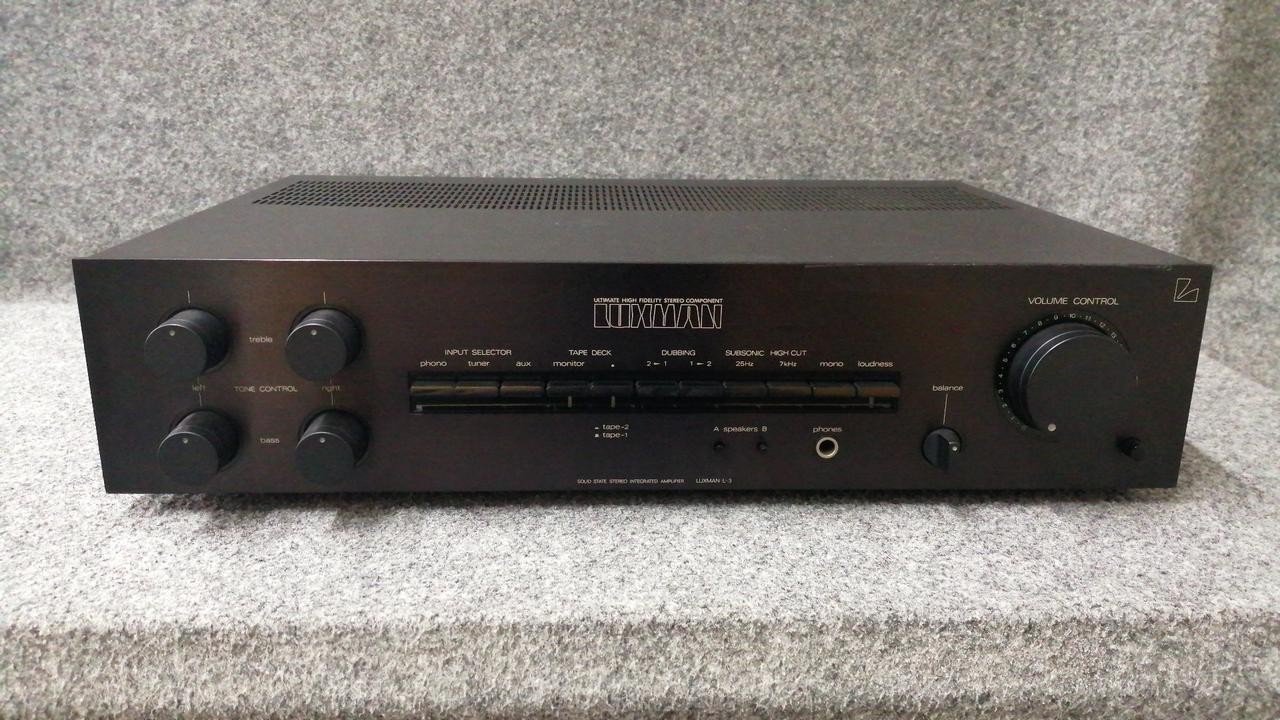
| Finish | Champagne gold chassis, black front panel with brushed aluminum trim |
The L-3B features both phono and line inputs, with the phono stage tailored for moving magnet (MM) cartridges of the era. Its dual 6SN7 tubes handle voltage amplification and phase splitting, while the 5U4G rectifier ensures smooth, low-noise power delivery—typical of Luxman’s conservative yet effective design philosophy.
Sound Characteristics and Performance
The Luxman L-3B is revered for its warm, organic tonality and effortless musicality. Unlike some tube preamps that lean heavily into romanticized sound signatures, the L-3B strikes a rare balance: it imparts a gentle tube glow without sacrificing clarity or midrange transparency. Instruments are rendered with lifelike texture, and vocals possess a palpable presence that draws the listener in.
Bass response is tight and well-controlled for a tube preamp of its era, avoiding the flabbiness sometimes associated with early Japanese designs. The midrange is where the L-3B truly shines—rich, open, and free of grain. High frequencies are smooth and extended, never edgy or fatiguing, making it an excellent match for vintage ribbon or dynamic speakers.
Its dual-mono layout and high-quality internal wiring contribute to a spacious soundstage with precise imaging. When paired with complementary tube power amplifiers—such as the contemporaneous Luxman M-40 or M-60—the L-3B forms the heart of a system capable of delivering deeply engaging, emotionally resonant listening experiences.
Notable Features and Innovations
While the L-3B may appear modest by modern standards, it incorporated several thoughtful design elements that set it apart:
- Point-to-point wiring: Hand-soldered connections ensure signal integrity and ease of servicing.
- High-quality potentiometers: Luxman used precision Japanese-made volume and tone controls known for smooth operation and longevity.
- Dual-mono signal path: Though not fully isolated, the left and right channels are carefully separated to minimize crosstalk.
- Elegant aesthetic: The champagne-colored chassis, black faceplate, and minimalist layout reflect the refined industrial design sensibilities of 1960s Japan.
- Tone controls with bypass: The bass and treble controls can be disengaged for pure signal path operation—a forward-thinking feature at the time.
The L-3B also features a record/monitor switch, allowing users to route input signals directly to tape outputs for monitoring during recording—a practical feature in an era when reel-to-reel tape decks were common in high-end systems.
Common Issues and Maintenance
As with any 60-year-old tube equipment, the Luxman L-3B requires careful evaluation before use. Common issues include:
- Aging capacitors: The electrolytic and coupling capacitors degrade over time and should be replaced by a qualified technician to prevent hum, distortion, or damage to tubes.
- Tube wear: Original 6SN7 and 5U4G tubes may still function, but NOS (New Old Stock) or modern equivalents (e.g., Tung-Sol, RCA, or Svetlana) are recommended for optimal performance.
- Oxidized controls: Volume and selector switches often develop crackling due to oxidation. Cleaning with contact cleaner (applied carefully) can restore smooth operation.
- Transformer health: While Luxman used high-quality transformers, checking for winding integrity and insulation breakdown is essential before powering up a long-dormant unit.
Due to its relatively simple circuitry and robust construction, the L-3B is considered a reliable restoration candidate. Many units still in circulation have been lovingly refurbished and continue to perform beautifully.
Current Market Value and Collectibility
The Luxman L-3B is a sought-after piece among vintage audio collectors, particularly those focused on Japanese tube gear. While not as common as later Luxman models like the C-05 or C-1000, the L-3B is increasingly recognized for its historical significance and sonic charm.
In original, working condition, prices typically range from $800 to $1,500 USD, depending on cosmetic condition, tube complement, and whether it has been recently serviced. Fully restored units with upgraded capacitors and NOS tubes can command higher prices, especially when paired with matching Luxman amplifiers.
Its collectibility is enhanced by Luxman’s enduring reputation for quality and the growing appreciation for mid-century Japanese hi-fi. As interest in analog audio continues to grow, well-maintained examples of the L-3B are likely to appreciate in value.
Conclusion: A Legacy of Refinement
The Luxman L-3B is more than just a vintage preamplifier—it’s a window into a pivotal moment in Japanese audio history. Crafted with care and designed for musical truth, it represents the quiet confidence of a brand that valued substance over spectacle. While it may lack the power output of an amplifier or the visual drama of a large receiver, the L-3B’s role as a signal conductor is vital, and its performance remains compelling over half a century later.
For the discerning collector or tube enthusiast, the L-3B offers a rare combination of heritage, craftsmanship, and soulful sound. It’s a reminder that great audio equipment isn’t just about specifications—it’s about emotion, connection, and the timeless joy of listening.
eBay Listings


As an eBay Partner, we earn from qualifying purchases. This helps support our independent vintage technology research.
Related Models
- Luxman L-530 (1975)
- Luxman R-404 (1975)
- Luxman RV-371 (1975)
- Luxman SQ-38U (1975)
- Luxman T-14 (1972)
- Luxman T-530 (1975)
- Luxman TX-101 (1975)
- Denon DRA-800 (1985)
- Denon PMA-350Z (1980)
- Denon POA-1500 (1979)