Luxman L-230 (1982–1985)
A forgotten overachiever from Luxman’s golden age—solid-state muscle wrapped in understated elegance, with a sonic signature that still turns heads.
Overview
Turn it on, and the Luxman L-230 doesn’t announce itself with fanfare—no glowing VU meters, no chrome flourishes, no remote. But within seconds, you notice the way the bass locks in, tight and articulate, how the midrange breathes with natural warmth, and how the highs shimmer without ever becoming fatiguing. This isn’t a flashy statement piece; it’s a working-class aristocrat, built during a time when Japanese manufacturers were perfecting the art of high-value, high-performance audio. The L-230, produced from 1982 to 1985, sits in the middle of Luxman’s L200 series, a lineup known for balancing advanced engineering with accessible pricing. It wasn’t the flagship, but it wasn’t an entry model either—this was the sweet spot for audiophiles who wanted real performance without selling a kidney.
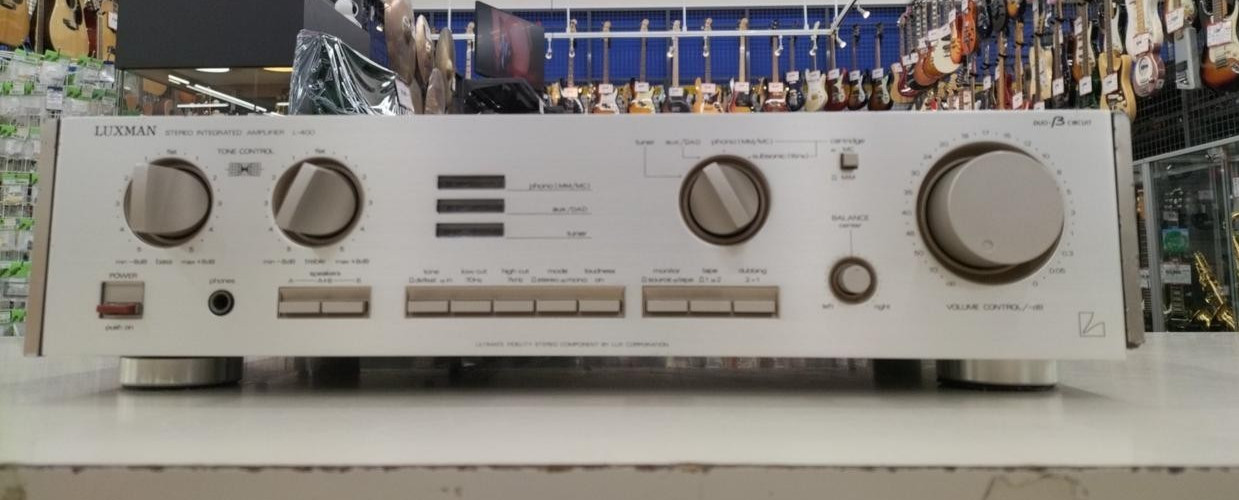
Unlike the minimalist preamps of the same era, the L-230 is a full-featured integrated amplifier, packing a phono stage (with both MM and MC inputs), tone controls, a switchable loudness contour, and a full tape loop with bi-directional monitoring. It even offers speaker A/B selection, a rare convenience in mid-tier gear of the time. But what truly sets it apart is Luxman’s proprietary Duo-Beta circuit—a feedback topology designed to reduce distortion while preserving dynamic punch. In practice, it gives the L-230 a rare combination: the clarity of solid-state design with a touch of tube-like ease in the upper mids. It’s not warm in the romantic sense, but it never feels clinical. This is an amplifier that disappears into the music, letting the recording—not the hardware—take center stage.
For all its capabilities, the L-230 flies under the radar compared to more famous contemporaries like the Marantz 2270 or the Sansui AU-99000. But those in the know recognize it as one of the quiet triumphs of early '80s Japanese engineering—a component that delivers flagship-level musicality with midrange pricing and solid long-term reliability.
Specifications
| Manufacturer | Luxman Corporation, Japan |
| Production Years | 1982–1985 |
| Original Price | Not available |
| Power Output | 63 watts per channel into 8Ω (stereo) |
| THD | 0.02% (1kHz, rated output) |
| IM Distortion | Not available |
| Frequency Response | 10Hz – 100kHz (±1dB) |
| S/N Ratio | 80dB (MM), 90dB (MC), 100dB (line) |
| Input Sensitivity | 0.3mV (MC), 1.8mV (MM), 160mV (line) |
| Load Impedance | 4–16Ω |
| Damping Factor | Not available |
| Inputs | Phono (MM/MC), CD, Tuner, Tape 1, Line 1–3 |
| Outputs | Main, Tape 1, Tape 2 |
| Weight | 7.6 kg |
| Dimensions | 453 × 111 × 317 mm |
| Power Consumption | 125 W |
| Color Options | Champagne, matt brushed finish |
| Remote Control | No |
Key Features
Duo-Beta Circuit: The Secret Sauce
Luxman’s Duo-Beta circuit wasn’t just marketing fluff—it was a genuine engineering innovation aimed at minimizing distortion without sacrificing speed or dynamics. Unlike conventional negative feedback systems that can dull transients, the Duo-Beta design applies feedback in a complementary, symmetrical way across the signal path. The result? Lower distortion (0.02% is exceptionally low for a mid-tier integrated of the era) and a more stable output stage. What you hear is a cleaner, more precise presentation, especially in complex passages. Strings don’t blur, kick drums don’t smear, and vocal sibilance stays controlled. It’s one of the reasons the L-230 can drive difficult speaker loads with confidence, even if it’s not the most powerful amp on the block.
Phono Stage That Punches Above Its Weight
For an integrated amplifier in its class, the inclusion of a dedicated MC (moving coil) input is a standout feature. Most competitors at this price point offered MM-only phono stages, forcing vinyl lovers to add an external step-up transformer or preamp. The L-230’s phono stage uses a common IC-based design, but Luxman tuned it carefully—documentation shows it performs exceptionally well with low-output cartridges, delivering a quiet, detailed signal with solid channel separation. Owners report that it extracts fine detail from records without sounding etched or aggressive. That said, the MC gain is fixed, so users with ultra-low-output cartridges (below 0.2mV) may still need external assistance. But for the vast majority of MC and MM setups, it’s more than sufficient—and a major value add.
Thoughtful, No-Nonsense Layout
The front panel is a masterclass in usability. Large, tactile knobs for volume and input selection are flanked by clearly labeled buttons for tone control, loudness, tape monitoring, and speaker selection. The layout avoids clutter while keeping essential functions within easy reach. The tape loop is fully bi-directional, allowing for easy dubbing between sources. The back panel is equally well-organized, with gold-plated RCA jinks and robust speaker terminals that accept bare wire, spades, or pins. The chassis, finished in champagne or brushed gray, feels substantial without being overly heavy—7.6 kg is light for its era, but the internal bracing and component layout suggest no corners were cut in rigidity or grounding.
Historical Context
The early 1980s were a golden period for Japanese high-fidelity audio. Companies like Sansui, Yamaha, Technics, and Luxman were locked in a quiet arms race, each pushing the boundaries of what solid-state amplification could achieve. The L-230 arrived at a time when integrated amplifiers were the heart of most home systems—receivers were gaining popularity, but purists still favored separates or high-end integrals like this one. Luxman, while never as mass-market as Sony or Pioneer, had earned a reputation among connoisseurs for meticulous build quality and musicality. The L-230 wasn’t a showpiece; it was a workhorse, designed for listeners who valued performance over flash.
Its main competitors included the Marantz 2270 (a tone-curved classic), the Sansui AU-D1000 (known for its “air” and openness), and the Yamaha B-7 (a clean, modern-sounding alternative). What set the L-230 apart was its balance: it didn’t lean into warmth like the Marantz, nor did it chase neutrality at the expense of engagement like some Yamahas. Instead, it offered a cohesive, natural presentation that worked across genres. It was also one of the few mid-tier amps to include both MC phono and switchable tone controls—features typically reserved for more expensive models.
Luxman’s parent company, Alpine, manufactured the L-230, which explains its solid construction and cost-effective design. While some collectors dismiss Alpine-era Luxmans as “budget” models, the reality is more nuanced. The L-230 shares design philosophies, circuit topologies, and even service manuals with higher-end Luxman gear. It’s not a diluted product—it’s a focused one.
Collectibility & Value
The Luxman L-230 doesn’t command the same prices as the brand’s Laboratory or Limited Edition models, but it’s steadily gaining recognition among vintage audio enthusiasts. A fully functional unit in good cosmetic condition typically sells for $400–$650 on the secondary market, with champagne finishes sometimes fetching a slight premium. Fully restored examples—with recapped power supplies, cleaned pots, and replaced output transistors—can reach $750, especially if paired with original packaging or documentation.
Common failure points are predictable for a 40-year-old amplifier. Electrolytic capacitors, particularly in the power supply and signal path, are the first to go. If neglected, they can cause hum, channel imbalance, or complete failure. The original power transistors (2SA1263/2SC3181) are also known to fail, especially if the amp has been driven hard or into low-impedance loads. Many service technicians recommend replacing them with modern equivalents like the Sanken 2SA1694/2SC4467, which offer better thermal stability and current handling.
The front-panel indicator lamps are another weak point. These incandescent bulbs can burn out or, worse, overheat and damage the PCB traces. A popular mod is to replace them with LEDs—a simple upgrade that reduces heat and power draw. However, doing so requires adjusting the current-limiting resistor (R153) to prevent damage to the driver circuit. Some owners report that the original zener diode (D112) fails after such a mod if not properly addressed.
When buying an L-230, check for consistent channel output, absence of hum or crackling, and smooth operation of all switches and pots. Verify that the tape loop functions correctly and that the speaker relays click cleanly when A/B is selected. A unit that powers on and plays without issues is likely in decent shape—but a full recap and transistor check are wise investments for long-term ownership.
Despite its relative obscurity, the L-230 is repairable and well-supported. Service manuals are available, and the circuit design is straightforward enough that most experienced techs can work on it without specialized tools. Spare parts, while not always in stock, are generally obtainable through Japanese audio suppliers or surplus dealers.
eBay Listings


As an eBay Partner, we earn from qualifying purchases. This helps support our independent vintage technology research.
Related Models
- Luxman L-530 (1975)
- Luxman R-404 (1975)
- Luxman RV-371 (1975)
- Luxman SQ-38U (1975)
- Luxman T-14 (1972)
- Luxman T-530 (1975)
- Luxman TX-101 (1975)
- Denon DRA-800 (1985)
- Denon PMA-350Z (1980)
- Denon POA-1500 (1979)