Luxman L-225 (1985–1988)
That rare vintage amp that doesn’t just play music—it invites you into it, with a midrange so smooth it feels like silk on skin.
Overview
The Luxman L-225 isn’t the loudest, flashiest, or most feature-packed integrated amplifier from the 1980s. But if you value musicality over specs, craftsmanship over gimmicks, this one slips under the radar and then refuses to leave your mind. Introduced in 1985 and built through 1988, the L-225 stands as a refined statement of Japanese high-end audio engineering at a time when the market was splitting between raw power and sonic finesse. Priced at approximately 700 Deutsche Mark at launch, it wasn’t cheap—but it wasn’t trying to be. It was built to last, to perform, and to disappear into the music.
Positioned as the bigger brother to the L-205, the L-225 shares its footprint but packs more authority: 60 watts per channel into 8 ohms, a full MM/MC phono stage, and a thoughtful array of inputs that include an AV option—unusual for a hi-fi-focused amp of its era. It’s a stereo integrated amplifier through and through, made in Japan with a champagne, matt-brushed finish that ages gracefully, avoiding the chrome-and-gloss trap that now screams “1980s” in all the wrong ways.
What sets the L-225 apart isn’t just its spec sheet—it’s the way it delivers sound. Owners consistently describe it as refined, natural, and highly musical, with a smooth midrange, well-controlled bass, clear highs, and a subtle, inviting warmth that never veers into coloration. It doesn’t shout; it speaks clearly, with poise. This is an amplifier that rewards careful listening, revealing texture and timbre in a way that feels less reproduced and more lived-in.
Specifications
| Manufacturer | Luxman |
| Model | L-225 |
| Product type | Stereo Integrated Amplifier |
| Production years | 1985 to 1988 |
| Power output | 60 W per channel into 8 Ω |
| Frequency response | 10 Hz to 100 kHz |
| Total harmonic distortion | 0.02% at 1 kHz |
| Input sensitivity | 1.8 mV (phono MM), 160 mV (line) |
| Signal-to-noise ratio | >90 dB (phono), 107 dB (line) |
| Dimensions | 453 x 111 x 317 mm |
| Weight | 7.4 kg |
| Inputs/Controls | MM phono, tuner, AUX, tape loop, tone controls, subsonic/high filters, loudness, mono/stereo switching |
| Remote control | no |
| Made in | Japan |
| Color | Champagne, matt brushed |
Key Features
Duo-Beta Circuitry: The Heart of the Matter
The Luxman L-225 runs on what the company called its “Duo-Beta Circuitry”—a design philosophy aimed at maximizing linearity and minimizing distortion. While the exact technical implementation isn’t detailed in available sources, the listening results are clear: coherence, detail, and a lively yet accurate sound. This isn’t a circuit that smooths over flaws or adds romantic warmth. Instead, it delivers a balanced, articulate presentation that feels both dynamic and natural. The 0.02% THD at 1 kHz backs that up, but the real proof is in how instruments occupy space—solid, focused, and free from grain.
Phono Stage with MM and MC Support
For vinyl lovers, the L-225 is a gift. It includes a built-in phono preamplifier that handles both MM (moving magnet) and MC (moving coil) cartridges—an uncommon inclusion in integrated amps, even today. With an input sensitivity of just 1.8 mV for MM, it’s clearly tuned for real-world cartridges, not just high-output ones. This flexibility means you can pair it with a wide range of turntables without needing an external phono stage, simplifying your setup without sacrificing quality.
Front Panel Input Display
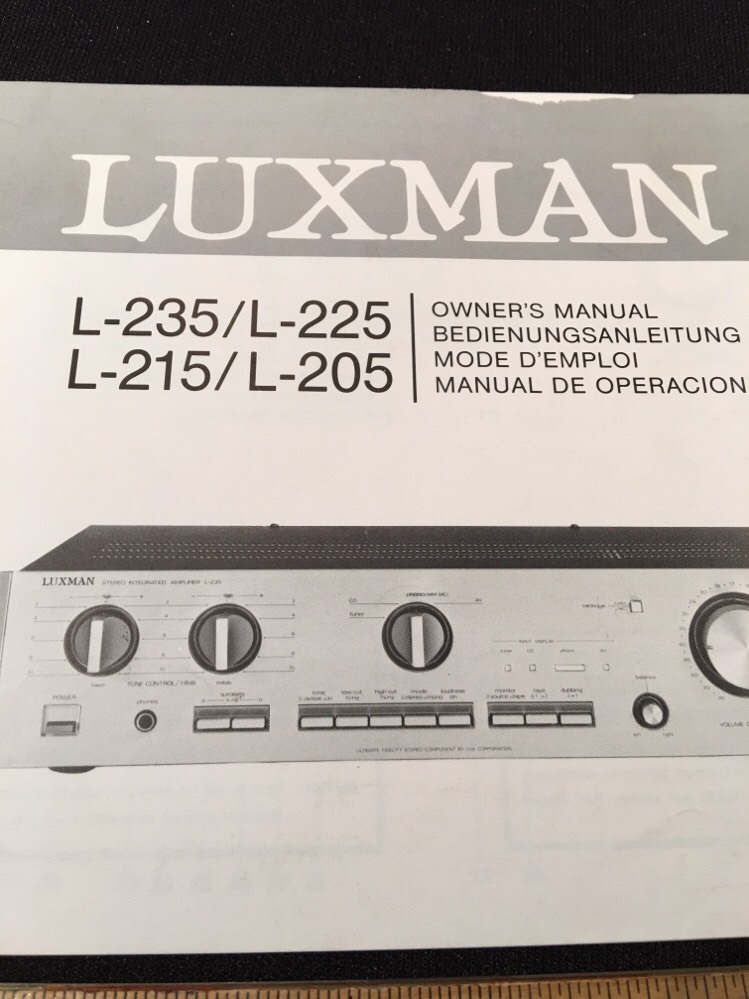
One of the L-225’s charming quirks is its front-mounted “input display” compartment—a small, recessed window that shows which source is active. It’s a simple mechanical touch, but it adds a tactile, almost analog elegance to source switching. No blinking LEDs, no digital readouts—just a clean, physical indicator that feels deliberate and well-considered.
AV Input: Ahead of Its Time
While marketed as a hi-fi component, the L-225 includes an AV input, acknowledging the growing role of audiovisual devices in home entertainment. This wasn’t common in dedicated stereo amps of the mid-80s, where AV was often relegated to receivers. Luxman’s inclusion of this input shows a practical awareness of how people actually used their systems—blending music with TV and early home theater—without compromising the amp’s core fidelity.
Full Complement of Analog Controls
The back panel and front layout are packed with thoughtful options: tone controls for those who like to tweak, a loudness switch for low-volume listening, subsonic and high filters to clean up problem frequencies, and a mono/stereo switch for vintage broadcasts. There’s even a full tape loop for recording. None of this feels like clutter—it’s all laid out logically, with solid, tactile knobs that inspire confidence. It’s an amplifier designed for engagement, not set-and-forget.
Collectibility & Value
The Luxman L-225 has grown in stature among vintage audio enthusiasts, not because it’s rare in the extreme, but because it’s good—consistently, dependably good. Units in well-kept condition offer exceptional performance and reliability, often admired for their enduring quality. It’s not a flashy showpiece, but a serious listening tool that ages well.
Current listings reflect steady demand: one unit was listed at Dhs. 2,599.00 AED in excellent condition, while recent used sales in Europe have ranged from €150 to €230 (as of 2025). An auction bid reached €101 in April 2025, suggesting that prices can vary widely based on condition and location. There’s no evidence of widespread failures or design flaws—owners report that, when properly maintained, these amps just keep working.
Its position as a “Classic Model” in the Luxman lineup adds to its appeal, especially for collectors tracing the brand’s evolution. While it lacks the cult status of tube gear or ultra-rare limited editions, the L-225 is the kind of amplifier you buy not to flip, but to use—daily, for years.
eBay Listings


As an eBay Partner, we earn from qualifying purchases. This helps support our independent vintage technology research.
Related Models
- Luxman L-530 (1975)
- Luxman R-404 (1975)
- Luxman RV-371 (1975)
- Luxman SQ-38U (1975)
- Luxman T-14 (1972)
- Luxman T-530 (1975)
- Luxman TX-101 (1975)
- Denon DRA-800 (1985)
- Denon PMA-350Z (1980)
- Denon POA-1500 (1979)