Luxman L-190A (1984)
That warm, golden glow isn’t just from the front panel—it’s the sound of Class A purity in a box.
Overview
The Luxman L-190A isn’t the kind of amplifier that shouts for attention. It doesn’t come wrapped in chrome or stacked with features. But plug it in, fire it up, and within seconds you’ll understand why this little integrated from 1984 still shows up on the shelves of discerning collectors. Built as a small, entry-level unit in Luxman’s DUO BETA series, the L-190A delivers a surprisingly rich and refined listening experience—proof that even at the lower end of the lineup, Luxman refused to compromise on core sonic values. This is an integrated amplifier designed for those who care more about musical flow than flashy specs, a component that slips into a system and simply makes everything sound more alive.
It’s easy to overlook the L-190A in favor of its more famous siblings, like the legendary L-550 series—the world’s first pure Class A integrated amplifiers. But the L-190A shares that same DNA, just distilled into a more compact, budget-friendly package. It was built for listeners who wanted a taste of Luxman’s magic without the premium price tag, and by all accounts, it delivers. Owners report good sound quality, a clean signal path, and that signature Luxman warmth—all wrapped in a sleek, understated chassis that ages beautifully.
Specifications
| Manufacturer | Luxman |
| Model | L-190A |
| Year of Release | 1984 |
| Type | Integrated amplifier |
| Power Output | 30 watts per channel into 8 Ω (stereo) |
| Frequency Response | 10 Hz to 100 kHz |
| Total Harmonic Distortion | 0.02% |
| Input Sensitivity | 1.8 mV (MM), 160 mV (line) |
| Signal-to-Noise Ratio | 90 dB (MM), 107 dB (line) |
| Inputs | 4 high-level inputs |
| Outputs | 1 tape output |
| Dimensions (W×H×D) | 453 × 317 × 111 mm |
| Weight | 6.7 kg |
Key Features
Duo Beta Circuit in Pure Class A
At the heart of the L-190A is Luxman’s Duo Beta Circuit topology, operating in pure Class A. This means the output devices are always conducting, eliminating crossover distortion and delivering a smooth, natural sound even at low volumes. It’s a design philosophy that prioritizes listening pleasure over efficiency—yes, the amp runs warm, and yes, it draws more power than a typical Class AB design, but the payoff is a liquidity and harmonic richness that solid-state gear often struggles to match. The frequency response stretches from 10 Hz to 100 kHz, well beyond the audible range, which owners say contributes to a sense of ease and openness in the sound.
Thoughtful Front Panel Layout
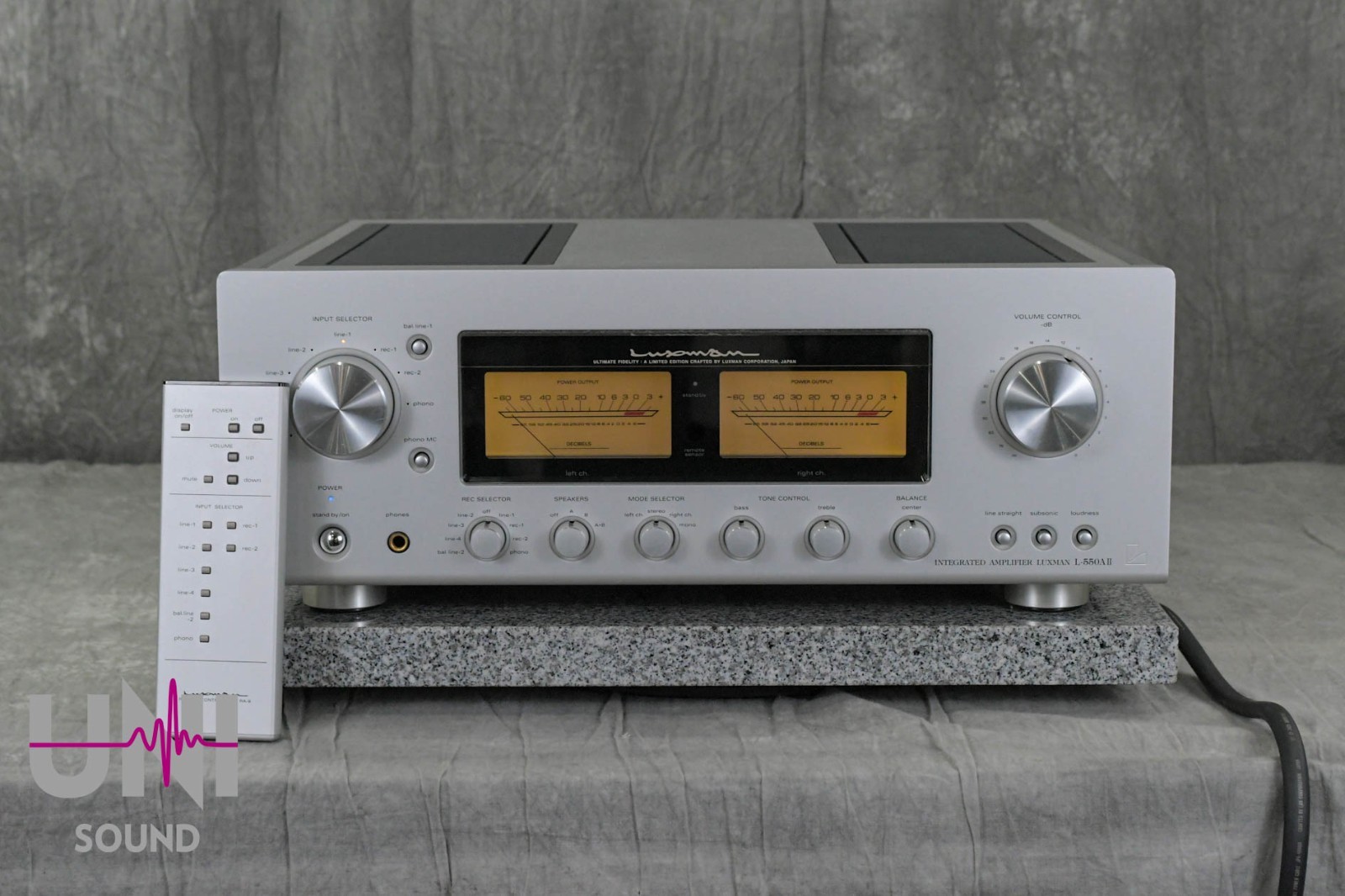
The L-190A wears its 1980s heritage with quiet confidence. Its brushed aluminum front panel has a slightly golden tint, giving it a warm, inviting presence on the rack. The aluminum selection buttons click with satisfying precision, and the elegant lighting—likely from small incandescent or early LED indicators—adds a touch of class without being flashy. A beautifully designed heat dissipation grille spans the top of the case, not just for looks but as a functional necessity for the Class A operation below.
Input Flexibility for Its Class
Despite being an entry-level model, the L-190A doesn’t skimp on connectivity. It includes two phono inputs—one with a Subsonic filter to tame rumble from vinyl—plus dedicated AUX and TUNER inputs, all part of its four high-level inputs. This makes it a practical hub for a full analog setup: turntable, tape deck, tuner, and maybe a CD player if you’re bridging eras. The single tape output allows for basic recording loops, a standard feature of the time but still appreciated by those who like to archive or mix.
Collectibility & Value
The Luxman L-190A is often described as a “good entry-level model with a moderate budget and good audio performance,” and that reputation holds up today. It’s not a rare unicorn, but original units in working condition are increasingly hard to find, especially in Europe where they were well distributed. Current listings show prices ranging from €110 to €200, with one unit noted at PLN 200 (roughly $50 USD), suggesting condition and location play a big role in valuation. Units advertised as serviced—“reviewed and maintained by technicians”—tend to sit at the higher end, and for good reason.
One known issue collectors and technicians have flagged is “la maladie d’alZener”—a playful but telling reference to failing Zener diodes, a common ailment in this and other Luxman models of the era. These components help regulate voltage and can degrade over time, leading to instability or noise. There’s also an open question in repair circles about the buffer capacitor: a 35V 4700 µF unit installed in a circuit measuring +/-40V, with a schematic calling for +/-45V. Whether that’s a safe margin or a ticking time bomb depends on component quality and operating conditions, but it’s something to check if you’re buying untested. Otherwise, the L-190A is considered reliable, especially given its straightforward design and solid build.
eBay Listings



As an eBay Partner, we earn from qualifying purchases. This helps support our independent vintage technology research.
Related Models
- Luxman L-530 (1975)
- Luxman R-404 (1975)
- Luxman RV-371 (1975)
- Luxman SQ-38U (1975)
- Luxman T-14 (1972)
- Luxman T-530 (1975)
- Luxman TX-101 (1975)
- Denon DRA-800 (1985)
- Denon PMA-350Z (1980)
- Denon POA-1500 (1979)