Luxman L-116 (1980–1983)
A no-nonsense integrated amplifier from Japan’s golden era of solid-state design, built to disappear into the music—once you wait those 15 seconds for the relay to kick in.
Overview
The Luxman L-116 isn’t flashy, but it doesn’t need to be. Released between 1980 and 1983, this solid-state integrated amplifier sits squarely in the middle of Luxman’s early ’80s lineup—a time when Japanese engineering was hitting its stride with precision, reliability, and sonic refinement. It’s not the biggest or the flashiest in the family, but it carries the same DNA: clean signal paths, high-quality components, and a sound that owners still describe as “sweet” and “greatish,” even decades later. For a certain kind of listener—one who values coherence over hype—this thing remains competitive with modern gear, which says more than any spec sheet ever could.
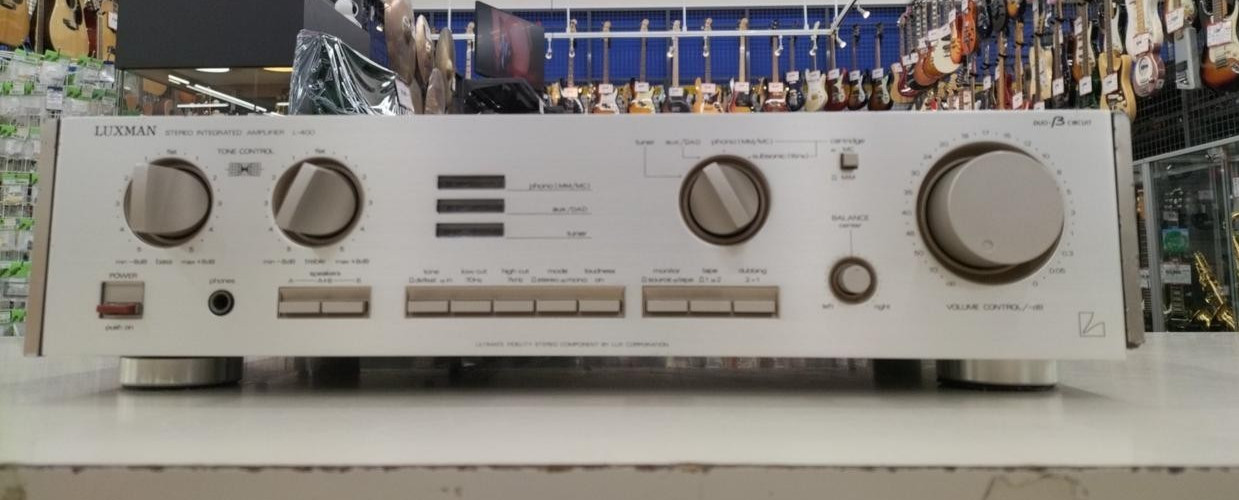
Marketed as part of Luxman’s Duo-Beta Standard Series, the L-116 was built in Japan with a focus on circuit stability and low distortion. It’s an integrated design, meaning it combines preamplifier and power amplifier stages in one chassis, and it’s fully solid-state—no tubes, no gimmicks. The front panel is functional but elegant: silver face, black cabinet, minimal labeling. Drop it into a wood enclosure like the one used on the C-120A, and suddenly you’ve got a component that looks as classy as it sounds. It’s discreetly dazzling, to borrow a phrase from those who’ve lived with it.
This isn’t a high-powered beast like the beefier L-120A, but it’s no slouch, either. With 70 watts per channel into 8 ohms, it’s built for real speakers and real rooms. And while it doesn’t shout, it doesn’t flinch—delivering a balanced, composed performance that’s earned it a quiet but loyal following among vintage Luxman fans.
Specifications
| Manufacturer | Luxman |
| Model | L-116 |
| Type | Integrated amplifier |
| Production years | 1980–1983 |
| Power output | 2x 70W (8 Ohm, 20Hz–20kHz) |
| THD | 0.02% (rated power, 8 Ohm) |
| Frequency response | 20 Hz – 20 kHz ±0.3 dB (phono); 10 Hz – 150 kHz -1.5 dB (line) |
| Inputs | 250µV / 200 Ohm (phono MC); 1.5 mV / 50 kOhm (phono MM); 150 mV / 40 kOhm (tuner, tape 1/2, aux.) |
| S/N ratio | >80 dB (MM); >100 dB (line) |
| Crosstalk | >80 dB (aux, tape) |
| Bass control | +8 / -10 dB at 80 Hz |
| Treble control | +8 / -10 dB at 14 kHz |
| Subsonic filter | 6dB/octave below 30 Hz |
| High cut filter | 6dB/octave above 7 kHz |
| Loudness switch | +10 dB at 100 Hz (volume at -30 dB) |
| Dimensions | 438 x 335 x 111 mm |
| Weight | 10.5 kg |
| Color | Front Silver, Cabinet Black |
| Phono input types | MM and MC |
| Phono overload | 150 mV (MM) |
| Power transistors | 2x2 Sanken A1106 C2581 |
| Filter capacitors | 2x10000µF Rubycon |
| Other capacitors | Rubycon, Nippon Chemicon SM components; CE1744 220 uF 35 WV |
| Made in | Japan |
Key Features
The Duo-Beta Circuit: Stability First
At the heart of the L-116 is Luxman’s Duo-Beta circuitry—a design approach that uses high fT (transition frequency) and low Cob (collector output capacitance) power transistors to improve linearity and reduce distortion. The idea isn’t to wow you with raw specs, but to ensure the amplifier behaves predictably across the entire frequency range. It’s engineering for the long haul: stable, reliable, and sonically neutral. Paired with four Sanken A1106 and C2581 output transistors (two per channel), the amp delivers its 70 watts with composure, even under load.
Tone Controls That Don’t Ruin Everything
One of the L-116’s quirks is that its tone controls—bass, treble, loudness, even the high-cut and subsonic filters—are incorporated directly into the power amplifier stage. That’s unusual. Most designs keep tone circuitry in the preamp section to avoid affecting the final output stage. But Luxman pulled it off without obvious sonic penalties. The result? You get full tonal flexibility without the usual muddiness or phase shifts that plague lesser amps. The bass control gives you ±10 dB at 80 Hz, treble ±8 dB at 14 kHz, and the loudness switch kicks in +10 dB at 100 Hz when volume drops below -30 dB—handy for late-night listening.
Phono Stage for Real Collectors
The L-116 doesn’t just accept a phono input—it handles both MM and MC cartridges natively. The MM input expects 1.5 mV at 50 kOhm, while the MC side is sensitive to 250µV at 200 Ohm, making it compatible with a wide range of cartridges without needing an external step-up transformer. The phono stage’s overload point is a healthy 150 mV, so even hot records won’t clip it. And with a signal-to-noise ratio topping 80 dB on MM, it’s quiet enough for most analog setups. For an integrated amp of this era, that’s thoughtful engineering.
Build Quality You Can Trust
Inside, the L-116 is a showcase of 1980s Japanese component discipline. Two massive 10,000µF Rubycon filter capacitors smooth the power supply, while additional Rubycon and Nippon Chemicon SM parts populate the signal path. There’s even a specific cap listed in the service manual—CE1744 220 uF 35 WV—hinting at a design where every part was chosen with care. The chassis is robust, the weight substantial (10.5 kg), and the layout clean. This is not a budget build. It’s over-engineered in the best way.
Historical Context
The L-116 arrived in the early 1980s, just before Luxman underwent significant corporate changes. It wasn’t a flagship, but it wasn’t an entry-level model either. Positioned between the L-114 and the more powerful L-120A, it offered a balanced mix of performance and features for the serious listener. At its launch, it carried an original price of approximately 1,000 Deutsche Mark—solidly mid-tier for the time. Today, it’s listed in Luxman’s own “Classic Models Reference” table, confirming its status as a legitimate part of the brand’s heritage, even if it never reached the cult status of some of its siblings.
Collectibility & Value
The L-116 trades in a quiet corner of the vintage audio market. It’s not rare, but it’s not common either. Sample listings from HifiShark suggest current market prices range from approximately €129 to €380, depending on condition and location. Fully working units with clean internals and intact cosmetics sit at the higher end, while those needing service go for less—sometimes significantly less.
But “working” comes with caveats. Owners report a few recurring quirks: the relay can take 12 to 15 seconds to engage after power-on, which is normal but unnerving the first time you hear it. More concerning are reports of the “ON” and “winker” indicator bulbs failing to light, even when the relay clicks. The touch MUTE function sometimes doesn’t work, and sliding switches—especially around input selection—can get grubby over time, leading to crackles or dropouts. A good dose of contact cleaner often fixes this, but it’s a sign of age.
More serious issues include a low-frequency buzz in one channel, which forum users have traced to unstable coils in the output stage or failing power supply capacitors. Given that recapping is a common maintenance procedure for aging Luxman amplifiers, it’s wise to assume the caps are original unless proven otherwise. A service manual is available, which helps, but professional servicing is recommended—especially if you’re not comfortable probing live circuits.
One final note: original Luxman speaker terminals have a reputation for being prone to overtightening. Strip the threads, and you’re in for a repair headache. Use a light touch.
Despite these quirks, the L-116 holds up sonically. Owners consistently report that it sounds “sweet” and “greatish,” with a balance that feels modern. It’s not hyped or aggressive—it just gets on with the music. And for that, it’s earned a second life among those building vintage Japanese stacks or chasing that elusive “classic but not colored” sound.
eBay Listings



As an eBay Partner, we earn from qualifying purchases. This helps support our independent vintage technology research.
Related Models
- Luxman L-530 (1975)
- Luxman R-404 (1975)
- Luxman RV-371 (1975)
- Luxman SQ-38U (1975)
- Luxman T-14 (1972)
- Luxman T-530 (1975)
- Luxman TX-101 (1975)
- Denon DRA-800 (1985)
- Denon PMA-350Z (1980)
- Denon POA-1500 (1979)