Luxman L-114A (1981–1983)
It doesn’t shout, it sings—smooth, full, and effortlessly musical, like a perfectly tuned instrument that’s been hiding in plain sight.
Overview
The Luxman L-114A isn’t the loudest or flashiest integrated amplifier from the early '80s, but it might be one of the most satisfying. Built between 1981 and 1983, this solid-state workhorse sits in that sweet spot where Japanese engineering met serious audiophile intent. Luxman, already known as a perfectionist name in high-end audio, didn’t try to reinvent the wheel here—they just built it better. This is a mid-priced amplifier that, by owner accounts and listening impressions, delivers a sound often associated with much more expensive gear. It’s warm, detailed, and musically engaging, with a richness in the lower midrange and bass that some describe as “a little chubby,” but in the best possible way—like your favorite wool sweater for your ears.
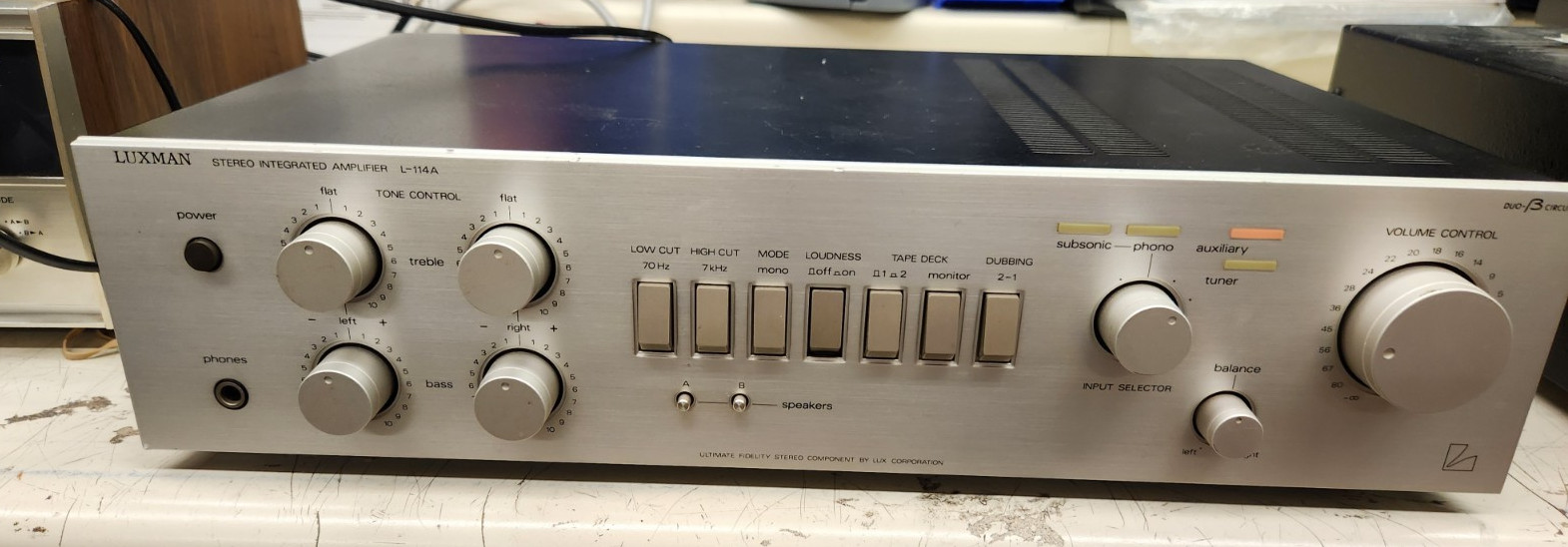
What stands out isn’t just the performance, but the thoughtful feature set packed into a no-nonsense chassis. It handles both MM and MC phono inputs right out of the box, a rarity even among higher-end integrated amps of the era. Add in separate bass and treble controls per channel, a dubbing selector, loudness compensation, and the ability to drive two pairs of speakers, and you’ve got a machine built for real-world use, not just lab specs. It’s the kind of amp that could anchor a serious system in 1982 and still hold its own today—owners consistently report it rivals the sound quality of modern mid-tier amplifiers.
Specifications
| Manufacturer | Luxman |
| Model | L-114A |
| Product type | Solid State Stereo Integrated Amplifier |
| Production years | 1981–1983 |
| Power output | 48 watts per channel into 8Ω (stereo) |
| Frequency response | 10Hz to 100kHz |
| Total harmonic distortion | 0.008% |
| Input sensitivity | 2.5mV (MM), 150mV (line), 0.15mV (MC) |
| Signal to noise ratio | 92dB (MM), 100dB (line) |
| Output | 150mV (line), 1V (Pre out) |
| Speaker load impedance | 4Ω to 16Ω |
| Semiconductors | 63 transistors, 34 diodes |
| Dimensions | 438 x 360 x 151mm |
| Weight | 13.5kg |
Key Features
Pure Complementary OCL Circuitry
At its core, the L-114A uses a pure complementary OCL (Output Capacitor-Less) circuit in the power amplifier stage—a design choice that eliminates coupling capacitors from the signal path, reducing phase shift and improving transient response. This contributes to its clean, dynamic delivery and tight bass control. Paired with a large EI transformer power supply, it delivers stable, robust power even under demanding loads.
Duo Beta Circuit Technology
Luxman implemented its proprietary Duo Beta circuit technology, aimed at improving linearity and reducing distortion across the frequency range. Combined with a newly developed high slew rate amplifier stage, this helps the L-114A track fast transients with clarity and composure, giving it a sense of pace and rhythm that many contemporaries lack.
High-Speed Phono Equalizer
One of the standout features is its high-speed capacitor-coupled phono equalizer, designed for both MM and MC cartridges. With an input sensitivity of just 0.15mV for MC, it can handle low-output moving coils without needing a separate pre-preamp—a rare and practical inclusion for an integrated amplifier of this class.
Flexible Connectivity and Controls
Beyond its core amplification duties, the L-114A is packed with user-friendly features: separate tone controls per channel, a 70Hz low cut and 7kHz high cut filter, loudness compensation for low-volume listening, and a dubbing selector for tape looping. It also provides a preamp output, allowing future expansion with a separate power amp, and can drive two sets of speakers independently—ideal for multi-room setups or A/B testing.
Historical Context
In the early 1980s, Luxman had already cemented its reputation as a high-end, detail-obsessed brand—sometimes seen as elitist, always taken seriously by audiophiles. The L-114A emerged during this period as part of a broader family of integrated amplifiers that included the L-1, L-113A, L-116A, and L-120A. While the fact sheet doesn’t specify its exact hierarchy within the lineup, its feature set and performance suggest it occupied a mid-to-upper tier position—offering near-flagship functionality without the top-tier price.
Collectibility & Value
The L-114A trades in the $200–$400 USD/CAD range on the used market, with prices varying by condition and region—recent listings have shown units selling for $367.53 on Reverb (plus shipping) and RM950 (approximately $200 USD) in Penang. It’s not a blue-chip collector’s item yet, but it’s gaining recognition as a “sleeper” classic—praised for delivering a musical, non-fatiguing sound that remains compelling decades later.
Common maintenance issues include scratchy volume and selector controls, typically resolved with contact cleaner like DeoxIT. Over time, owners may need to replace capacitors and resistors in the power supply and power rail—routine aging for electronics of this era. Units described as “bench tested, works great” are not uncommon, and many remain fully functional with minimal servicing. Its durability, combined with its rich, detailed sound, makes it a smart buy for those who value musicality over brand hype.
eBay Listings


As an eBay Partner, we earn from qualifying purchases. This helps support our independent vintage technology research.
Related Models
- Luxman L-530 (1975)
- Luxman R-404 (1975)
- Luxman RV-371 (1975)
- Luxman SQ-38U (1975)
- Luxman T-14 (1972)
- Luxman T-530 (1975)
- Luxman TX-101 (1975)
- Denon DRA-800 (1985)
- Denon PMA-350Z (1980)
- Denon POA-1500 (1979)