Luxman L-114 (1981–1983)
A forgotten gem from Luxman’s high-end 1980s lineup — a transistor-powered integrated with serious circuitry and a cult-worthy sonic signature.
Overview
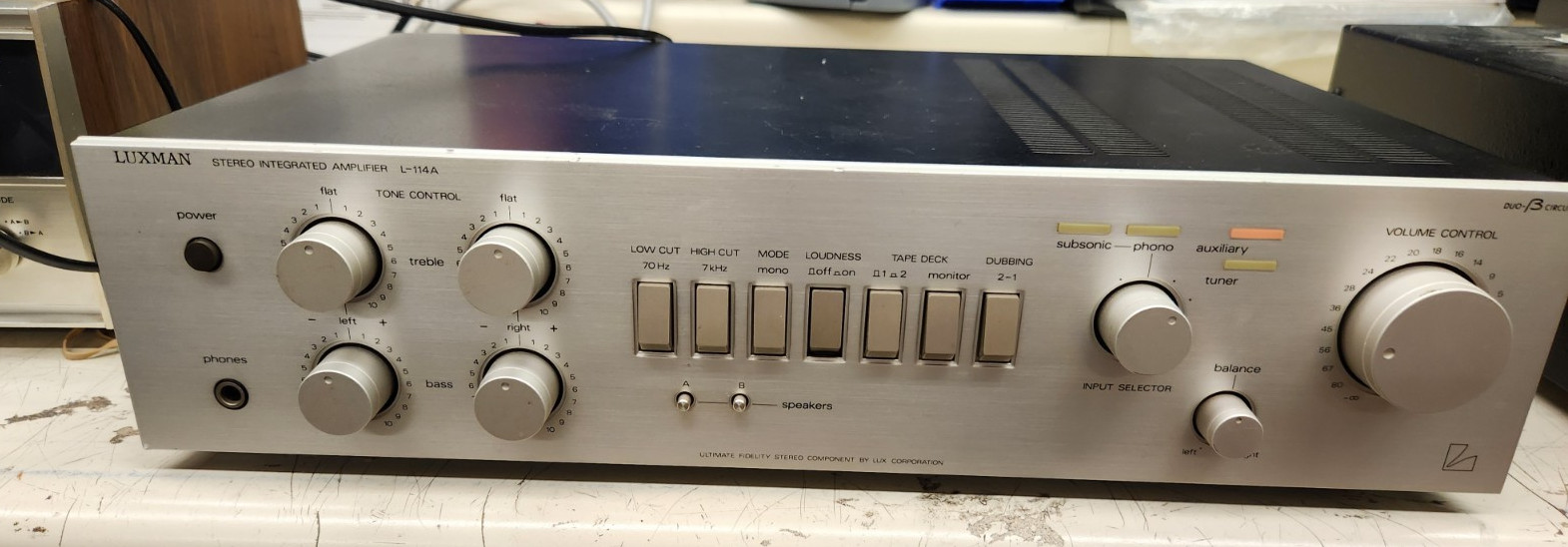
The Luxman L-114 isn’t the loudest, flashiest, or most famous integrated amplifier from Japan’s golden era of hi-fi — but for those who’ve heard it, it’s often unforgettable. Built between 1981 and 1983, this solid-state workhorse came from a time when Luxman was firmly planted in the high-end, perfectionist segment of the market, crafting gear for listeners who valued precision, musicality, and thoughtful engineering over mass appeal. The L-114 wasn’t a flagship, but it carried the DNA of Luxman’s best: a DC amplifier design with Duo-Beta (Duo-ß) circuits, a low-noise PNP phono stage, and a build philosophy that prioritized signal integrity and thermal stability. It’s the smaller sibling of the L-116A, sharing design cues and a visual kinship with the European matte-finish C-120A preamp era. While it may not have made waves in its day, today it’s gaining quiet recognition among vintage audio enthusiasts who appreciate its smooth, full-bodied sound and well-considered architecture.
Specifications
| Manufacturer | Luxman |
| Model | L-114 |
| Production years | 1981–1983 |
| Type | Integrated amplifier |
| Technology | Transistors |
| Power output | |
| Frequency response | 20 Hz to 20 kHz (MM, ±0.5 dB) |
| Total harmonic distortion | 0.02% |
| Input sensitivity | 2.5mV / 50 kΩ (MM); 150mV / 50 kΩ (aux, tuner, monitor) |
| Maximum phono input | 130 mV (0.05% THD) |
| Signal to noise ratio | 92dB (MM), 100dB (line) |
| Residual noise | < 0.5 mV |
| Bass control | +8 dB / -10 dB at 70 Hz |
| Treble control | +8 dB / -10 dB at 14 kHz |
| High cut filter | 6dB/octave above 7 kHz |
| Low cut filter | 6dB/octave below 70 Hz |
| Phono subsonic | 6dB/octave below 30 Hz |
| Headphones output | Stereo jack 6.35mm |
| Dimensions (W×D×H) | 438 × 306 × 111mm |
| Weight | 8.1 kg |
| Power supply | 220V (likely regional variant) |
Key Features
DC Amplifier with Duo-Beta Circuitry
At the heart of the L-114 is a DC-coupled amplifier design using Luxman’s proprietary Duo-Beta (Duo-ß) circuitry, applied to both the main amplifier and the low-noise PNP phono stage. This design aims to eliminate coupling capacitors in the signal path, reducing phase shift and preserving transient response. The use of high fT (transition frequency) and low COB (collector output capacitance) transistors further enhances speed and linearity, contributing to the amplifier’s clarity and dynamic control.
Dedicated Equalization Power Supply
One of the L-114’s more sophisticated touches is its dedicated ±42V equalization power supply for the phono stage. This isolated rail helps maintain a stable, low-noise environment for the delicate RIAA equalization process, improving signal-to-noise ratio and minimizing crosstalk — a feature typically found in higher-end separates, not mid-tier integrateds.
Tone Controls in the Final Stage
Unlike many designs that place tone controls early in the signal chain, the L-114 integrates them within the final amplification stage. This “no flat amp” approach means there’s no bypass mode — the signal always passes through the tone circuitry. While purists may frown, this design choice likely contributes to the amplifier’s cohesive, non-fatiguing sound, avoiding the slight tonal shifts that can occur when switching tone controls in and out.
Thermal and Mechanical Design
Thermal management is handled by dual-row “sharkfin” heatsinks, a signature Luxman feature of the era, providing ample surface area for heat dissipation in a compact footprint. The chassis emphasizes minimal internal wiring and houses a large, low-leakage transformer — a hallmark of Luxman’s attention to power supply quality. The entire schematic diagram is printed directly onto the single main circuit board, a boon for technicians and tinkerers trying to trace issues decades later.
eBay Listings


As an eBay Partner, we earn from qualifying purchases. This helps support our independent vintage technology research.
Related Models
- Luxman L-530 (1975)
- Luxman R-404 (1975)
- Luxman RV-371 (1975)
- Luxman SQ-38U (1975)
- Luxman T-14 (1972)
- Luxman T-530 (1975)
- Luxman TX-101 (1975)
- Denon DRA-800 (1985)
- Denon PMA-350Z (1980)
- Denon POA-1500 (1979)