Luxman L-100: The Pinnacle of Passive Preamplifier Design
In the early 1970s, Japanese high-fidelity audio engineering reached a golden age. Brands like Accuphase, Sansui, and Luxman were pushing the boundaries of analog refinement, crafting components that balanced technical precision with musical warmth. Among Luxman’s most revered offerings from this period is the L-100, a passive preamplifier that stands as a quiet masterpiece of minimalist audio design.
Released in 1972, the Luxman L-100 was not designed for power or flash. Instead, it embodied the philosophy that the best preamplifier is often the one you don’t hear—transparent, neutral, and utterly faithful to the source. As a passive preamp, the L-100 forgoes active gain stages, relying instead on precision attenuators and high-quality passive components to manage volume and source selection. This design approach eliminates the coloration and distortion introduced by active circuitry, making the L-100 a favorite among purists and audiophiles who prize sonic purity above all.
Technical Specifications
| Specification | Detail |
| Model | Luxman L-100 |
| Year of Release | 1972 |
| Type | Passive Preamplifier |
| Gain | 0 dB (no amplification) |
| Input Impedance | 100 kΩ |
| Output Impedance | 10 kΩ |
| Inputs | 4 line-level (RCA) |
| Outputs | 1 main output (RCA) |
| Volume Control | Precision stepped attenuator |
| Source Selection | Rotary switch |
| Power Requirements | None (passive design) |
| Dimensions (W×H×D) | 430 × 148 × 342 mm |
| Weight | 8.5 kg (approx.) |
| Finish | Silver or black chassis with wood end panels |
The L-100’s passive architecture means it requires no power supply, eliminating potential sources of noise and hum. Its volume control uses a precision stepped attenuator—a hallmark of high-end audio design—ensuring accurate, repeatable channel balance and minimal signal degradation. Each step is achieved through a network of high-tolerance resistors, offering superior linearity compared to potentiometer-based systems.
Sound Characteristics and Performance
The Luxman L-100 delivers a listening experience defined by clarity, neutrality, and spatial accuracy. Without active circuitry to color the sound, the L-100 acts as a near-invisible conduit between source and power amplifier. This transparency allows the true character of your components to shine through—whether you're using a warm tube DAC or a crisp solid-state CD player.
Listeners often describe the L-100’s sound as effortless and open, with a wide, three-dimensional soundstage and pinpoint imaging. Bass response remains tight and controlled, while the midrange is clean and uncolored—ideal for vocal and acoustic recordings. High frequencies are extended but never harsh, preserving detail without artificial brightness.
Because it lacks gain, the L-100 performs best when paired with high-output sources (such as modern DACs or phono preamps with strong line stages) and sensitive power amplifiers. It is not recommended for use with low-output sources or inefficient speaker systems that demand high drive levels. However, in the right system, the L-100 reveals microdynamic nuances and subtle textures that active preamps often obscure.
Notable Features and Innovations
While minimalist in function, the L-100 is rich in thoughtful engineering:
- Stepped Attenuator Volume Control: Offers precise, channel-matched attenuation with no wear-related channel imbalance over time.
- High-Quality Internal Wiring: Luxman used oxygen-free copper wiring even in this era, minimizing signal loss.
- Discrete Input Selection: Each input has a dedicated signal path, avoiding the crosstalk and degradation common in cheaper switch-based systems.
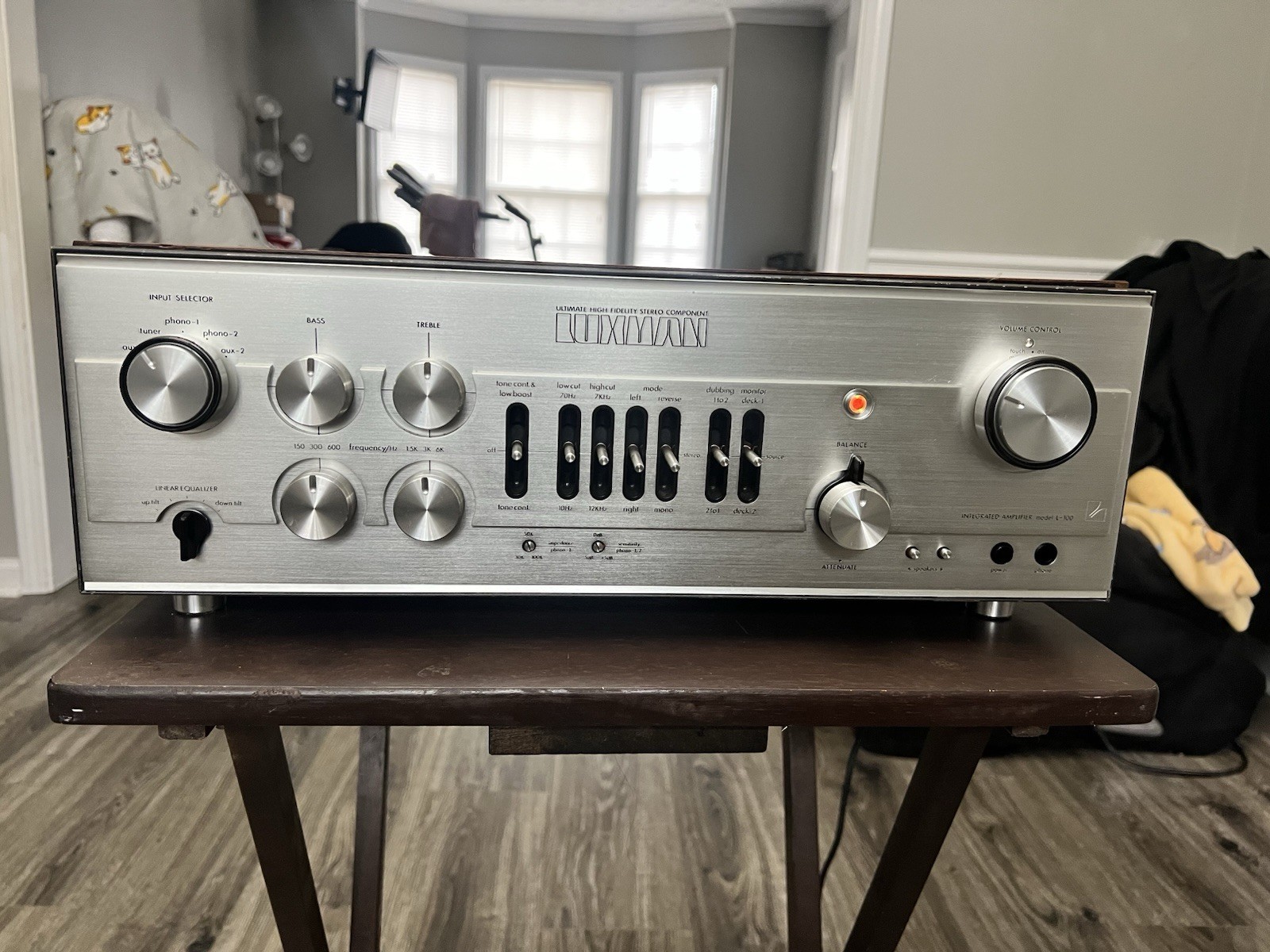
- Luxurious Build Quality: The chassis features a heavy-gauge steel frame, machined aluminum front panel, and optional walnut end caps—signs of Luxman’s commitment to both performance and aesthetics.
- No Power Supply Noise: As a passive unit, the L-100 introduces no hum, buzz, or RFI, making it ideal for low-noise systems.
The L-100 also reflects Luxman’s philosophy of "Less is More"—a belief that reducing circuit complexity enhances fidelity. This design ethos would influence later Luxman classics like the C-05 and C-9 preamplifiers.
Common Issues and Maintenance
Given its passive nature, the Luxman L-100 is remarkably reliable. With no tubes, transistors, or power supply to fail, the unit can last for decades with minimal maintenance. However, a few potential issues should be considered:
- Oxidation on Switches and Jacks: After 40+ years, RCA jacks and rotary switches may develop oxidation, leading to crackling or intermittent connections. Cleaning with contact cleaner (e.g., DeoxIT) usually resolves this.
- Wear on Stepped Attenuator: Though robust, the precision resistor ladder can degrade if the unit was frequently adjusted. A rebuild with modern metal-film resistors can restore performance.
- Cable Fatigue: Internal wiring may become brittle over time. Re-termination with modern OFC cable is recommended during servicing.
- Cosmetic Aging: The original finish may show wear, and wood end panels can fade or warp. Replacement or refinishing is possible but should preserve originality for collectors.
Because the L-100 contains no proprietary ICs or rare parts, restoration is generally straightforward for experienced technicians.
Current Market Value and Collectibility
The Luxman L-100 is a highly sought-after collector’s item, particularly among enthusiasts of vintage Japanese audio. While not as flashy as tube gear or large integrated amps, its reputation for transparency and build quality has only grown over time.
In recent years, working units in good condition typically sell for $800–$1,500 USD, depending on finish, provenance, and completeness. Fully restored models with upgraded internal wiring or modernized jacks may command higher prices, especially when paired with matching Luxman components like the M-100 amplifier or D-300 tuner.
Its collectibility is bolstered by low production numbers and Luxman’s reputation for understated excellence. Unlike mass-market receivers of the era, the L-100 was a premium product aimed at discerning audiophiles, making original, unmodified units increasingly rare.
Conclusion and Legacy
The Luxman L-100 is more than a preamplifier—it’s a statement about the pursuit of audio truth. In an era when many manufacturers were adding features, meters, and complex circuitry, Luxman chose restraint. The result is a component that doesn’t impress with specs, but with its ability to disappear from the signal chain, leaving only the music.
Today, the L-100 stands as a benchmark for passive preamp design. Modern equivalents from brands like Audient, Aikido, and even Luxman’s own C-02U pay homage to its minimalist philosophy. Yet few match the L-100’s combination of vintage craftsmanship, elegant simplicity, and sonic purity.
For the collector, restorer, or minimalist audiophile, the Luxman L-100 remains a timeless treasure—a quiet legend from the golden age of Japanese hi-fi.
eBay Listings


As an eBay Partner, we earn from qualifying purchases. This helps support our independent vintage technology research.
Related Models
- Luxman L-530 (1975)
- Luxman R-404 (1975)
- Luxman RV-371 (1975)
- Luxman SQ-38U (1975)
- Luxman T-14 (1972)
- Luxman T-530 (1975)
- Luxman TX-101 (1975)
- Denon DRA-800 (1985)
- Denon PMA-350Z (1980)
- Denon POA-1500 (1979)