Luxman K-100
Overview
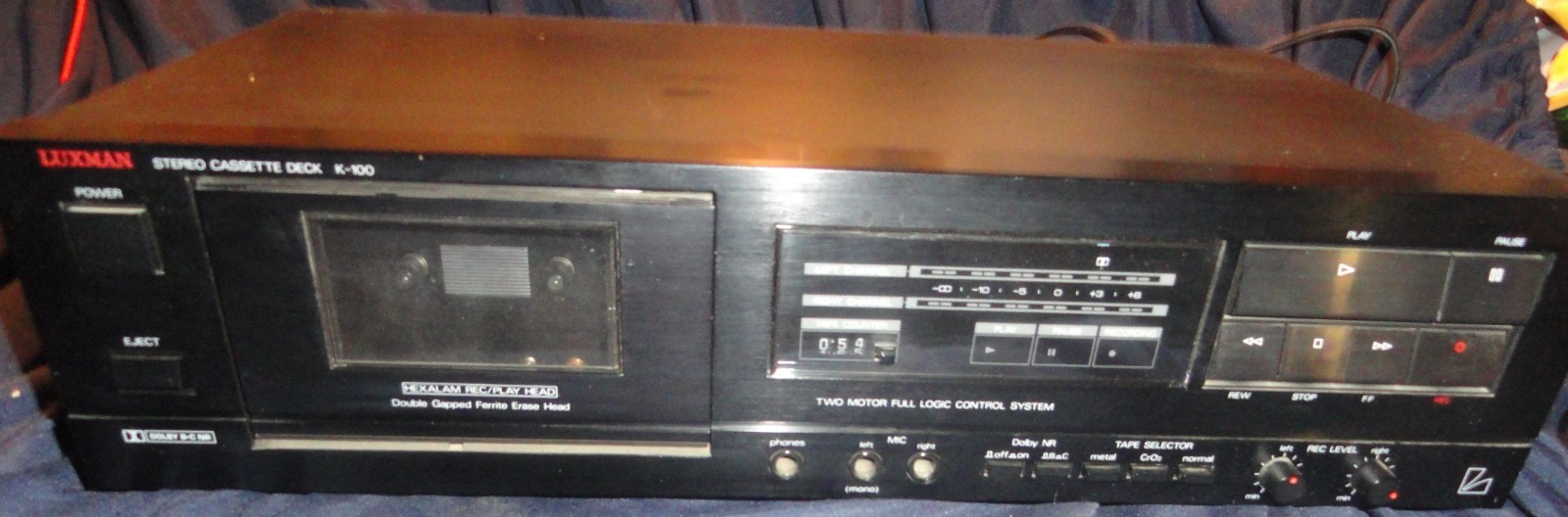
The K-100 is one of those Luxman decks that shows up at estate sales with a seized transport and a price tag that reflects nothing about what's inside. That footprint is the first clue that this isn't a throwaway BPC deck. The casework is metal, and the internals back it up.
The numbers tell a specific story. HiFI-Stereo (July 1987, p.74) listed the K-100 in its tape deck roundup. It noted the two-color fluorescent spectro-peak indicator alongside the logic-controlled transport and soft-touch operation.
The signal-to-noise figures are where the Dolby implementation earns its keep. That last figure is the reason to own one of these today. Dolby C was a genuinely effective noise reduction system, and a deck that hits 65 dB with metal tape can make hiss effectively disappear on a good recording.
Input and output levels are conventional. The distortion figures look high by modern digital standards, but they're typical for the format and the era. Cassette was never a low-distortion medium, and the K-100's numbers sit in the normal range for a two-head deck of its generation.
That semiconductor count reflects a design that leans on integrated circuits for the logic and Dolby processing rather than discrete parts. That's sensible for a deck at this price point, and it makes servicing more about swapping chips than chasing individual transistors.
The K-100 was sold in multiple voltage configurations. Buyers in Europe and Asia got the multi-voltage version. North American buyers got the fixed 120V version. For anyone importing a deck today, the AD model is the flexible one, and the UC/UQ units need a step-down transformer anywhere other than North America.
The service manual's adjustment procedures show the usual maintenance points. Record/playback frequency response is adjusted for 0 ±1 dB. These are the adjustments a technician makes when a K-100 comes in with dull highs or speed drift, and they're all documented, which is more than can be said for a lot of decks from smaller manufacturers.
The manual carries a standard product safety notice about special-characteristic components marked with a triangle in the schematic and parts list. That's boilerplate for the era, but cassette decks run line voltage into the chassis, and the power supply section is not a place for guesswork.
The K-100 sits in an interesting spot in Luxman's cassette lineup. It's not a reference deck, and it doesn't pretend to be. It offers Dolby C, metal-tape compatibility, a logic-controlled transport, and a useful fluorescent level display in a compact chassis. That combination made mid-range Luxman decks popular with people who wanted serious taping capability without paying for a three-head machine. Collectors today tend to overlook it in favor of the brand's bigger decks, which means prices stay reasonable.
The K-100 also benefits from the brand's generally good service documentation. The manual covers head azimuth, tape speed, playback sensitivity, bias oscillator, line input sensitivity, and record/playback frequency adjustment. That's a full alignment procedure rather than a token one, and technicians can actually bring the deck back to spec instead of guessing.
eBay Listings



As an eBay Partner, we earn from qualifying purchases. This helps support our independent vintage technology research.