LUXMAN K-05 (1983–1987)
At 11.5kg, it doesn’t just sit on the rack—it stakes a claim, promising something few cassette decks ever delivered: obsessive engineering without apology.
Overview
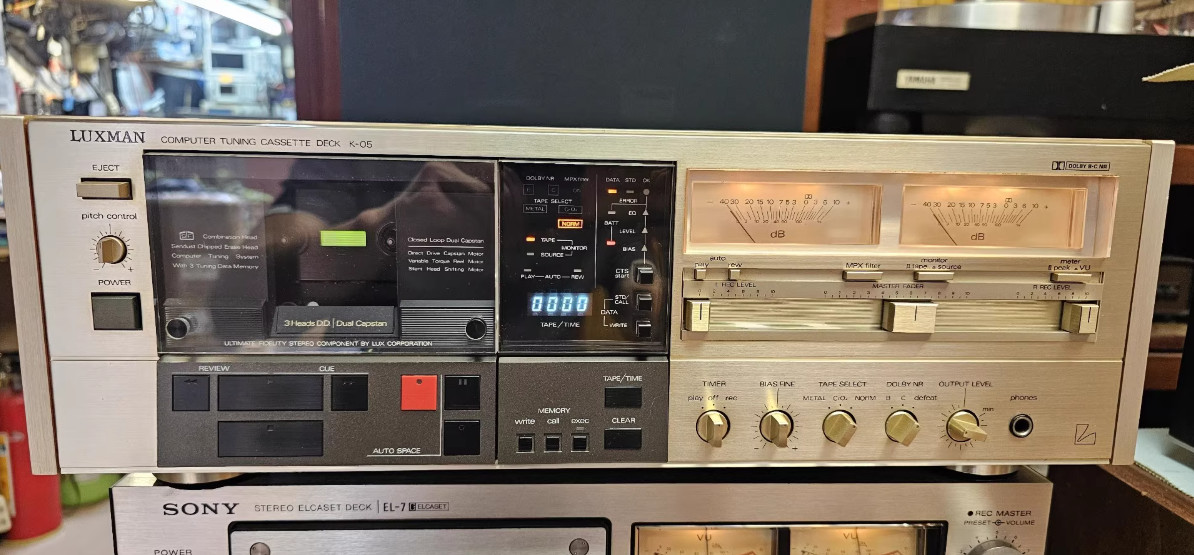
The LUXMAN K-05 isn’t merely a cassette deck; it’s a statement in brushed aluminum and precision die-cast alloy, released in September 1983 as a flagship stereo cassette deck during the analog tape’s technical peak. Weighing in at 11.5kg, its mass alone signals intent—this was built to resist vibration, resist compromise, resist time. Owners report it was positioned as the pinnacle of Luxman’s cassette offerings, with some going so far as calling it “the very best Luxman tape” deck ever made. Whether that’s hyperbole or hardware truth, the K-05 was engineered like a laboratory instrument, not a consumer appliance.
It arrived in an era when high-end audio manufacturers were pushing cassette technology to its absolute limits, and Luxman responded with the GT transport system—a dual capstan mechanism where capstan and pinch roller bearings are integrally molded under high temperature and pressure into a thick die-cast alloy chassis. This wasn’t just overkill; it was a direct assault on wow and flutter, which the K-05 suppresses to a reportedly 0.022% or less (W.R.M.S.). That figure, paired with a 4.75 cm/sec tape speed and a 2 + 1 direct drive motor configuration (dedicated motors for capstan, reels, and head lift), forms the backbone of its reputation for tape stability and speed accuracy.
But the real magic lies in the CTS—Computer Tuning System—an auto-calibration function that scans tape characteristics and selects the optimal bias and equalization from over a million possible combinations (1,048,576, to be exact) in about 20 seconds. It doesn’t just assume your metal tape is standard; it interrogates it, then tunes itself accordingly. The entire process plays out on the front panel like a diagnostic light show, a rare moment of theater in an otherwise stoic design.
Specifications
| Manufacturer | LUXMAN |
| Product type | Cassette deck |
| Production years | Released in September 1983 (reportedly produced until 1987) |
| Original price | ¥ 258,000 |
| Track format | 4-track, 2-channel stereo system |
| Type | 3-head, single compact cassette deck |
| Heads | Recording: Sendust / ferrite combination; Erasing: dual gap ferrite / sendust junction |
| Tape speed | 4.75cm/sec. |
| Motor configuration | For Capstan: Direct Drive FG Servo DCx1; For Reel: DCx1; For Head Housing Lift: DCx1 |
| Wow flutter | 0.022% or Less (W. R. M.S.) |
| Winding time | 80 seconds or less (both FF and REW at C60) |
| Frequency characteristic | 15 Hz ~ 27 kHz (20 Hz ~ 22 kHz ± 1.5 dB, metal) |
| Frequency Response | 20Hz ~ 20kHz (± 3dB, Type I) |
| Signal-to-noise ratio | 73 dB or More (Dolby C, CCIR Correction, metal) |
| S/N ratio | 60 dB (Dolby off) |
| Cancellation attenuation | > 69 dB (125 Hz, Type IV) |
| Power consumption | 40W |
| External dimensions | Width 460 x Height 158 x Depth 361 mm |
| Weight | 11.5kg |
| Inputs | Line In: 100 mV, 50 kOhm; DIN In |
Key Features
GT Transport with Dual Capstan System
The GT transport isn’t just a marketing term—it’s a mechanical fortress. By integrating two pairs of capstan and pinch roller bearings into a single die-cast alloy motor frame, Luxman eliminated flex and misalignment under stress. This isn’t a belt-driven afterthought; it’s a rigid, thermally stable platform that ensures consistent tape-to-head contact. The result is a transport system that resists resonance and maintains speed with near-laboratory precision, a necessity for a deck targeting the upper echelon of analog fidelity.
2 + 1 Direct Drive Motor Configuration
Three dedicated DC motors handle critical functions: one for the capstan (with FG servo control), one for the reel drives, and a third to assist in lifting and lowering the head assembly and driving the brake. This 2 + 1 configuration avoids the compromises of shared motors, ensuring that tape tension, speed, and head engagement are each managed independently. The capstan’s direct drive eliminates belts that degrade over time, a common failure point in lesser decks, though long-term reliability still hinges on lubrication and wear in the gear train.
Computer Tuning System (CTS) with 1 Million+ Calibration Combos
The CTS is where the K-05 transcends typical high-end cassette design. Instead of manual bias and EQ adjustments, it automatically analyzes the tape in real time, cycling through 1,048,576 possible combinations of bias level and equalization to find the optimal setting. The process takes about 20 seconds and is displayed dynamically on the front panel, giving users a rare glimpse into the calibration logic. While the exact algorithm remains proprietary, the system effectively tailors playback and recording to the specific magnetic characteristics of each tape, whether Type I, II, or IV.
3-Head Configuration with Sendust/Ferrite Combination
Equipped with separate record, playback, and erase heads, the K-05 allows true monitoring during recording—a hallmark of professional and high-end consumer decks. The record head uses a Sendust/ferrite combination, chosen for its balance of high-frequency response and durability, while the erase head employs a dual-gap ferrite/sendust junction for thorough signal cancellation. This head assembly, combined with the deck’s wide frequency response (up to 27 kHz with metal tapes), enables recordings that approach the clarity of open-reel formats.
Dolby Noise Reduction Support
The K-05 includes Dolby noise reduction, with specifications citing Dolby C for a signal-to-noise ratio of 73 dB or more (CCIR, metal tape). While the exact types supported aren’t fully detailed beyond Dolby C, the inclusion of noise reduction was essential for maximizing dynamic range on cassette—a critical feature at a time when metal tapes were pushing the format’s limits. The 60 dB S/N ratio without Dolby engaged still places it well above average for the era.
Collectibility & Value
Originally priced at ¥258,000, the K-05 was a premium product from launch, and today it commands attention in the vintage audio market. Collectors note its close relationship to the Alpine AL-90 and AL-80, with some referring to the K-05 as a “silver copy” of the AL-90, suggesting shared engineering or manufacturing. Service manuals and schematics are available online, which helps maintain functionality, though aging capacitors and dried grease remain common issues with long-term storage.
One frequently mentioned quirk is VU meter misalignment—owners report that the meters can drift and often require minor screw adjustment, a relatively simple fix. Despite its complexity, the K-05’s build quality and availability of repair documentation have helped preserve working units. Whether it surpasses a Nakamichi Dragon remains a debated question in enthusiast circles, but its reputation as one of Luxman’s finest tape machines is rarely contested.
Market Value
┌──────────────────────────────────────────────────────────────────────────┐
│ LUXMAN K-05                                                     Apr 2026 │
├──────────────────────────────────────────────────────────────────────────┤
│ High      $140                                    Latest             $80 │
│ Median    $80                                     Trend           ▼ Down │
│ Low       $37                                     Volume           ~2/mo │
├──────────────────────────────────────────────────────────────────────────┤
│   $200 ┤                                                                 │
│        │                                                                 │
│        │                                                                 │
│   $114 ┤    .                                                            │
│        │                                                                 │
│        │                                        .                       .│
│        │.                                                                │
│     $0 ┤                                                                 │
│        ├─────────────────────────────────────────────────────────────────│
│    vol │█   █                                   █                       █│
│        └─────────────────────────────────────────────────────────────────│
│         2026-02                      2026-03                      2026-04│
└──────────────────────────────────────────────────────────────────────────┘
eBay completed sales. Excludes accessories, parts, and non-working units. Hover points for details.
eBay Listings
As an eBay Partner, we earn from qualifying purchases. This helps support our independent vintage technology research.