Luxman CL-34: The Quiet Master of Analog Refinement
In the pantheon of vintage high-fidelity audio, few names command the respect and reverence of Japanese audiophiles quite like Luxman. Renowned for their meticulous engineering, understated elegance, and a deep commitment to analog purity, Luxman produced a lineage of components during the 1970s and 1980s that remain highly sought after today. Among these is the CL-34, a passive preamplifier released in 1975 that stands as a testament to minimalist design executed with exceptional craftsmanship.
While active preamplifiers of the era often relied on gain stages and complex circuitry, the CL-34 took a different path—embracing the philosophy that less can indeed be more. As a passive control unit, it forgoes amplification entirely, instead focusing on signal routing and volume attenuation using high-quality passive components. This approach, though less common, appeals to purists who value transparency, low noise, and the preservation of the original signal’s integrity.
Technical Specifications
The Luxman CL-34 was designed during a golden period for Japanese hi-fi, when brands like Accuphase, Sansui, and Yamaha were pushing the boundaries of performance. Luxman, with its heritage rooted in vacuum tube technology, brought a refined sensibility to solid-state design. The CL-34 reflects this balance—simple in function, but executed with precision.
| Specification | Detail |
| Model | CL-34 |
| Year of Release | 1975 |
| Type | Passive Preamplifier / Control Unit |
| Inputs | 4 (Tuner, Phono, Aux, Tape) |
| Output | 1 Main Output, 1 Tape Output |
| Volume Control | Dual-gang potentiometer, stepped attenuator style |
| Tone Control | None (pure passive signal path) |
| Impedance | Not applicable (passive design) |
| Power Requirement | None (no internal power supply) |
| Dimensions (W×H×D) | 430 × 140 × 318 mm |
| Weight | Approx. 6.5 kg |
| Finish | Silver or Black (brushed aluminum front panel) |
| Manufacturer | Lux Corporation, Japan |
Notably, the CL-34 does not include a power supply or active circuitry, making it one of the few truly passive preamplifiers from a major Japanese manufacturer of the era. Its signal path consists solely of high-grade switches and a precision volume attenuator, minimizing the potential for coloration or distortion.
Sound Characteristics and Performance
The sonic signature of the Luxman CL-34 is best described as neutral, transparent, and effortlessly natural. Without active gain stages or feedback loops, the unit imparts minimal sonic character of its own. Instead, it acts as a "wire with volume control"—allowing the source components and power amplifier to shine through with uncolored fidelity.
Because it lacks gain, the CL-34 works best in systems where source components have strong output levels (such as high-output moving magnet phono stages or modern DACs) and are paired with power amplifiers that have high input sensitivity. When properly matched, the CL-34 delivers a spacious soundstage, excellent imaging, and a smooth midrange—hallmarks of Luxman’s design philosophy.
Its passive nature also means exceptionally low noise and distortion. There are no transistors or op-amps to introduce hiss, hum, or crossover distortion. The result is a black background that allows subtle musical details to emerge, making it particularly well-suited for acoustic, jazz, and vocal recordings.
Notable Features and Design Philosophy
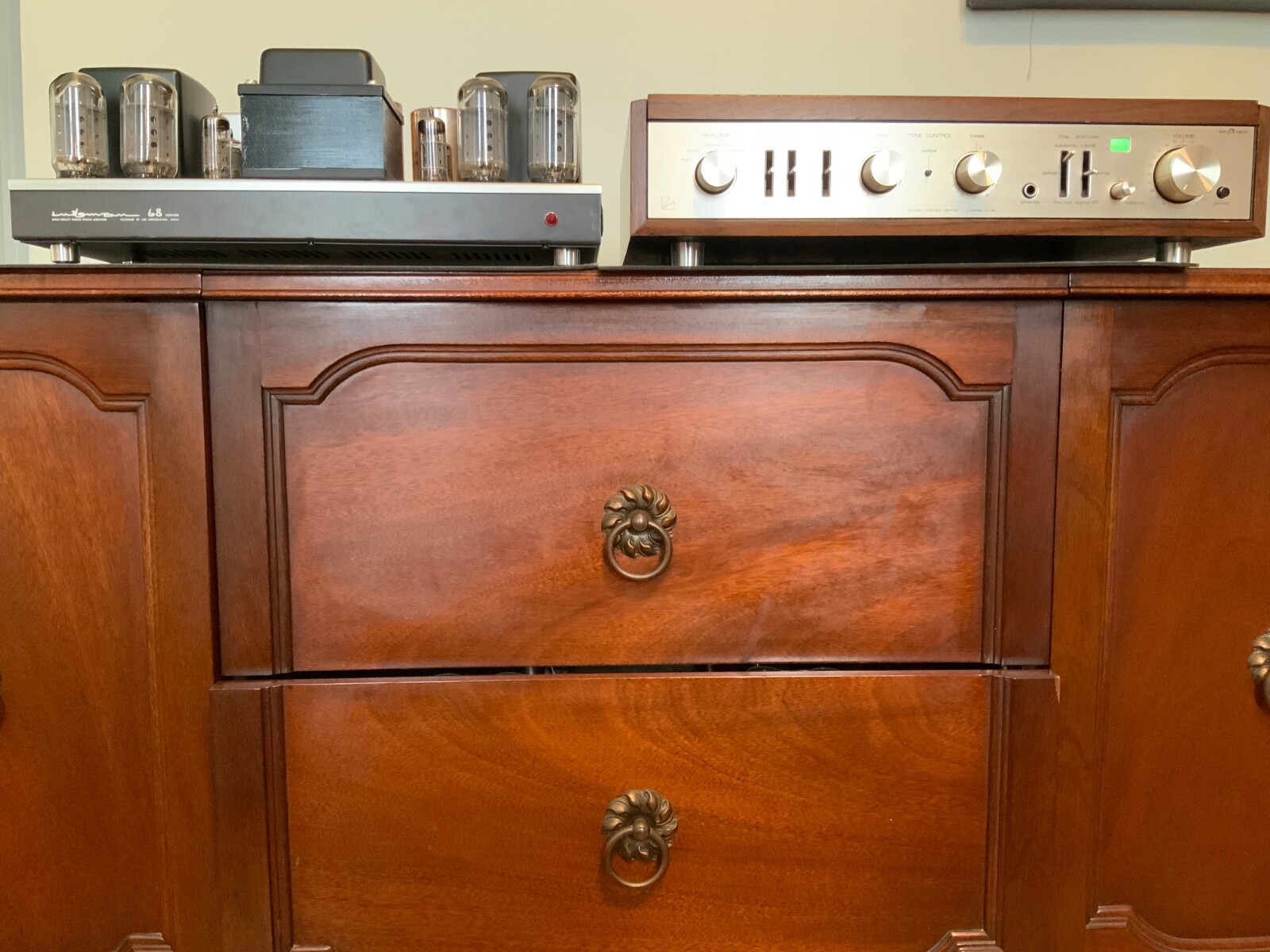
The CL-34 embodies Luxman’s commitment to simplicity, durability, and aesthetic harmony. The front panel features a clean, symmetrical layout with large, knurled aluminum knobs for input selection and volume. The stepped attenuator-style volume control uses a high-quality dual-gang potentiometer, offering precise and repeatable level settings.
One of the most distinctive aspects of the CL-34 is its lack of tone controls or balance adjustment—a bold design choice that underscores its purist orientation. This reflects a growing trend in high-end audio during the mid-1970s, where some manufacturers began to question whether tone controls, often implemented with lossy circuits, degraded overall sound quality.
Internally, the CL-34 uses heavy-duty toggle switches and gold-plated connectors to ensure reliable signal transfer. The chassis is constructed from thick steel with a non-magnetic design to reduce interference, and the entire unit is built to last—many examples today still function flawlessly after nearly 50 years.
The industrial design is quintessential 1970s Japanese hi-fi: understated, functional, and elegant. The brushed aluminum faceplate, recessed logo, and minimalist labeling give it a timeless appearance that blends well with both vintage and modern systems.
Common Issues and Maintenance
Given its passive design, the CL-34 is remarkably reliable. With no power supply, no transistors, and no complex circuitry, there are few components that can fail. However, age-related issues do occasionally arise:
- Volume Potentiometer Wear: The most common problem is crackling or channel imbalance due to oxidation or wear in the potentiometer. This can often be resolved with careful cleaning using contact cleaner, though replacement with a modern high-quality pot (such as an Alps or Noble) may be necessary in severe cases.
- Switch Contact Oxidation: The input selector switches may develop intermittent connections over time. Regular use and occasional cleaning can prevent this.
- Cable and Connector Degradation: Original RCA jacks and internal wiring may degrade. Upgrading to modern, high-purity cables can improve performance and reliability.
Because the CL-34 has no active electronics, it does not require recapping or bias adjustments, unlike active preamplifiers. This makes it a low-maintenance component for collectors and audiophiles alike.
Current Market Value and Collectibility
The Luxman CL-34 is not as widely known as some of Luxman’s more famous active preamplifiers (like the C-05 or C-1000), but it holds a special place among analog purists and minimalist audio enthusiasts. Its rarity and unique passive design contribute to its appeal in the vintage audio market.
Today, a working CL-34 in good cosmetic condition typically sells for $400–$700 USD, depending on finish, provenance, and included accessories. Units in mint condition with original packaging can command higher prices, especially in Japan, where Luxman enjoys a particularly strong collector base.
Its value has been steadily increasing, not just for its sound quality, but as a representative of a specific design philosophy—one that prioritizes signal purity over convenience. In an era where high-end audio is rediscovering the virtues of passive preamps and direct-coupled circuits, the CL-34 feels surprisingly modern.
Conclusion: A Legacy of Simplicity
The Luxman CL-34 is more than just a vintage control unit—it’s a statement. In an age of increasing complexity, it reminds us that fidelity can be achieved through restraint. By removing amplification, feedback, and tone controls, Luxman created a component that serves the music rather than the engineer.
While not suitable for every system—particularly those with low-output sources or insensitive amplifiers—the CL-34 excels in well-matched, high-resolution setups. It rewards careful system synergy with a level of transparency and musicality that many active preamps struggle to match.
For collectors, it represents a rare example of Luxman’s willingness to experiment with minimalist design. For audiophiles, it offers a window into a purer form of analog reproduction. And for both, the CL-34 remains a quiet masterpiece—unassuming in appearance, but profound in its ability to deliver the essence of the music.
In the world of vintage audio, where flashiness often overshadows substance, the Luxman CL-34 stands apart: a humble, honest, and enduring testament to the power of less.
eBay Listings



As an eBay Partner, we earn from qualifying purchases. This helps support our independent vintage technology research.
Related Models
- Luxman L-530 (1975)
- Luxman R-404 (1975)
- Luxman RV-371 (1975)
- Luxman SQ-38U (1975)
- Luxman T-14 (1972)
- Luxman T-530 (1975)
- Luxman TX-101 (1975)
- Denon DRA-800 (1985)
- Denon PMA-350Z (1980)
- Denon POA-1500 (1979)