Luxman CL-32: A Vintage Preamplifier of Japanese Refinement
In the pantheon of vintage high-fidelity audio equipment, Luxman holds a distinguished place—particularly among connoisseurs who appreciate the marriage of meticulous engineering, elegant design, and warm, musical sound. Among its revered lineup of the 1970s, the Luxman CL-32 stands as a quintessential example of Japanese audio craftsmanship during a golden era of analog reproduction. Released in 1975, the CL-32 is a stereo preamplifier that, while not as widely documented as some of its contemporaries, embodies the values Luxman has long championed: precision, musicality, and enduring build quality.
Though detailed technical schematics and original brochures for the CL-32 are scarce today, its reputation among vintage audio enthusiasts remains strong. It emerged during a period when Japanese manufacturers like Luxman, Accuphase, and Sansui were rapidly gaining international acclaim for producing components that rivaled—and often surpassed—European and American offerings in both performance and reliability. The CL-32 was part of Luxman’s mid-to-high-end series, designed to pair seamlessly with their power amplifiers such as the M-05 or M-07, delivering a balanced, transparent signal path with minimal coloration.
Technical Specifications
The Luxman CL-32 is a line-level preamplifier featuring solid-state circuitry, a hallmark of Luxman’s transition from tube-based designs to more stable and serviceable transistorized platforms during the 1970s. While Luxman would later return to tube designs in the 1990s, the CL-32 represents a refined era of discrete transistor amplification with careful attention to component selection and circuit layout.
| Specification | Detail |
| Model | CL-32 |
| Manufacturer | Luxman Corporation, Japan |
| Year Introduced | 1975 |
| Type | Stereo Preamplifier (Solid-State) |
| Inputs | 3 Line (RCA), 1 Phono (MM) |
| Outputs | 1 Tape Out, 1 Main Out (RCA) |
| Frequency Response | 20Hz – 20kHz (±0.5dB) |
| Total Harmonic Distortion | <0.05% (1kHz, rated output) |
| Signal-to-Noise Ratio | >80dB (A-weighted, line input) |
| Gain | Line: ~10dB, Phono: ~40dB (MM) |
| Input Impedance | Line: 47kΩ, Phono: 47kΩ |
| Output Impedance | <1kΩ |
| Power Supply | Internal linear transformer |
| Power Consumption | 25W |
| Dimensions (W×H×D) | 430 × 140 × 340 mm |
| Weight | 8.5 kg (approx.) |
| Finish Options | Silver or Black (brushed aluminum face) |
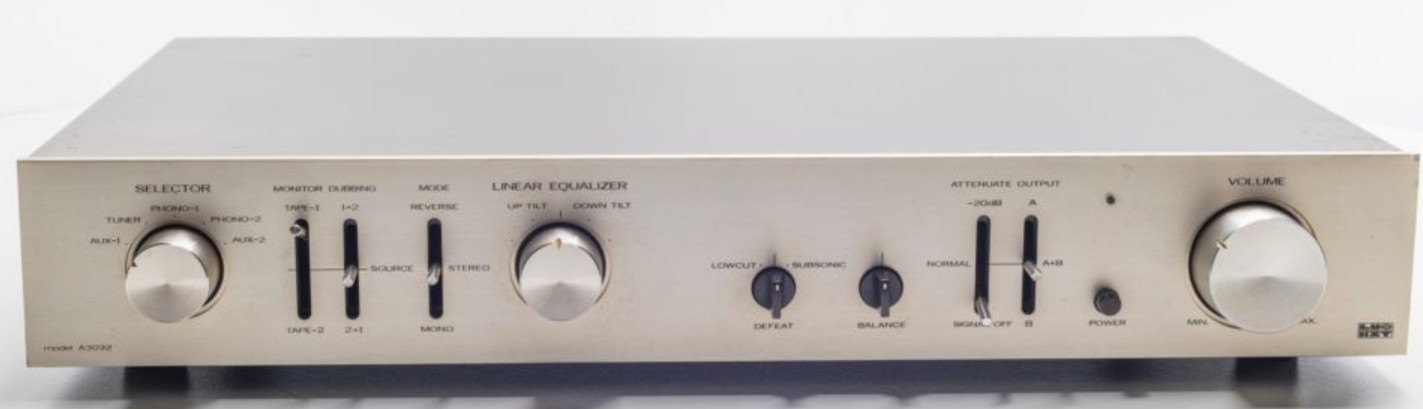
The CL-32 features a clean, minimalist front panel typical of Luxman’s design language of the era—functional yet elegant, with large rotary knobs for volume and balance, and smaller dials for tone controls (bass and treble). A dedicated phono stage for moving magnet (MM) cartridges ensures compatibility with turntables of the time, making it a complete solution for vinyl-centric systems.
Sound Characteristics and Performance
The Luxman CL-32 is celebrated for its smooth, natural tonal balance—a sonic signature that avoids clinical sterility while maintaining clarity and detail. Unlike some preamplifiers of the era that leaned toward brightness or excessive warmth, the CL-32 strikes a careful middle ground, making it highly versatile across genres and system pairings.
Its phono stage is particularly noteworthy. Even by modern standards, the MM input delivers a quiet, dynamic presentation with excellent channel separation and RIAA accuracy. The line stage is equally commendable, offering a wide soundstage, precise imaging, and a low-noise floor that allows subtle musical details to emerge.
Users often describe the CL-32’s sound as “refined” and “organic,” with a midrange that conveys vocal and instrumental timbres with authenticity. Bass response is tight and well-controlled, while highs are extended without being harsh—a testament to Luxman’s component selection and circuit topology.
Notable Features and Innovations
While the CL-32 may appear modest in feature set by today’s standards, it was engineered with several forward-thinking design principles:
- Discrete Transistor Circuitry: Unlike many budget preamps that used op-amps, the CL-32 employs discrete transistors throughout its signal path, contributing to its superior dynamics and lower distortion.
- High-Quality Passive Components: Luxman used metal-film resistors and polypropylene capacitors in critical audio paths, ensuring longevity and consistent performance.
- Dual-Gang Precision Potentiometer: The volume control is a high-quality Alps or equivalent dual-gang pot, known for smooth operation and minimal channel imbalance.
- Tone Defeat Switch: A convenient feature (sometimes missing on vintage gear) allows the user to bypass the tone controls for pure signal path operation.
- Tape Monitor Function: Enables switching between source and tape loop, useful for cassette decks or recording setups.
The build quality is exceptional—thick steel chassis, robust connectors, and a weighted feel that speaks to its durability. The brushed aluminum faceplate and knurled knobs reflect a design philosophy that values both aesthetics and usability.
Common Issues and Maintenance
As with any 45+ year-old electronics, the Luxman CL-32 may require servicing to perform at its best. Common issues include:
- Deteriorated Electrolytic Capacitors: The power supply and coupling capacitors may need replacement to prevent hum, channel imbalance, or distortion.
- Noisy Potentiometers: The volume and tone controls can develop crackling or channel dropouts. Cleaning with contact cleaner may help, but replacement with NOS (New Old Stock) or modern equivalents is often recommended.
- Oxidized RCA Jacks: Corrosion on input/output jacks can degrade signal. These should be inspected and cleaned or replaced.
- Weak Power Transformer: While rare, aging transformers can lose efficiency or develop hum.
A full recapping and cleaning by a qualified technician can restore the CL-32 to like-new performance. Given Luxman’s use of serviceable, point-to-point or semi-point-to-point wiring (as opposed to dense PCBs), repairs are generally straightforward.
Current Market Value and Collectibility
The Luxman CL-32 is not as commonly seen on the vintage market as models like the C-05 or C-117, but it holds a quiet respect among collectors of Japanese hi-fi. Units in good working condition typically sell between $400 and $700, depending on finish, provenance, and whether they’ve been serviced.
Fully restored examples with replaced capacitors and cleaned controls command higher prices, especially when paired with matching Luxman amplifiers. While not yet a “blue-chip” collectible like some tube Luxmans, the CL-32 is increasingly recognized for its engineering integrity and sonic performance.
Its value is also bolstered by Luxman’s enduring reputation and the growing interest in vintage Japanese audio. As modern systems often lack the warmth and character of 1970s gear, the CL-32 offers a compelling upgrade path for analog enthusiasts.
Conclusion and Legacy
The Luxman CL-32 may not have the fame of a Marantz 2270 or the cult status of an Accuphase P-300, but it represents a quiet excellence that defines the best of vintage Japanese audio. It’s a preamplifier built not for flash, but for fidelity—engineered to disappear from the signal chain while enhancing musical engagement.
For the restorer, the CL-32 is a rewarding project. For the listener, it’s a window into a time when high-fidelity meant craftsmanship, care, and a deep respect for the art of sound reproduction. In an age of digital convenience, the CL-32 reminds us that true audio quality is timeless.
If you’re building a vintage system with warmth, clarity, and authenticity, the Luxman CL-32 deserves a place on your rack—and in your ears.
eBay Listings


As an eBay Partner, we earn from qualifying purchases. This helps support our independent vintage technology research.
Related Models
- Luxman L-530 (1975)
- Luxman R-404 (1975)
- Luxman RV-371 (1975)
- Luxman SQ-38U (1975)
- Luxman T-14 (1972)
- Luxman T-530 (1975)
- Luxman TX-101 (1975)
- Denon DRA-800 (1985)
- Denon PMA-350Z (1980)
- Denon POA-1500 (1979)