Luxman C-10II: The Pinnacle of Passive Preamplification
In the pantheon of vintage high-fidelity audio, few names command as much reverence as Luxman, the Japanese manufacturer renowned for its meticulous engineering, elegant design, and unwavering commitment to sonic purity. Among its storied lineup of preamplifiers, the Luxman C-10II stands as a rare and exceptional example of minimalist audiophile philosophy executed at the highest level. Introduced in 1974, the C-10II is not merely a preamplifier—it is a statement piece from Luxman’s golden era, embodying the belief that the shortest signal path yields the most transparent sound.
Unlike the majority of preamplifiers of its time (and today), the C-10II is a passive preamplifier, meaning it contains no active gain stages. Instead, it relies solely on high-quality passive components—precision resistors and switches—to manage volume and source selection. This design eliminates the coloration and distortion that can be introduced by active circuitry, offering a level of neutrality and transparency that continues to captivate purists and collectors alike.
Technical Specifications
| Specification | Detail |
| Model | Luxman C-10II |
| Year of Release | 1974 |
| Type | Passive dual-monaural preamplifier |
| Gain | 0 dB (no amplification) |
| Volume Control | 24-step precision resistor ladder |
| Input Impedance | 100 kΩ |
| Output Impedance | 10 kΩ |
| Inputs | 4 line-level (RCA) |
| Outputs | 1 pair (RCA) |
| Power Requirement | None (passive design) |
| Construction | Dual-monaural, point-to-point wiring |
| Chassis Material | Solid steel with brushed aluminum face |
| Dimensions (W×H×D) | 430 × 145 × 345 mm |
| Weight | Approx. 10.5 kg |
| Finish | Silver or black (depending on variant) |
Sound Characteristics and Performance
The sonic signature of the Luxman C-10II is best described as effortless, transparent, and dynamically alive. Without active circuitry to color or compress the signal, music flows through the C-10II with remarkable clarity and immediacy. There’s a sense of “invisibility” to its operation—when properly matched, the preamplifier seems to disappear from the signal chain, leaving only the source and power amplifier to shape the sound.
Due to its passive nature, the C-10II excels in systems where the downstream power amplifier has sufficient gain and low input impedance. When paired with high-gain tube amplifiers or sensitive solid-state designs, the C-10II reveals micro-details, spatial cues, and tonal textures that many active preamps obscure. Its dual-monaural construction ensures excellent channel separation and a wide, stable soundstage, while the precision resistor ladder provides smooth, consistent volume attenuation across its 24 steps.
Listeners often report a natural timbre, particularly with acoustic instruments and vocals. The midrange is lush yet uncolored, the treble is extended without harshness, and the bass remains tight and well-controlled—provided the system’s amplification can drive the speakers effectively. The C-10II does not add warmth or richness; instead, it reveals what is already present in the recording, making it a favorite among those who value accuracy over euphony.
Notable Features and Innovations
The Luxman C-10II was a bold departure from conventional preamplifier design, even by the standards of the 1970s. Its most striking feature is its dual-monaural architecture, meaning that the left and right channels are completely isolated from each other, both electrically and physically. This design minimizes crosstalk and interference, contributing to its exceptional stereo imaging.
The 24-step resistor ladder attenuator is another hallmark of the C-10II. Unlike potentiometers, which can wear unevenly and introduce noise, this stepped attenuator uses discrete, high-precision metal-film resistors for each volume level. This ensures consistent performance over decades and eliminates the channel imbalance common in aging volume pots.
Luxman also paid meticulous attention to mechanical design. The heavy steel chassis provides excellent shielding against electromagnetic interference, while the thick aluminum front panel lends both rigidity and aesthetic refinement. Internally, the C-10II features hand-soldered, point-to-point wiring—a labor-intensive method that avoids printed circuit boards and further reduces signal degradation.
Despite its simplicity, the C-10II was engineered for longevity. Luxman used only the highest-grade components available at the time, including military-spec resistors and gold-plated RCA jacks. The result is a preamplifier built not just to perform, but to endure.
Common Issues and Maintenance
Because the Luxman C-10II contains no active electronics, it is remarkably reliable. However, like any vintage component, it is not immune to age-related issues.
The most common concern is contact oxidation on the selector switches and attenuator contacts. Over time, dust and oxidation can lead to crackling or channel dropouts. Fortunately, this is usually resolved with careful cleaning using high-quality contact cleaners such as DeoxIT, applied sparingly and with proper ventilation.
Another potential issue is resistor drift. While rare, the precision resistors in the attenuator ladder can change value slightly over decades, affecting channel balance. A full recalibration by a qualified technician may be necessary in extreme cases, though most units remain well within spec.
The RCA jacks, while robust, can also loosen over time due to repeated plugging and unplugging. Tightening or replacing them with modern equivalents (while preserving originality) may be advisable for daily use.
Because the C-10II lacks power circuitry, there are no capacitors or tubes to degrade—making it one of the most maintenance-friendly vintage preamps available. Still, owners should store it in a dry, dust-free environment and avoid exposing it to extreme temperatures.
Current Market Value and Collectibility
The Luxman C-10II is a rare and sought-after component, particularly in fully functional, original condition. Due to its limited production run and niche appeal, finding one on the open market can be challenging. When available, prices typically range from $1,800 to $3,000 USD, depending on condition, finish, and provenance.
Units in silver finish with all-original parts and clean internals command a premium, especially among collectors who value authenticity. The C-10II is not just an audio component—it is a piece of high-fidelity history, representing a time when Japanese manufacturers pushed the boundaries of analog design with uncompromising standards.
Its collectibility is further enhanced by its association with Luxman’s legendary “C” series, which includes other revered models like the C-05 and C-9. While later active preamps offered more features, the C-10II remains a cult favorite for its purity and engineering integrity.
Conclusion and Legacy
The Luxman C-10II is more than a preamplifier—it is a testament to the power of simplicity in high-end audio. In an era increasingly obsessed with features, feedback loops, and digital processing, the C-10II reminds us that sometimes, the best way to enjoy music is to get out of its way.
Its passive, dual-monaural design, precision engineering, and timeless build quality make it a standout even among Luxman’s own elite offerings. For the right system and listener, the C-10II delivers a listening experience that is transparent, emotionally engaging, and profoundly natural.
Today, it stands as a benchmark of minimalist audio design and a symbol of Luxman’s golden age. Whether used in a modern high-resolution setup or preserved as a collector’s item, the C-10II continues to inspire audiophiles who believe that in the pursuit of sonic truth, less is indeed more.
eBay Listings

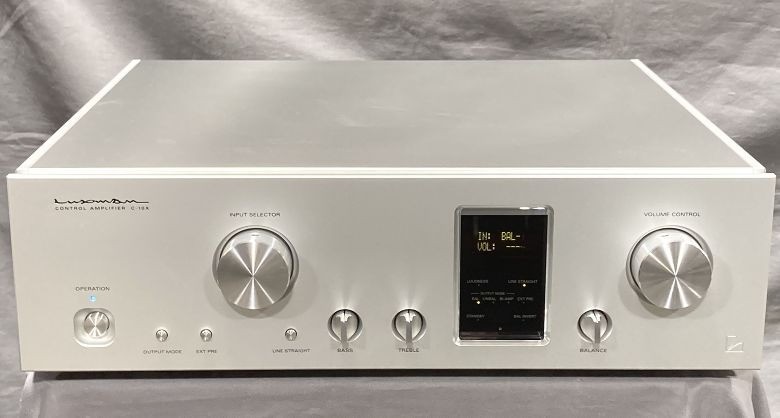


As an eBay Partner, we earn from qualifying purchases. This helps support our independent vintage technology research.
Related Models
- Luxman L-530 (1975)
- Luxman R-404 (1975)
- Luxman RV-371 (1975)
- Luxman SQ-38U (1975)
- Luxman T-14 (1972)
- Luxman T-530 (1975)
- Luxman TX-101 (1975)
- Denon DRA-800 (1985)
- Denon PMA-350Z (1980)
- Denon POA-1500 (1979)