Luxman C-03B: The Quiet Masterpiece of Japanese Hi-Fi
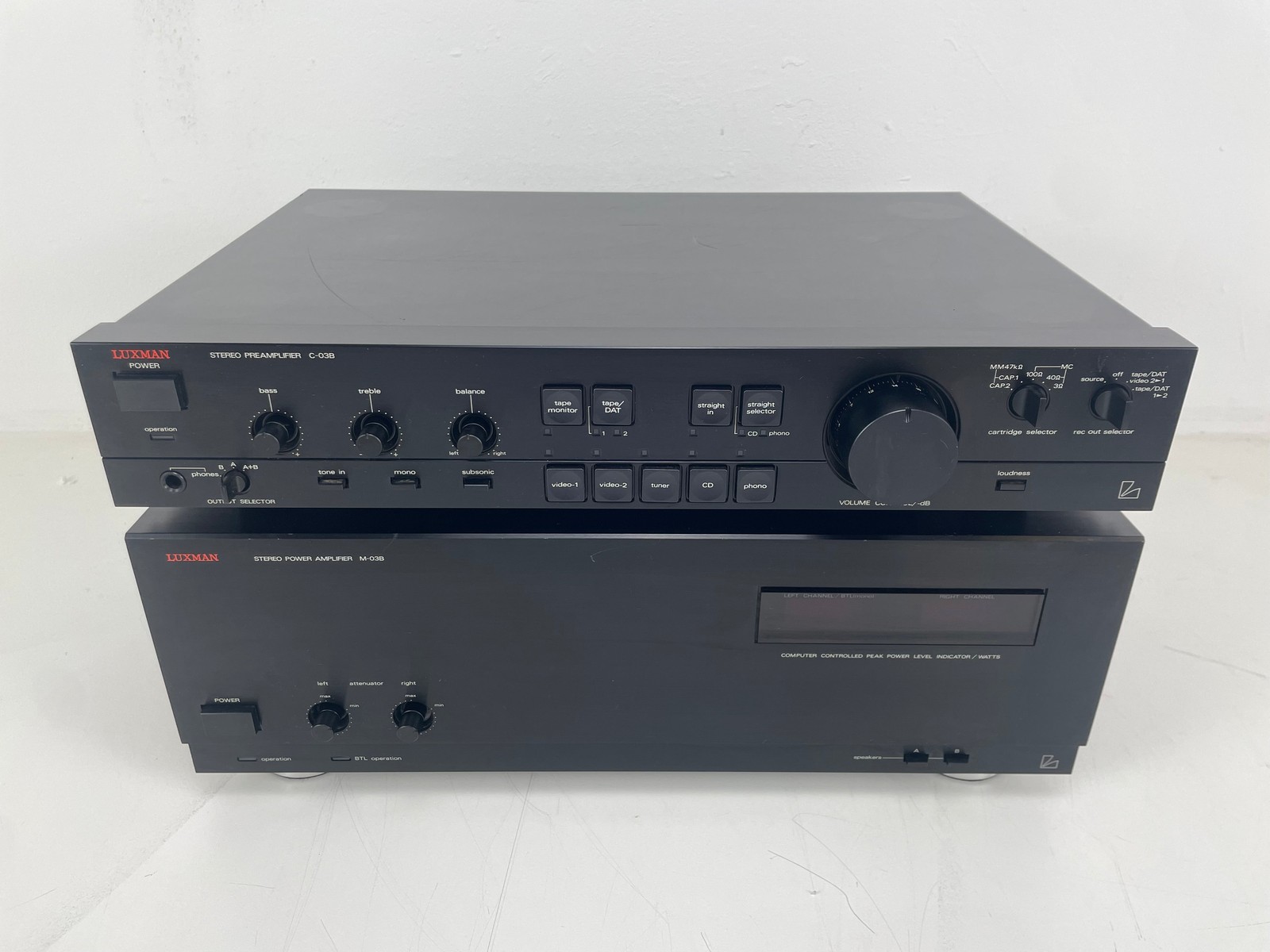
In the late 1970s, Japanese audio engineering reached a golden peak, and few companies embodied that era’s pursuit of sonic purity quite like Luxman. Among their refined lineup of components, the Luxman C-03B stands out as a rare and understated gem—a passive preamplifier that defied the trend of increasingly complex active circuitry. Released in 1979, the C-03B was part of a minimalist wave that prioritized signal integrity, transparency, and musicality over feature-laden designs. Though less celebrated than its active siblings like the C-05 or C-07, the C-03B has quietly earned a cult following among purists and vintage audio connoisseurs who value purity of tone and elegant simplicity.
Technical Specifications
The C-03B is a no-frills, passive preamplifier designed to do one thing exceptionally well: pass the audio signal from source to power amplifier with minimal interference. It contains no amplification stages, relying instead on precision attenuators and high-quality passive components to manage volume and source selection.
| Specification | Detail |
| Model | Luxman C-03B |
| Year of Release | 1979 |
| Type | Passive Preamplifier |
| Inputs | 4 (MM, MC, Tuner, Aux) |
| Output | 1 Pair (to power amplifier) |
| Volume Control | Dual-gang precision potentiometer |
| Tone Controls | None |
| Power Requirement | None (passive design) |
| Impedance | Not applicable |
| Gain | Less than 1 (signal attenuation only) |
| Construction | Point-to-point wiring, high-grade internal cabling |
| Chassis Material | Steel with brushed aluminum front panel |
| Dimensions (W×H×D) | 435 × 143 × 342 mm |
| Weight | Approx. 8.5 kg |
| Finish Options | Silver or Black |
Sound Characteristics and Performance
The Luxman C-03B doesn’t “color” the sound—instead, it reveals what’s already there. Its passive architecture eliminates active gain stages, power supplies, and associated noise, resulting in a remarkably transparent and neutral presentation. Audiophiles often describe its sound as “effortless,” with a natural timbral accuracy and delicate midrange that brings vocals and acoustic instruments to life.
Because it lacks amplification, the C-03B works best in systems where source components have strong output levels and power amplifiers are sufficiently sensitive. When properly matched, the preamp delivers a wide soundstage, precise imaging, and exceptional dynamic micro-details. There’s no artificial warmth or brightness—just a clean, open window into the music.
Its performance is particularly striking with vinyl setups. Paired with a high-output moving magnet (MM) or well-matched moving coil (MC) cartridge via a quality step-up transformer, the C-03B preserves the analog richness and spatial cues that define great turntable systems. CD players and tape decks of the era also benefit from its uncolored signal path.
Notable Features and Innovations
While the C-03B appears simple on the surface, its design reflects Luxman’s meticulous attention to detail:
- High-Precision Attenuator: The dual-gang volume potentiometer is carefully matched for channel balance across the entire range, minimizing stereo skew even at low listening levels.
- Gold-Plated Switches and Jacks: Input selection uses durable, low-resistance switches with gold-plated contacts to ensure reliable connectivity and minimize signal loss.
- Minimalist Signal Path: With no circuit boards and a direct, point-to-point wiring layout, the signal travels the shortest possible route, reducing capacitance and inductance.
- Heavy-Duty Chassis: The rigid steel frame reduces vibration and electromagnetic interference, while the elegant aluminum faceplate gives it a timeless aesthetic.
One of the most distinctive aspects of the C-03B is its lack of tone controls or balance adjustments—a bold design choice that reflects Luxman’s confidence in the neutrality of their circuit and the sophistication of their target audience. This purity-first philosophy places the C-03B in the same lineage as other minimalist classics like the Audio Research SP-1 or the early Naim NAC series.
Common Issues and Maintenance
As with any vintage component, the Luxman C-03B requires careful evaluation before purchase. While its passive design means fewer failure points than active preamps, several issues can arise after decades of use:
- Worn or Noisy Potentiometer: The volume control is the most vulnerable component. Over time, dust and oxidation can cause crackling or channel imbalance. Cleaning with high-quality contact cleaner (e.g., DeoxIT) may help, but replacement with a modern high-precision pot (while preserving originality) is sometimes necessary.
- Loose Input Switches: The selector switch can become flaky with age. Regular use helps, but internal cleaning or replacement may be needed.
- Oxidized RCA Jacks: Corrosion on the input and output jacks can degrade signal transfer. Gentle cleaning with isopropyl alcohol and a soft brush is recommended.
- Cable Degradation: Internal wiring, while high-quality, can become brittle. If the unit has been stored poorly or exposed to moisture, inspection by a qualified technician is advisable.
Despite these potential issues, the C-03B is generally robust. Its lack of power supply and active electronics means fewer components to fail. With proper care, it can perform reliably for decades.
Current Market Value and Collectibility
The Luxman C-03B is a rare find today. Unlike more famous models, it was produced in limited numbers and often overshadowed by Luxman’s active preamps. As a result, it remains somewhat under the radar—a hidden treasure for discerning collectors.
In excellent working condition, the C-03B typically sells for $800 to $1,500, depending on finish, provenance, and included accessories. Fully serviced units with verified low noise and clean operation command the higher end of the range. Silver-face models are slightly more sought after, though both finishes are prized for their classic 1970s aesthetic.
Its value is likely to rise as interest in minimalist, high-trace passive preamps grows. Modern equivalents like the Zanden Audio Systems 1200 or custom-built passive boxes cost significantly more, making the C-03B an attractive vintage alternative.
Conclusion and Legacy
The Luxman C-03B is not a flashy statement piece—it’s a quiet, confident performer for those who value musical truth over technical spectacle. In an era when preamplifiers were becoming increasingly complex, Luxman took a bold step back, trusting in the quality of their materials and craftsmanship to deliver an uncolored, lifelike sound.
Today, the C-03B stands as a testament to the elegance of simplicity. It appeals to a niche but passionate audience: vinyl lovers, minimalist system builders, and audiophiles who believe that sometimes, the best electronics are the ones you don’t hear.
If you’re building a vintage Japanese high-fidelity system or seeking a transparent preamp that gets out of the music’s way, the Luxman C-03B deserves serious consideration. It may not have the fame of a Marantz 2600 or the power of a Sansui AU-αL, but in its quiet way, it captures the soul of analog reproduction with rare grace.
eBay Listings


As an eBay Partner, we earn from qualifying purchases. This helps support our independent vintage technology research.
Related Models
- Luxman L-530 (1975)
- Luxman R-404 (1975)
- Luxman RV-371 (1975)
- Luxman SQ-38U (1975)
- Luxman T-14 (1972)
- Luxman T-530 (1975)
- Luxman TX-101 (1975)
- Denon DRA-800 (1985)
- Denon PMA-350Z (1980)
- Denon POA-1500 (1979)