Linn KLOUT
Linn's self-declared "best amplifier ever" - a solid-extrusion stereo power amp rated at 80W into 8 ohms that still shows up on the used market with dead channel LEDs and asking prices north of a grand.
Overview
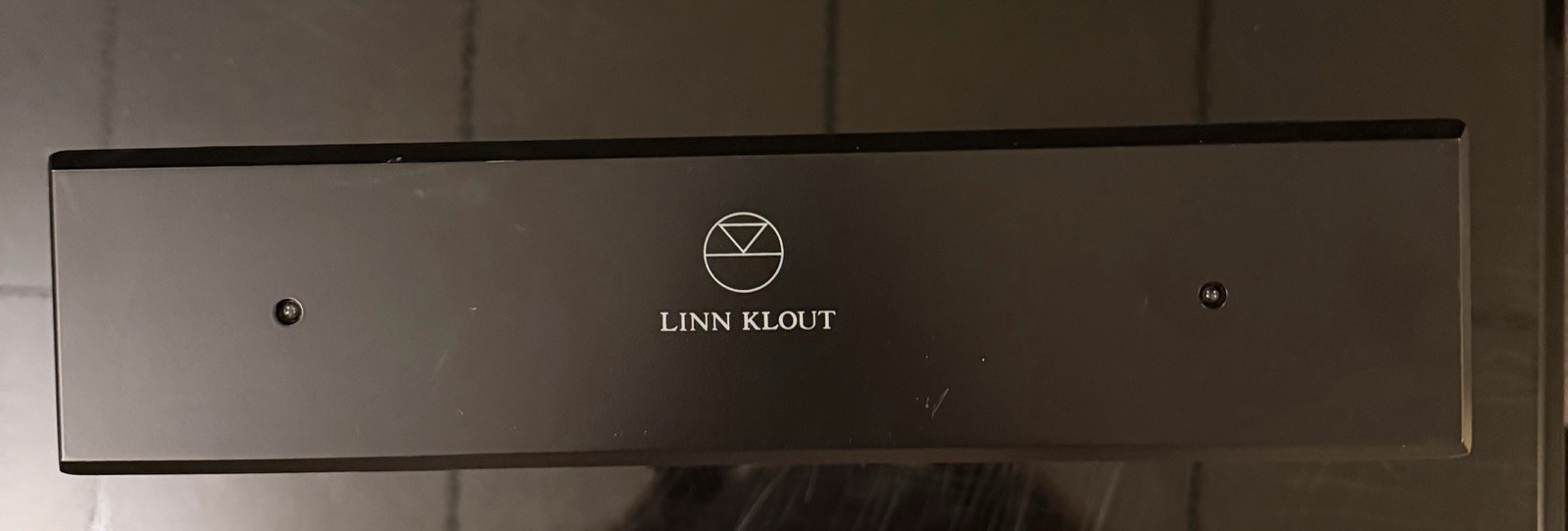
The KLOUT is a two-channel stereo power amplifier from Linn Products, built in Scotland. It sits in a strange spot on the used market. People who own one respect it, and almost nobody else has documented it. Linn's own owner's manual states power output at 80 Watts per channel into 8 Ohms and 160 Watts per channel into 4 Ohms, with maximum power consumption quoted at 840 VA. That looks modest for a piece this heavy. One eBay buyer put the shipping weight at around 33 pounds. That's informal testimony, not a manufacturer spec, but it lines up with a chassis built from a one-piece solid extrusion. Some listings and secondary sources circulate much higher figures for the KLOUT. The manual is the document that names this exact model, so its numbers are the ones to trust.
The published specs are thin, but the stated design goals are not. Linn's manual describes the KLOUT as having "many unique attributes which set new standards in both mechanical and electronic engineering" - house language, but the specifics behind it are real. The circuit boards mount vertically and transfer heat from the power stages directly into the case, so the extrusion itself is the heatsink. The circuitry uses surface-mount technology for cooler, more reliable operation. A screened transformer lets the amp sit close to other components in a rack without inducing interference. Anyone who has chased hum through a stacked system knows why that matters. Inputs are RCA and XLR, so it will take a balanced feed if the preamp can provide one.
The KLOUT was designed to partner the Linn KAIRN preamplifier and can be operated directly from it. A three-way switch on the back panel selects manual on, standby, or off. In standby, the KAIRN's own mains switch brings the KLOUT up, with the indicators lighting red, then green once the power supplies stabilize. Chain more than one KLOUT together via the remote link and the switch-on delay grows by a few seconds per amplifier. Owners of multi-amp active systems learn to live with that.
Key Features
One-Piece Solid Extrusion Chassis
The KLOUT is housed in a single extruded enclosure engineered for strength and heat dissipation rather than cosmetics. The output stages bolt to vertically mounted boards that couple directly to the case, so the whole housing works as a heatsink. Linn's manual is explicit that the amp should be positioned to allow free air movement around the heatsinks. It also warns against stacking the amp with anything that obstructs airflow or can't take the weight.
80 Watts per Channel, 160 into 4 Ohms
The manual's rating is 80W into 8 Ohms, doubling to 160W into 4 Ohms. An amplifier that doubles its output as impedance halves has a stiff enough supply to deliver current when a speaker demands it. Linn's own copy claims the design provides "the uncompromising power, stability and performance required to drive any loudspeaker to the highest standard of musical accuracy." That's marketing, not a measurement, but the 840 VA maximum consumption figure backs up the idea that there's real reserve in there. Owners on the used market describe it as a powerful amp that gives a system what it needs.
Protection Circuitry and Indicator Logic
The KLOUT's self-protection is more sophisticated than most amps of its generation. It guards against current overload, short circuits, and over-temperature conditions. When protection trips, the affected channel's indicator goes red and that channel mutes. After a brief overload it returns to green and un-mutes in roughly six seconds. If the indicator stays red and the channel stays muted, the manual points to a short circuit or overheating - check the speaker cables and connections, or improve ventilation. If the indicator is red but the channel is *not* muted, that signals an internal fault and the unit should go back to a dealer. It also explains why so many used KLOUTs are described in terms of what their LEDs are doing.
Three Pairs of Speaker Outlets per Channel
Each channel carries three pairs of speaker outlets, which makes bi-wiring or tri-wiring straightforward without external adapters. Linn recommends its own K series speaker cable and KNEKT plugs. The cable is marked with the Linn logo to indicate directionality, and the logo should point toward the loudspeaker. One wiring subtlety: when the KLOUT is driven by a phase-inverting preamp such as the KAIRN, the signal arrives inverted. To preserve absolute phase, the positive output should go to the negative (black) speaker terminal and vice versa.
Screened Transformer and Remote Chaining
Linn screened the transformer specifically so the KLOUT can be positioned close to other audio products without interference. That helps in a stacked Linn system where the preamp, tuner, and CD player all sit in one rack. The remote link is a simple phono-to-phono chain: KAIRN REMOTE IN to KLOUT REMOTE OUT, then each additional KLOUT's REMOTE IN to the next unit's REMOTE OUT. The more units in the chain, the longer the power-up delay.
Historical Context
The KLOUT appears in period amplifier listings - Audio (October 1996, p.95) included it among the power amplifiers of the era - but no production years have surfaced in the available record. Pinning down when it was introduced or discontinued isn't possible from the documentation at hand. What is documented is its intended partner: the Linn KAIRN preamplifier, from which the KLOUT can be operated directly, including via the preamp's mains switch. That pairing places the KLOUT within Linn's separates lineup rather than its integrated offerings. One reseller has billed it as "Linn's best amplifier ever," which is a seller's framing rather than a review verdict. The manual also carries a Y2K compliance statement, in which Linn notes that reasonable endeavours were made to ensure the software would operate normally before, during, and after 1 January 2000. That dates the documentation to the late 1990s.
Collectibility & Value
KLOUTs turn up on the used market with some regularity, and the asking prices are not trivial. A listing titled "LINN KLOUT STEREO AMPLIFIER" carried a price of $1,099. A Belgian listing showed €1,100 with an optional Linn K400 interconnect, though that listing's date reads as September 2026, which is suspect and should be treated with caution. Audioreview users have rated the KLOUT 5 out of 5 across 13 reviews. One forum poster called it "a beautiful beast," and another described it as an excellent amplifier best characterized as musical.
Know the failure patterns before buying. A YouTube video documents a KLOUT with no right channel. An eBay UK listing noted a unit that had been recently serviced with a receipt available, original packaging, and one careful owner, but with a dead left channel LED and everything else working. LEDs failing while the channel itself still functions is a recurring theme. More seriously, at least one owner has reported finding only the two amplification boards, with the entire power supply section missing ("toute la partie alimentation"). That makes a complete, working example more valuable than a cheap incomplete one. Linn's manual warns in the strongest terms against home maintenance, because the large capacitors hold lethal voltages long after the amp is switched off. Any service should go to an authorized dealer, and buyers should confirm what work, if any, has been done.
eBay Listings



As an eBay Partner, we earn from qualifying purchases. This helps support our independent vintage technology research.
Related Models
- Linn AV 5105
- Linn Klimax Solo 500
- Linn LK140
- Linn LK2
- Linn LK240
- Eico 3150 (1967)
- Fisher CUSTOM-ELECTRA-I (K-14/K-15) (1957)
- Fisher CUSTOM-ELECTRA IV (E33/E44) (1960)
- Akai AM-2400 (1978)
- Akai AM-2600 (1977)