Leak TROUGH-LINE-3: The Pinnacle of Passive Preamplification
In the golden era of British high-fidelity audio during the 1950s and 1960s, few names carried the prestige of Leak, a brand synonymous with engineering excellence, refined sound, and understated elegance. Among its celebrated lineup of amplifiers and tuners, the Leak TROUGH-LINE-3 stands apart—not as a power amplifier or integrated unit, but as a rare and highly regarded passive preamplifier. Introduced in 1957, the TROUGH-LINE-3 was designed for the discerning audiophile who valued purity of signal above all else. It represents a minimalist yet sophisticated approach to audio control, embodying the philosophy that sometimes, less is truly more.
Historical Context
The post-war British audio industry was a hotbed of innovation, and companies like Leak, Quad, and Linn led the charge in developing high-fidelity equipment that emphasized natural sound reproduction. At a time when active preamplifiers with vacuum tubes and complex circuitry were becoming more common, Leak took a different path with the TROUGH-LINE series. The TROUGH-LINE-3 was the third and most refined iteration of this concept, following the TROUGH-LINE and TROUGH-LINE-2.
Rather than amplifying the signal, the TROUGH-LINE-3 functioned as a passive attenuator, using high-quality resistive networks and precision switches to control volume and source selection. This design eliminated active gain stages, reducing distortion, noise, and coloration. For systems driven by high-output sources—such as Leak’s own Varislope or Stereo 60 amplifiers—this approach delivered a remarkably transparent and uncolored listening experience.
The TROUGH-LINE-3 was typically paired with Leak’s TANNOY or Monitor loudspeakers and used in conjunction with high-quality valve amplifiers of the era. It was not a mass-market product; rather, it was aimed at the serious listener who appreciated the subtleties of tone, spatial imaging, and dynamic nuance.
Technical Specifications
| Specification | Detail |
| Model | TROUGH-LINE-3 |
| Manufacturer | H. Leak & Co. Ltd., England |
| Year Introduced | 1957 |
| Type | Passive Preamplifier / Attenuator |
| Inputs | 3 (typically phono/turntable, tuner, auxiliary) |
| Output | 1 (to power amplifier) |
| Volume Control | Precision stepped attenuator (rotary switch) |
| Source Selection | Rotary switch |
| Impedance | High input impedance (~100kΩ), low output |
| Power Requirement | None (passive design) |
| Construction | Steel chassis, bakelite or aluminum front panel |
| Dimensions (approx) | 30 cm (W) × 8 cm (H) × 20 cm (D) |
| Weight | ~2.5 kg |
The TROUGH-LINE-3 used a stepped attenuator system—essentially a rotary switch connected to a precision resistor ladder—allowing for exact, repeatable volume settings without the inconsistencies of potentiometers. This design ensured channel balance and long-term reliability. The use of high-quality components, including vintage British-made resistors and gold-plated switch contacts, contributed to its reputation for durability and sonic purity.
Sound Characteristics and Performance
The sonic signature of the Leak TROUGH-LINE-3 is best described as neutral, transparent, and dynamically alive. Without active circuitry, there is no added coloration, no background hiss, and no phase shift—just the music, as it was intended to be heard.
Listeners often describe the sound as open and detailed, with excellent stereo imaging and a natural tonal balance. The absence of gain stages means the signal path is as short as possible, preserving micro-dynamics and transient response. When paired with compatible high-sensitivity speakers and high-output valve amplifiers, the TROUGH-LINE-3 delivers a listening experience that many describe as "effortless" and "engaging."
Its performance shines particularly with acoustic, jazz, and classical recordings from the 1950s and 1960s, where the clarity and spatial realism of the original master tapes can be fully appreciated. While it lacks modern conveniences like remote control or tone controls, its simplicity is its strength—offering a direct conduit from source to amplifier.
Notable Features and Innovations
- Stepped Attenuator Design: Unlike potentiometers, which wear over time and can introduce noise, the TROUGH-LINE-3’s rotary switch and resistor network provide consistent, precise volume control.
- Passive Operation: No power supply or tubes required, reducing failure points and eliminating hum or interference.
- Minimalist Signal Path: Only the necessary components are in the circuit, preserving signal integrity.
- High-Quality Switching: The source selector and volume control use robust, hand-assembled switches built to last decades.
- Elegant Aesthetic: Featuring a classic mid-century British design with a brushed aluminum or bakelite front panel, chrome knobs, and a compact, understated form factor.
The TROUGH-LINE-3 was not just a functional device—it was a statement of audio philosophy. It reflected Leak’s commitment to honest engineering and the belief that fidelity should never be compromised for convenience.
Common Issues and Maintenance
Due to its passive nature, the TROUGH-LINE-3 is remarkably reliable. However, after 60+ years, certain issues may arise:
- Switch Contact Oxidation: The rotary switches can develop resistance or crackling due to oxidation. Cleaning with contact cleaner (non-residue type) can restore performance, but care must be taken not to damage the delicate switch wipers.
- Resistor Drift: While rare, some original carbon composition resistors may have drifted in value over time. Replacing them with modern metal-film equivalents (while preserving originality) can improve accuracy.
- Cable and Connector Wear: Original wiring may be brittle. Replacing internal leads with high-quality, low-capacitance cable can enhance performance without altering the circuit.
- Mechanical Wear: The front panel knobs and switch mechanisms may become loose. Re-tightening or replacing worn parts is often sufficient.
Restoration should be approached with respect for the unit’s heritage. Purists recommend preserving original components whenever possible, while others opt for subtle upgrades to improve reliability without sacrificing the vintage character.
Current Market Value and Collectibility
The Leak TROUGH-LINE-3 is a rare and sought-after piece among vintage audio collectors. Complete, working units in good condition typically fetch £400–£800 on the UK market, with exceptional examples commanding higher prices. Units with original packaging, manuals, or matching serial numbers to other Leak components (like the Stereo 60) are especially prized.
Its value lies not just in nostalgia, but in its enduring sonic relevance. In an age of increasingly complex digital preamplifiers, the TROUGH-LINE-3 offers a refreshing alternative—a reminder that high fidelity doesn’t require microprocessors or feedback loops. It appeals to minimalist audiophiles, restoration enthusiasts, and those building period-correct vintage systems.
Conclusion and Legacy
The Leak TROUGH-LINE-3 is more than just a preamplifier—it is a testament to a philosophy of audio purity that remains influential today. In an era when many manufacturers were adding features and complexity, Leak chose the path of refinement and restraint. The result was a device of remarkable clarity and longevity.
While it may not suit every system—particularly those with low-output sources or modern digital gear—the TROUGH-LINE-3 continues to inspire admiration for its elegant simplicity and uncolored sound. It stands as a quiet masterpiece from the golden age of British hi-fi, a device that proves true innovation sometimes means knowing what not to add.
For the vintage audio enthusiast, owning a TROUGH-LINE-3 is like holding a piece of audio history—crafted with care, built to last, and still capable of delivering a deeply musical experience over half a century later.
eBay Listings
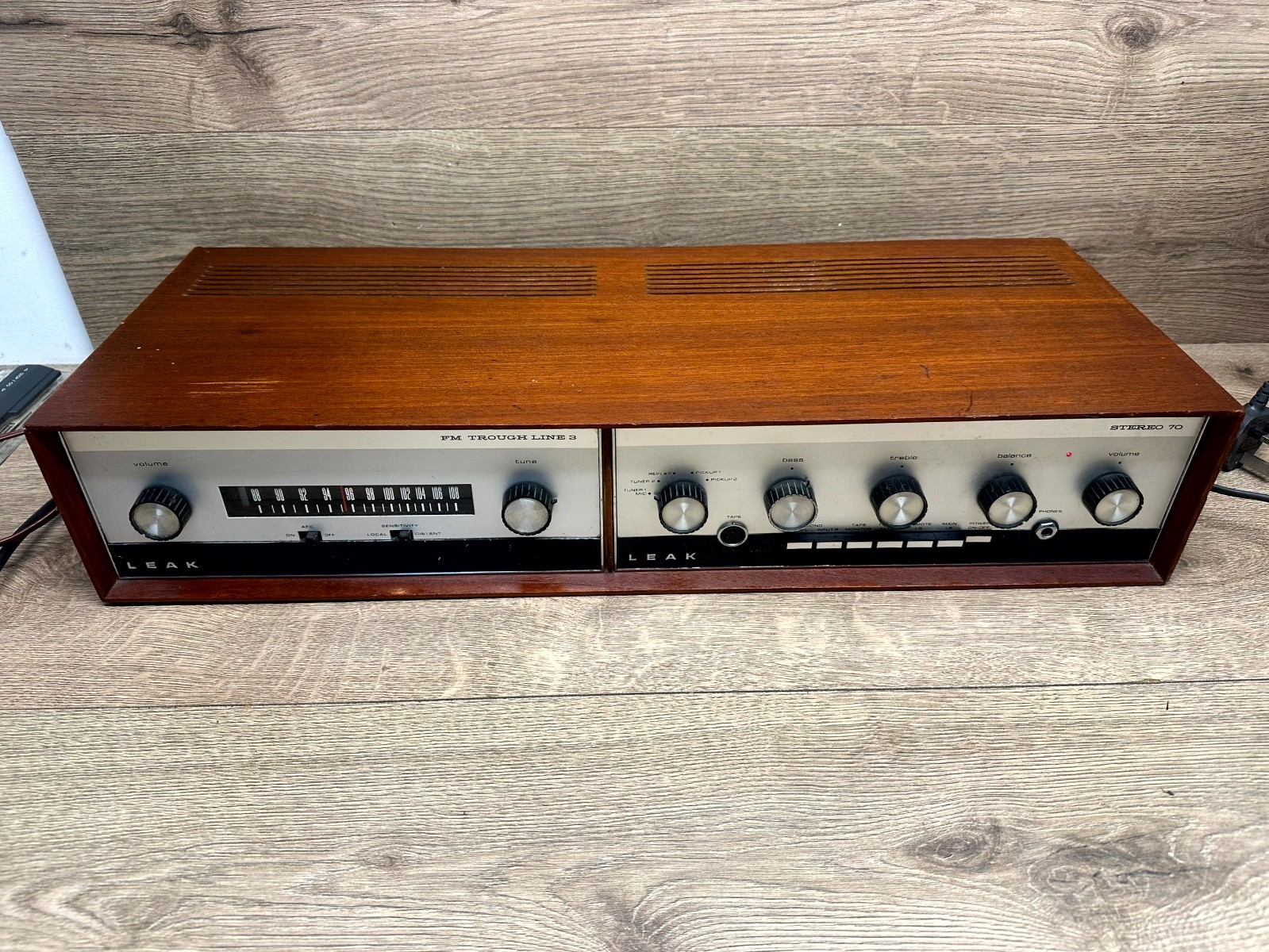
As an eBay Partner, we earn from qualifying purchases. This helps support our independent vintage technology research.
Related Models
- Leak TL/10 (1959)
- Leak 2060 (1958)
- Leak POINT-ONE-PLUS (1972)
- Leak POINT-ONE-STEREO (1957)
- Leak RC/PA (1952)
- Luxman L-530 (1975)
- Luxman R-404 (1975)
- Luxman RV-371 (1975)
- Luxman SQ-38U (1975)
- Luxman T-14 (1972)