Leak TL/25-PLUS: The Quiet Innovator in British Hi-Fi History
In the pantheon of vintage British audio equipment, few names carry the weight and reverence of Leak. Known primarily for their legendary amplifiers like the Leak TL/12 and Stereo 60, the company also ventured into more specialized territory with devices like the TL/25-PLUS—a passive line amplifier that, while less celebrated than its powered siblings, played a crucial role in high-fidelity signal management during the 1960s and 1970s. Designed not to amplify in the traditional sense, but to preserve signal integrity and optimize level matching between components, the TL/25-PLUS stands as a subtle yet significant artifact of Leak’s engineering philosophy: precision, transparency, and musicality above all.
Historical Context: Leak in the Golden Age of Hi-Fi
Founded in the 1930s, Leak became a cornerstone of British audio innovation, particularly during the post-war boom in home hi-fi systems. By the 1960s, as stereo recording gained popularity and home audio systems became more complex, the need for precise signal control grew. Turntables, tape decks, and early FM tuners often had mismatched output levels, and early preamplifiers lacked the refinement of modern designs. This is where the TL/25-PLUS entered the scene—not as a flashy amplifier, but as a passive control unit designed to bridge gaps in system synergy.
The TL/25-PLUS was an evolution of the earlier TL/25, with the "PLUS" denoting minor refinements in component quality and construction. Unlike active preamplifiers of the era, which used vacuum tubes and introduced gain (and sometimes coloration), the TL/25-PLUS employed a fully passive design, relying on high-quality potentiometers and precision resistive networks to manage volume and balance without active circuitry. This made it a favorite among purists who valued signal purity and minimal intervention.
Technical Specifications
| Specification | Detail |
| Manufacturer | Leak (The Sound Corporation Ltd.) |
| Model | TL/25-PLUS |
| Year Introduced | 1965 |
| Type | Passive Line Amplifier / Attenuator |
| Inputs | 3 x Unbalanced (RCA) |
| Outputs | 1 x Unbalanced (RCA) |
| Volume Control | Dual-gang logarithmic potentiometer |
| Balance Control | Center-tapped potentiometer |
| Impedance | High input impedance (~100kΩ) |
| Frequency Response | 20Hz – 20kHz (±0.5dB) |
| Signal-to-Noise Ratio | Effectively infinite (passive design) |
| Power Requirement | None (passive operation) |
| Dimensions (approx.) | 340mm (W) × 100mm (D) × 120mm (H) |
| Weight | 2.8 kg |
| Finish | Brushed aluminum front panel, black case |
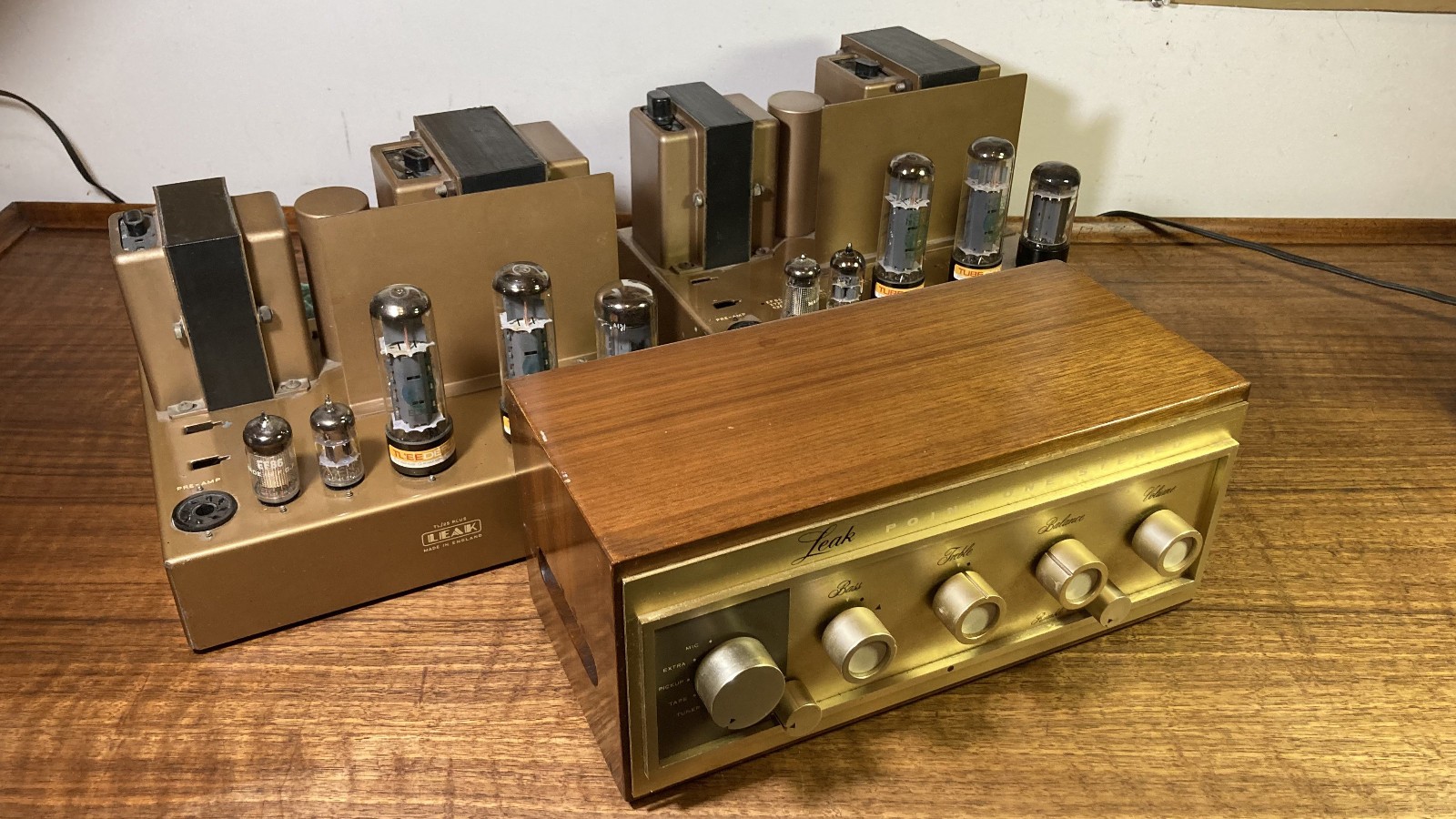
The TL/25-PLUS was housed in Leak’s signature minimalist chassis—sturdy, understated, and built to last. Its front panel featured a large central volume knob, a smaller balance control, and a row of input selectors. The use of high-quality RCA jacks and wirewound resistors ensured minimal signal degradation, a hallmark of Leak’s attention to detail.
Sound Characteristics and Performance
The sonic signature of the TL/25-PLUS is best described as transparent and neutral. Because it contains no active components, it adds no coloration, hum, or distortion to the signal path. This makes it an ideal choice for systems where the source components (such as a high-quality tuner or tape deck) already have sufficient output to drive a power amplifier directly.
Users often describe the sound as "effortless"—a testament to the unit’s ability to preserve dynamics and detail. In systems paired with Leak’s own Stereo 30 or Stereo 60 amplifiers, the TL/25-PLUS provided seamless integration, maintaining the warm, natural tonality that British hi-fi was known for. Its passive nature also meant exceptional channel separation and low crosstalk, critical for accurate stereo imaging.
While it doesn’t offer tone controls or remote operation (luxuries that wouldn’t appear for decades), the TL/25-PLUS excels in one area: doing nothing, but doing it perfectly. For audiophiles who believe that the best audio component is the one you don’t hear, this device is a quiet triumph.
Notable Features and Innovations
- Passive Design: No power supply or active circuitry eliminates noise and distortion.
- Precision Attenuation: Uses high-tolerance resistors and a dual-gang pot for accurate, smooth volume control.
- Balanced Signal Handling: Though not a true balanced (XLR) device, its symmetrical resistive network ensures excellent left/right tracking.
- Input Selector Switching: Robust rotary switch allows clean switching between three line-level sources.
- Build Quality: All-metal chassis, high-quality knobs, and durable connectors reflect Leak’s commitment to longevity.
The TL/25-PLUS was often used in conjunction with Leak’s TL/12 or TL/13 preamplifiers in high-end systems, serving as a secondary level control or for fine-tuning balance in critical listening environments. Some broadcasters and recording studios even adopted it for its reliability and transparency.
Common Issues and Maintenance
As with any vintage equipment, the TL/25-PLUS can suffer from age-related wear, though its simplicity works in its favor.
- Potentiometer Noise: The most common issue is crackling or scratching in the volume or balance controls. This is typically due to oxidation or dirt in the potentiometers. Cleaning with a high-quality contact cleaner (e.g., DeoxIT) can often restore smooth operation.
- Loose Input Jacks: RCA sockets may become loose over time. Tightening or resoldering connections usually resolves this.
- Fading Markings: The front panel labels may fade, but original units often retain legible silk-screening.
- Internal Wiring: While minimal, old insulation can become brittle. Inspection and, if necessary, retermination with modern silver-plated cable can improve performance.
Because the unit is passive, there are no tubes, capacitors, or power supplies to fail—making it one of the most reliable vintage audio components still in use today.
Current Market Value and Collectibility
The TL/25-PLUS is not as widely collected as Leak’s amplifiers, but it holds a cult following among hi-fi purists and vintage audio restorers. In good working condition, with clean controls and original finish, units typically sell for £150–£300 on the UK vintage market, with higher prices for fully restored examples or those sold as part of a matched Leak system.
Its value lies not in rarity, but in functionality and sonic integrity. Unlike many vintage preamps that require extensive refurbishment, a well-maintained TL/25-PLUS can be plugged into a modern system and still perform admirably. This "timeless utility" makes it a favorite among those who appreciate vintage gear not as museum pieces, but as living components.
Conclusion: A Legacy of Simplicity
The Leak TL/25-PLUS may not have the wattage to impress or the glowing tubes to mesmerize, but it embodies a philosophy that remains relevant: less is more. In an era increasingly obsessed with feature-laden preamps and digital processing, the TL/25-PLUS stands as a reminder that sometimes, the best way to enjoy music is to get out of its way.
It’s a testament to Leak’s engineering ethos—precision, honesty, and a deep respect for the source. For collectors, restorers, and audiophiles who value transparency and build quality, the TL/25-PLUS is more than just a relic. It’s a quiet masterpiece of passive design, and a worthy heir to the Leak legacy.
eBay Listings


As an eBay Partner, we earn from qualifying purchases. This helps support our independent vintage technology research.
Related Models
- Leak TL/10 (1959)
- Leak 2060 (1958)
- Leak POINT-ONE-PLUS (1972)
- Leak POINT-ONE-STEREO (1957)
- Leak RC/PA (1952)
- Luxman L-530 (1975)
- Luxman R-404 (1975)
- Luxman RV-371 (1975)
- Luxman SQ-38U (1975)
- Luxman T-14 (1972)