Leak STEREO-70: The British Pioneer of High-Fidelity Stereo Amplification
In the late 1950s, as stereo recording began to emerge from experimental novelty to serious audio pursuit, British manufacturer Leak stood at the forefront of high-fidelity innovation. Among their most celebrated contributions to the golden age of valve (tube) amplification was the Leak STEREO-70, a dual-mono stereo amplifier that helped define what high-end audio could be in the post-war era. Though not as widely documented as some of its contemporaries, the STEREO-70 holds a revered place among vintage audio enthusiasts for its engineering integrity, musicality, and role in shaping the future of stereo reproduction.
Introduced in 1957, the STEREO-70 arrived at a pivotal moment—when mono was still dominant, but stereo records and broadcast experiments were gaining traction. Leak, a division of The Williamson Organisation, had already earned acclaim with the Leak TL/12 and Point One preamplifiers, and the Type 15 and Stereo 60 amplifiers. The STEREO-70 represented a natural evolution: a high-performance, dual-channel valve amplifier designed specifically for the new stereo era.
Technical Specifications
The STEREO-70 was engineered with a dual-mono configuration, meaning each channel operated independently within the same chassis, minimizing crosstalk and inter-channel interference—a sophisticated approach for its time. It employed a push-pull output stage using KT66 beam tetrodes, valves celebrated for their rich harmonic character and dynamic headroom, also famously used in classic amplifiers like the Mullard 5-10 and early Fender guitar amps.
Here are the key technical specifications of the Leak STEREO-70:
| Specification | Detail |
| Manufacturer | Leak (The Williamson Organisation) |
| Model | STEREO-70 |
| Year Introduced | 1957 |
| Type | Valve (tube) stereo amplifier |
| Configuration | Dual-mono push-pull |
| Output Power | 25 watts per channel (RMS) |
| Output Impedance | 8Ω (matching taps available) |
| Frequency Response | 10Hz – 60kHz (±0.5dB) |
| Total Harmonic Distortion | <0.1% at 1W, <1% at full power |
| Input Sensitivity | 150mV for full output |
| Input Impedance | 100kΩ |
| Valves (Tubes) | 4 × KT66 (output), 4 × ECC83 (12AX7), 2 × ECC82 (12AU7) |
| Dimensions (approx.) | 480mm (W) × 280mm (H) × 300mm (D) |
| Weight | ~22 kg (48.5 lbs) |
| Finish | Brushed aluminum front panel, black or walnut cabinet |
The amplifier featured two line-level inputs, allowing connection to a preamplifier or tuner, and was typically paired with Leak’s own Point One or Stereo 60 preamps for a complete system. Its circuit design emphasized low feedback and high linearity, adhering to the British tradition of prioritizing musical coherence over raw power.
Sound Characteristics and Performance
The Leak STEREO-70 is often described in hushed, reverent tones by those who have experienced it. Its sound signature is warm, rich, and deeply textured, with a midrange that conveys exceptional vocal and instrumental realism. The use of KT66 output valves contributes to a dynamic, open presentation with strong bass control—remarkable for a 25W design.
Listeners frequently praise the amplifier’s spacious soundstage and precise imaging, qualities that belie its vintage origins. Despite being over six decades old, the STEREO-70 can deliver a three-dimensional listening experience that rivals many modern amplifiers. Its extended high-frequency response ensures clarity without harshness, while the low end remains tight and articulate.
One of the STEREO-70’s most admired traits is its ability to "disappear" in the system—drawing attention not to itself, but to the music. This transparency, combined with a natural tonal balance, makes it especially well-suited to acoustic, jazz, and classical recordings, where timbral accuracy and spatial cues are paramount.
Notable Features and Innovations
The STEREO-70 was more than just a stereo version of earlier Leak designs—it represented a thoughtful integration of several advanced features:
- Dual-Mono Architecture: By isolating the left and right channels, including separate power supplies and output transformers, Leak minimized interaction between channels, enhancing stereo separation and reducing distortion.
- High-Quality Output Transformers: Leak used custom-wound, high-bandwidth transformers, critical to the amplifier’s wide frequency response and low phase shift.
- Low Global Feedback Design: In contrast to the high-feedback American amplifiers of the era, the STEREO-70 used minimal negative feedback, preserving harmonic integrity and transient response.
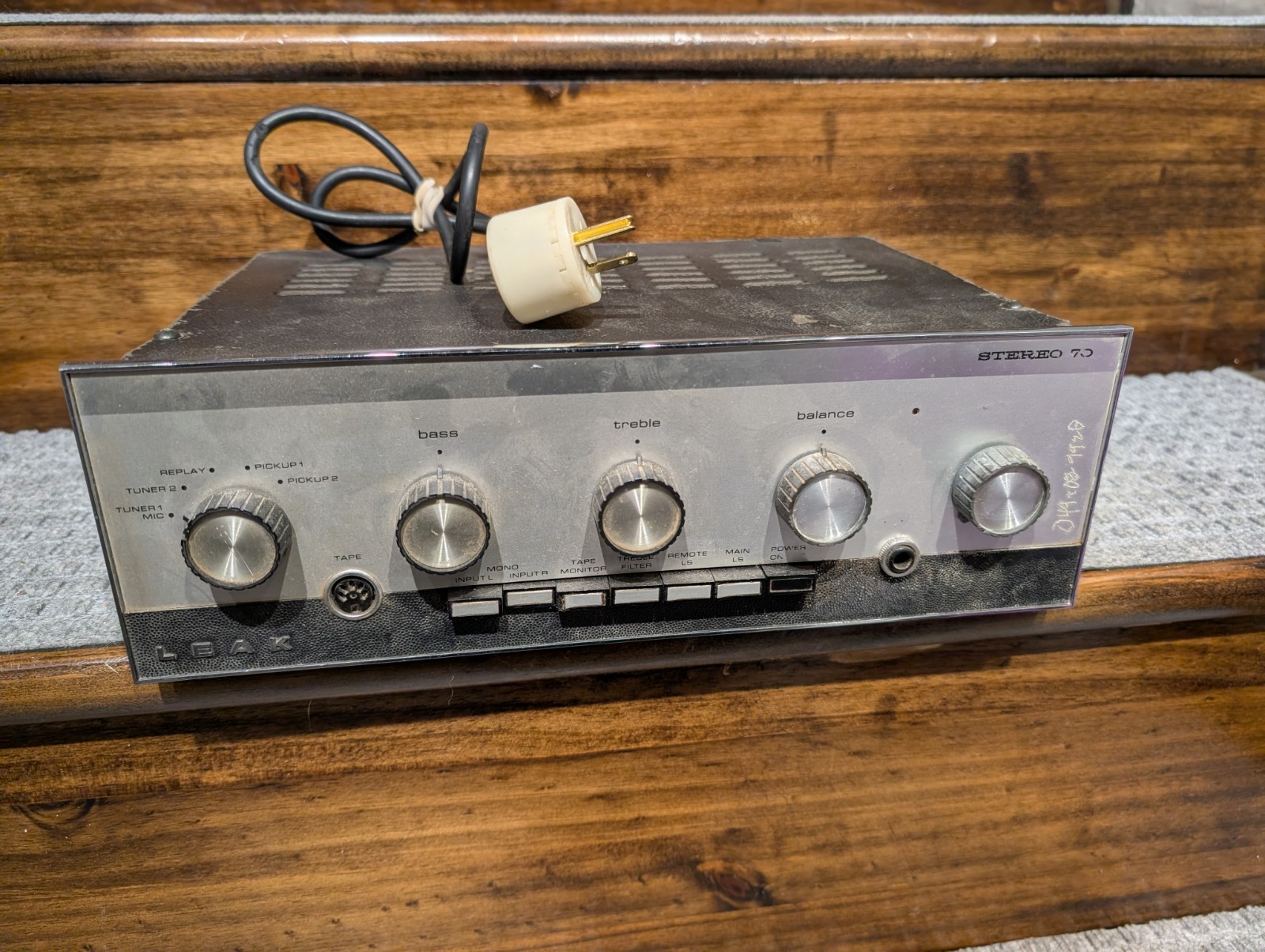
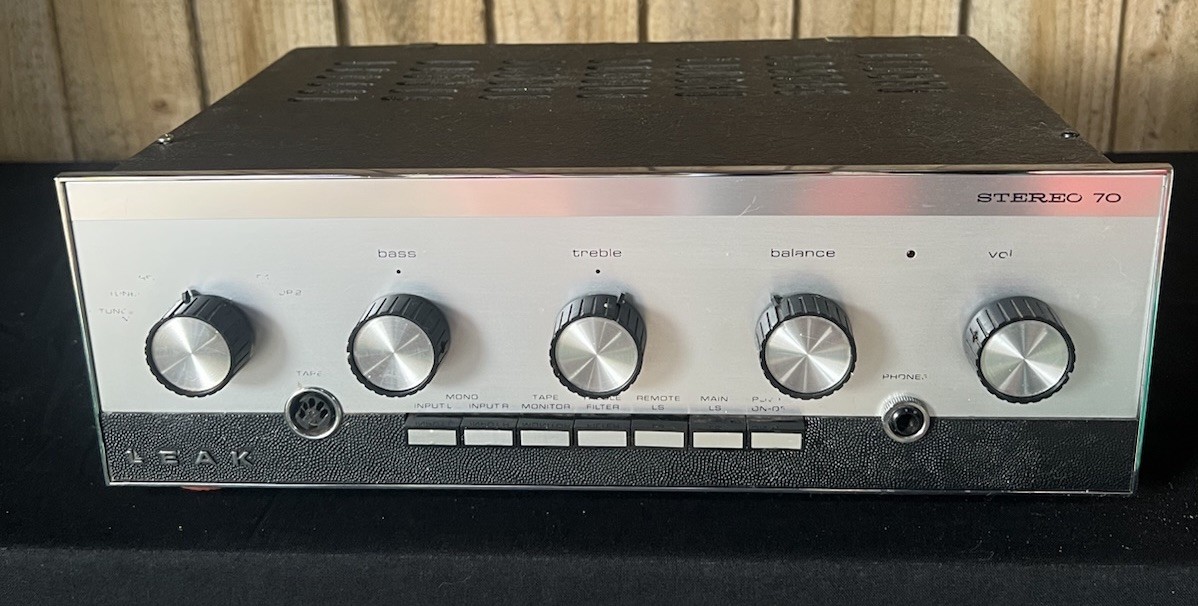
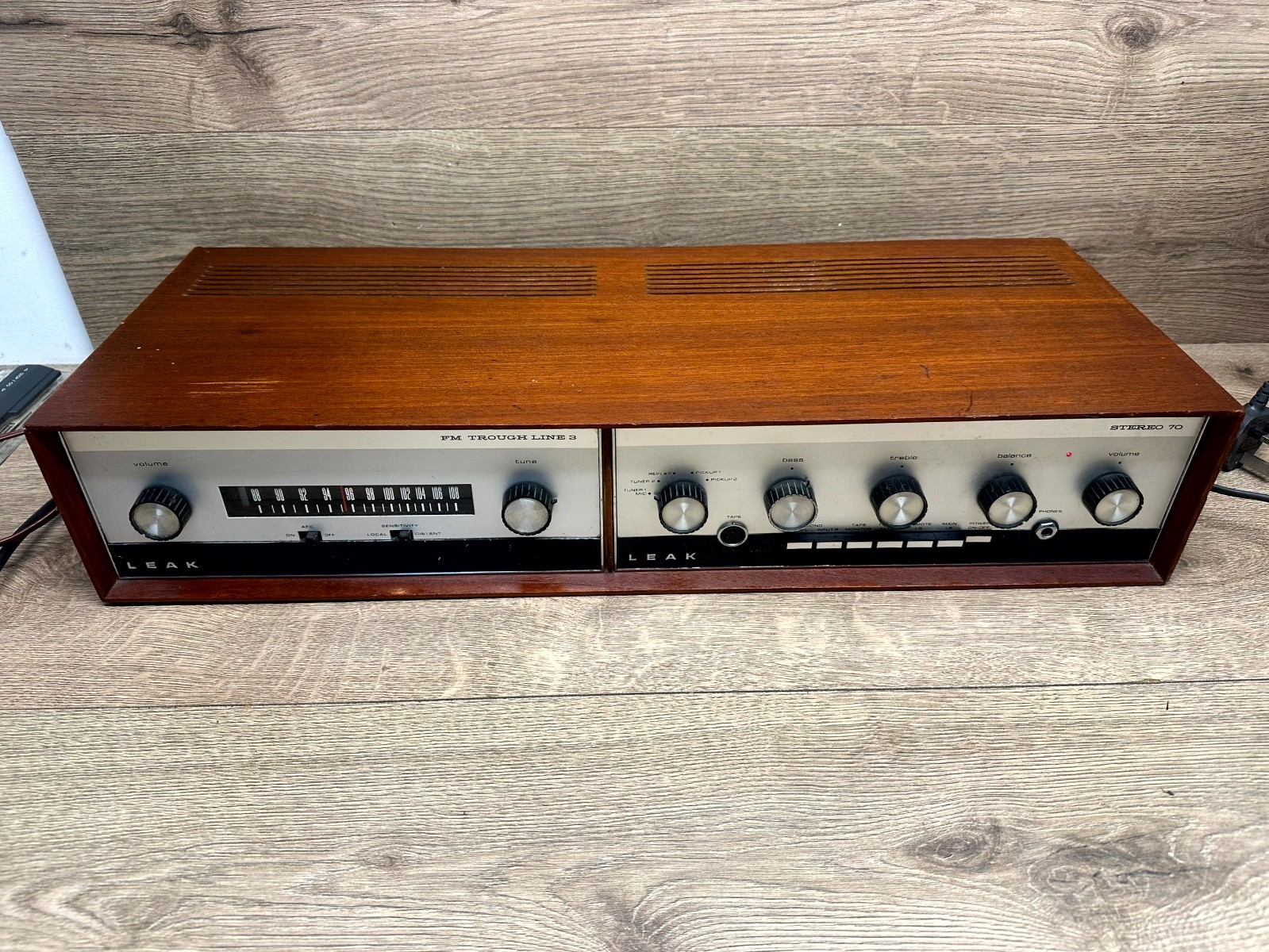
- Elegant Aesthetic: Housed in a hand-crafted walnut or black cabinet with a brushed aluminum front panel, the STEREO-70 was as much a piece of furniture as it was audio equipment—reflecting the British mid-century design ethos.
These features positioned the STEREO-70 as a serious competitor to other high-end amplifiers of the time, including those from Mullard, Quad, and even early offerings from America’s Fisher and Scott.
Common Issues and Maintenance
As with any valve amplifier of this vintage, the Leak STEREO-70 requires careful attention to ensure reliable and safe operation. Common issues include:
- Aging Capacitors: Electrolytic and paper capacitors degrade over time and should be replaced during restoration. This is critical for both performance and safety.
- Valve Wear: KT66s and small-signal tubes (ECC83, ECC82) may need replacement. NOS (New Old Stock) or high-quality modern equivalents are recommended.
- Output Transformer Health: While Leak transformers are generally robust, they can suffer from insulation breakdown or core saturation if the amplifier was previously misused.
- Bias Stability: The amplifier should be checked for proper bias on the output valves, especially after capacitor replacement.
- Dust and Corrosion: Decades of use can lead to dust buildup and oxidation on tube sockets and switches, requiring careful cleaning.
Owners are strongly advised to have the STEREO-70 serviced by a qualified technician familiar with vintage valve gear before regular use. A proper restoration can extend the life of the amplifier for decades more.
Current Market Value and Collectibility
The Leak STEREO-70 is a rare and sought-after amplifier today. Complete, working units in good cosmetic condition can command $3,000 to $6,000 USD, depending on provenance, originality, and restoration quality. Fully restored examples with documentation and original packaging may fetch even higher prices at auction or among private collectors.
Its collectibility stems not only from its performance but also from its historical significance. As one of the earliest dedicated stereo amplifiers from a major British hi-fi brand, the STEREO-70 represents a milestone in audio engineering. It appeals to collectors of vintage British audio, tube enthusiasts, and those building period-correct high-fidelity systems.
Conclusion and Legacy
The Leak STEREO-70 stands as a testament to British engineering excellence during the dawn of the stereo era. More than just a powerful amplifier, it was a statement of intent—a belief that high-fidelity audio should be both technically precise and emotionally engaging.
Though overshadowed in popular memory by later models like the Leak TL/25 or Stereo 30, the STEREO-70 was a pioneering force that helped establish Leak as a leader in high-end audio. Its combination of elegant design, dual-mono architecture, and lush, musical sound continues to captivate audiophiles today.
For those fortunate enough to own or hear a STEREO-70, it offers more than amplification—it offers a connection to the origins of stereo sound, and a reminder that great audio engineering transcends time. In the world of vintage audio, the Leak STEREO-70 isn’t just a relic—it’s a living legend.
eBay Listings

As an eBay Partner, we earn from qualifying purchases. This helps support our independent vintage technology research.
Related Models
- Leak TL/10 (1959)
- Leak 2060 (1958)
- Leak POINT-ONE-PLUS (1972)
- Leak POINT-ONE-STEREO (1957)
- Leak RC/PA (1952)
- Luxman L-530 (1975)
- Luxman R-404 (1975)
- Luxman RV-371 (1975)
- Luxman SQ-38U (1975)
- Luxman T-14 (1972)