Leak STEREO-30-PLUS: The Quiet Masterpiece of British Hi-Fi
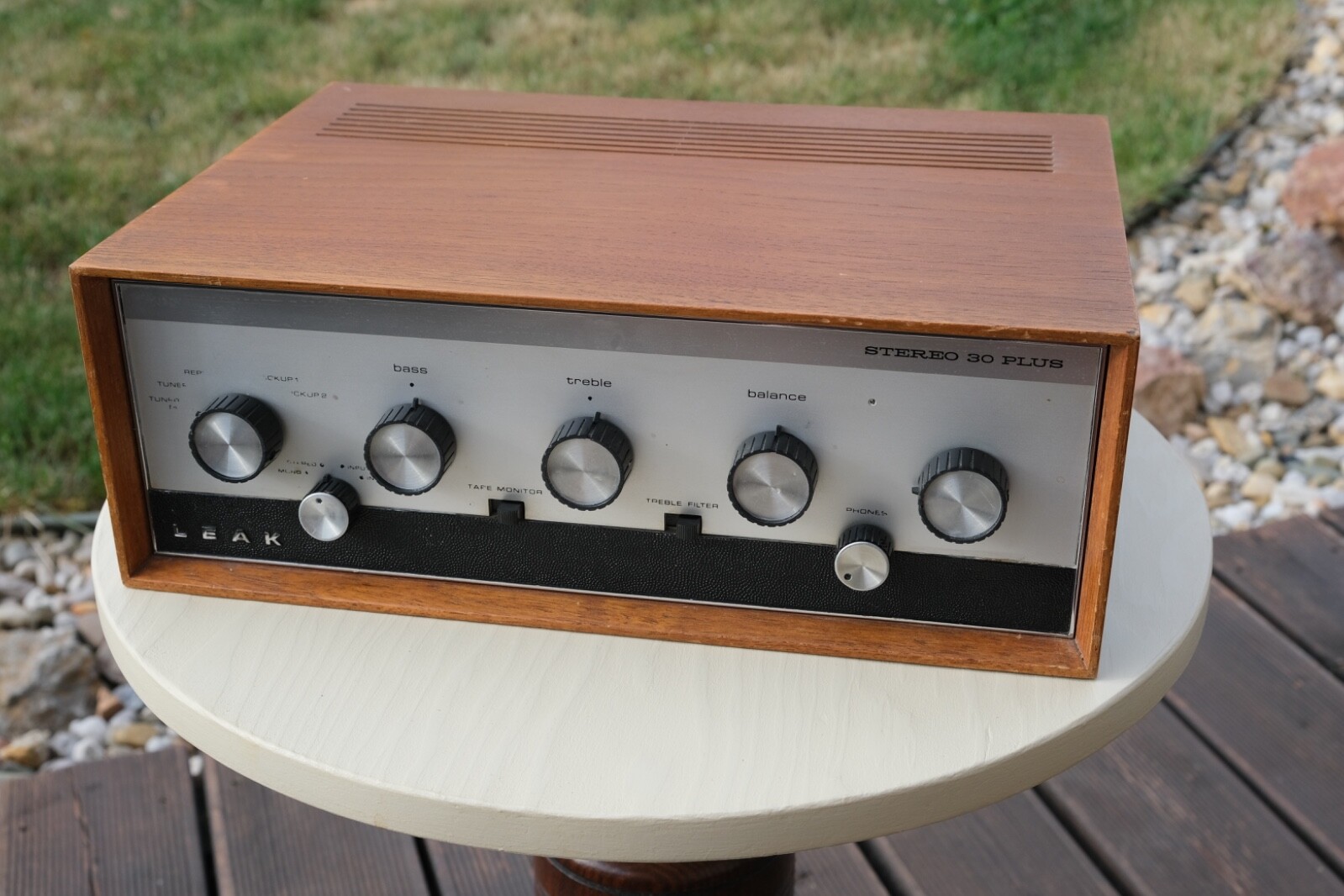
In the golden era of British high-fidelity audio, few names carried the prestige and sonic integrity of Leak. Known for their meticulous engineering and understated design, Leak amplifiers from the 1960s and 70s remain highly sought after by vintage audio enthusiasts. Among their more elusive offerings is the STEREO-30-PLUS, a stereo power amplifier introduced in the early 1970s as a successor to Leak’s earlier monobloc and dual-channel designs. Though not as widely documented as the legendary Leak TL/12 or Stereo 60, the STEREO-30-PLUS holds a special place in the hearts of collectors and purists who appreciate its refined performance, elegant build, and rare presence in the vintage market.
Historical Context: Leak in the 1970s
By the early 1970s, Leak—originally part of the Tannoy group and later absorbed into International Radio Corporation (IRC)—was navigating a shifting audio landscape. Transistor amplifiers were gaining ground, but Leak remained committed to valve (tube) technology for its superior sonic character. The STEREO-30-PLUS emerged during this transitional period, embodying the company’s dedication to high-quality valve design while embracing subtle modernizations in circuit layout and power delivery.
Unlike the iconic Stereo 60 (6W per channel), the STEREO-30-PLUS offered significantly more power—30 watts per channel—making it better suited for larger rooms and less sensitive speakers. It was designed for audiophiles who demanded both authority and finesse, positioning itself as a premium, no-compromise amplifier for discerning listeners.
Despite its capabilities, the STEREO-30-PLUS was produced in limited numbers and never achieved the same level of fame as its siblings. This scarcity, combined with its excellent build quality and musical performance, has elevated its status among vintage audio connoisseurs.
Technical Specifications
The STEREO-30-PLUS is a dual-monaural valve power amplifier, meaning it houses two independent amplifier channels within a single chassis, minimizing crosstalk and maximizing channel separation. It was designed to be driven by a high-quality preamplifier, making it a true "power amp plus" in the classic British tradition.
| Specification | Detail |
| Manufacturer | Leak (IRC) |
| Model | STEREO-30-PLUS |
| Year Introduced | 1972 |
| Type | Dual-monaural valve power amplifier |
| Power Output | 30 watts per channel (RMS, 8Ω) |
| Frequency Response | 10Hz – 60kHz (±1dB) |
| Total Harmonic Distortion | <0.5% (at full power, 1kHz) |
| Input Impedance | 100kΩ |
| Input Sensitivity | 1.2V for full output |
| Output Impedance | 8Ω (also compatible with 4Ω loads) |
| Damping Factor | ~6 (at 8Ω, 1kHz) |
| Valve Complement | 4 x EL34 (power), 4 x ECC83 (pre/driver) |
| Dimensions (W×H×D) | 450 × 170 × 340 mm |
| Weight | Approx. 22 kg (48.5 lbs) |
| Finish | Brushed aluminum front panel, black or walnut side cheeks |
The amplifier uses a classic push-pull configuration with EL34 output tubes, renowned for their rich harmonic texture and dynamic punch. The ECC83 (12AX7 equivalent) tubes handle voltage amplification and phase splitting, ensuring low-noise operation and excellent linearity. The output transformers are custom-wound to Leak’s exacting standards, contributing significantly to the amplifier’s smooth, extended frequency response.
Sound Characteristics and Performance
The Leak STEREO-30-PLUS is often described as having a "liquid" midrange, crisp but never harsh highs, and a tight, controlled bass—a rare combination in valve amplifiers of its era. Its 30-watt output allows it to drive a wide range of speakers, including classic British monitors like Tannoy, KEF, and Wharfedale, with authority and grace.
What sets the STEREO-30-PLUS apart is its exceptional tonal balance. Unlike some valve amps that lean toward warmth at the expense of clarity, this amplifier maintains a neutral foundation while adding just enough harmonic richness to make music feel alive. String instruments have body, vocals are present and intimate, and percussion retains its attack without becoming edgy.
The wide frequency response and low distortion also mean it handles complex orchestral passages and dynamic rock recordings with ease. Its dual-monaural design ensures excellent stereo imaging, with a wide, stable soundstage that places instruments precisely in space.
Notable Features and Innovations
While the STEREO-30-PLUS adheres to classic valve amplifier principles, it includes several thoughtful design elements that reflect Leak’s engineering excellence:
- Dual-Monaural Architecture: Independent power supplies and signal paths for each channel reduce interference and crosstalk.
- High-Quality Output Transformers: Custom-wound transformers ensure optimal power transfer and bandwidth.
- Robust Chassis Construction: Heavy-duty steel chassis with vibration-damping feet minimizes microphonics and external interference.
- Tube Monitoring and Bias Adjustment: Front-panel test points and bias adjustment allow for precise tube matching and long-term performance tuning.
- Classic Leak Aesthetics: The minimalist front panel, brushed aluminum finish, and optional walnut side panels reflect the understated elegance Leak was known for.
The amplifier was often paired with Leak’s VARISPEED or STEREO-30 PRE preamplifiers, forming a complete high-end valve system that competed with the best from Quad, Linn, and Naim in later years.
Common Issues and Maintenance
As with any vintage valve amplifier, the STEREO-30-PLUS requires careful maintenance to perform at its best:
- Tube Wear: EL34 and ECC83 tubes degrade over time. Replacing them with high-quality NOS (New Old Stock) or modern equivalents like Mullard reissues can restore performance.
- Capacitor Aging: Electrolytic capacitors in the power supply and coupling circuits should be checked or replaced after decades of use to prevent hum, distortion, or failure.
- Bias Stability: The amplifier requires periodic bias adjustment to ensure balanced operation across both channels.
- Transformer Health: While Leak’s transformers are generally robust, checking for winding resistance and insulation breakdown is recommended for units that have been dormant.
Owners are advised to have the amplifier serviced by a qualified technician familiar with vintage valve gear before extended use.
Current Market Value and Collectibility
The Leak STEREO-30-PLUS is rare and highly collectible, though it doesn’t command the same prices as the Stereo 60 or TL/12. In working condition, a fully serviced unit typically sells for £1,200–£2,000 (or $1,500–$2,500 USD), depending on cosmetics, tube condition, and provenance.
Its value is driven by:
- Low production numbers
- Superior build quality
- Excellent sonic performance
- Growing interest in British valve amplifiers
Units with original tubes, documentation, or matching-number chassis can fetch premiums. Given its rarity, finding a genuine STEREO-30-PLUS requires patience and vigilance—beware of mislabeled or restored units.
Conclusion: A Hidden Gem of British Hi-Fi
The Leak STEREO-30-PLUS may not be the most famous amplifier from Leak’s storied lineup, but it is undoubtedly one of the most refined. It represents the pinnacle of British valve engineering in the early 1970s—powerful yet musical, elegant yet understated.
For the collector or audiophile seeking a high-performance vintage amplifier with rarity and character, the STEREO-30-PLUS is a compelling choice. It delivers the warmth and richness of tubes without sacrificing clarity or control, making it equally at home with jazz, classical, or rock.
In a world where vintage audio often celebrates the well-known, the STEREO-30-PLUS stands as a quiet masterpiece—understated, exceptional, and deeply rewarding for those who discover it.
eBay Listings


As an eBay Partner, we earn from qualifying purchases. This helps support our independent vintage technology research.
Related Models
- Leak TL/10 (1959)
- Leak 2060 (1958)
- Leak POINT-ONE-PLUS (1972)
- Leak POINT-ONE-STEREO (1957)
- Leak RC/PA (1952)
- Luxman L-530 (1975)
- Luxman R-404 (1975)
- Luxman RV-371 (1975)
- Luxman SQ-38U (1975)
- Luxman T-14 (1972)