Leak STEREO-30: The Quintessential British Stereo Amplifier of the 1960s
In the golden age of valve (tube) audio, few names carried the prestige and sonic reputation of Leak, a British company synonymous with high-fidelity engineering and understated elegance. Among their most celebrated offerings was the Leak STEREO-30, introduced in 1963 as one of the UK’s earliest dedicated stereo amplifiers designed for the burgeoning hi-fi market. At a time when many listeners were still transitioning from mono to stereo, the STEREO-30 stood out as a forward-thinking, refined solution that combined British craftsmanship with warm, musical performance.
Though not as widely documented as some of its contemporaries, the STEREO-30 holds a special place in the hearts of vintage audio enthusiasts for its role in shaping the British hi-fi aesthetic—prioritizing tonal balance, clarity, and musicality over raw power.
Historical Context
The early 1960s marked a turning point in home audio. Stereo records were becoming mainstream, and manufacturers scrambled to offer equipment that could do justice to this new dimension in sound. Leak, already respected for their TTL (Transformer Transient Linearity) series of mono amplifiers and tuners, responded with the STEREO-30—a dual-channel valve amplifier that brought Leak’s renowned engineering into the stereo era.
Built at the Suffolk factory in England, the STEREO-30 was part of a broader suite of Leak components, often paired with the Leak DELTA 30 tuner or VARISPEED turntables. Its release coincided with a growing middle-class appetite for high-quality home entertainment, and it quickly became a favorite among discerning listeners who valued accuracy and refinement.
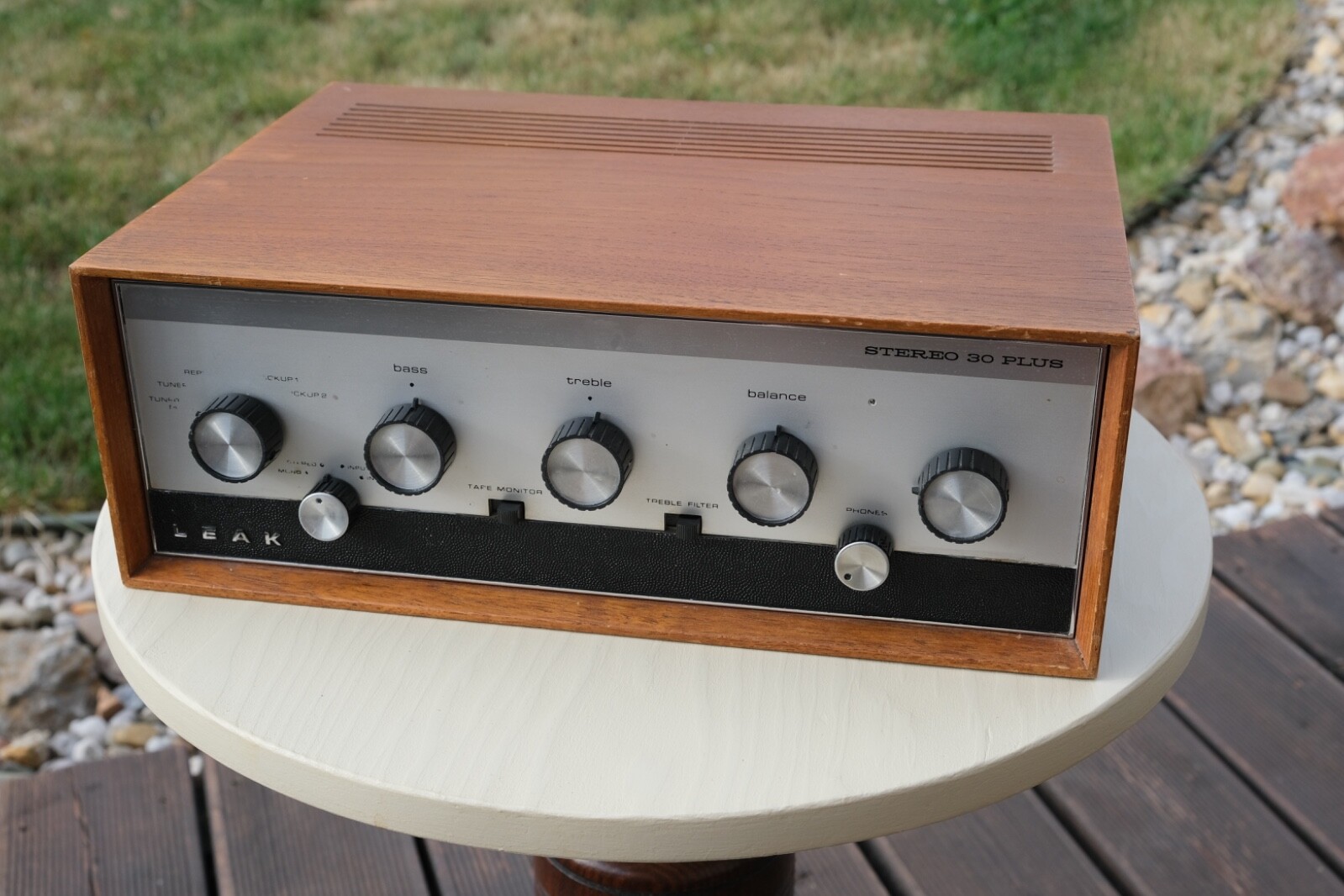
Unlike the flashy, chrome-laden designs emerging from the US and Japan, the STEREO-30 embodied British restraint: a simple walnut-veneered cabinet, minimal front-panel controls, and a focus on internal quality over cosmetic flair. It was an amplifier built for those who listened, not just looked.
Technical Specifications
The STEREO-30 was a fully balanced, dual-mono valve amplifier, utilizing a push-pull output stage to deliver clean, low-distortion power. It was designed to pair well with high-efficiency speakers of the era, such as Rogers, Celestion, or early KEF models.
| Specification | Detail |
| Model | Leak STEREO-30 |
| Year Introduced | 1963 |
| Type | Valve (Tube) Stereo Amplifier |
| Power Output | 15W per channel (RMS, 8Ω) |
| Frequency Response | 20Hz – 20kHz (±1dB) |
| Total Harmonic Distortion | <1% at full power |
| Input Sensitivity | 100mV (for full output) |
| Input Impedance | 1MΩ (high impedance for tube sources) |
| Output Impedance | 8Ω (matching taps available) |
| Valves (Tubes) | 4 x ECC83 (12AX7), 2 x EL84 per channel |
| Dimensions (W×H×D) | 410 × 170 × 280 mm |
| Weight | Approx. 12 kg (26.5 lbs) |
| Finish | Walnut veneer, black or silver faceplate |
The amplifier featured two line-level inputs (typically labeled “Tuner” and “Aux”), a volume control, balance control, and a simple toggle switch for input selection. Notably, it did not include a phono stage, meaning it was intended to be used with a separate preamplifier or a tuner with built-in RIAA equalization.
Sound Characteristics and Performance
The Leak STEREO-30 is revered for its warm, smooth, and harmonically rich sound—typical of well-designed EL84-based amplifiers. Its 15 watts per channel may seem modest by modern standards, but in efficient speaker pairings, it delivers a surprisingly dynamic and immersive experience.
Key sonic traits include:
- Natural midrange: Vocals and acoustic instruments are rendered with exceptional clarity and presence.
- Smooth treble: The highs are detailed without being harsh—ideal for extended listening.
- Tight, controlled bass: Despite limited power, the bass remains articulate and well-defined.
- Excellent stereo imaging: The STEREO-30 creates a wide, stable soundstage, a rarity in early stereo gear.
Its low feedback design and high-quality transformers contribute to a transparent, “unamplified” quality—listeners often describe the sound as “effortless” and “organic.”
Notable Features and Innovations
While the STEREO-30 may appear simple, it incorporated several advanced design principles for its time:
- Transformer Transient Linearity (TTL): Though more famously applied in later Leak models, the STEREO-30 benefited from early TTL research, resulting in improved transient response and reduced intermodulation distortion.
- High-quality output transformers: Custom-wound by Leak, these ensured wide frequency response and excellent channel separation.
- Dual-mono construction: Each channel was physically and electrically isolated, minimizing crosstalk and interference.
- Robust power supply: A well-filtered choke-input power supply contributed to low noise and stable operation.
The amplifier’s circuit layout emphasized signal purity, with point-to-point wiring and minimal component count—hallmarks of Leak’s “less is more” philosophy.
Common Issues and Maintenance
Like all vintage valve gear, the STEREO-30 requires careful attention to remain in optimal condition. Common issues include:
- Aging capacitors: The electrolytic and paper capacitors from the 1960s are likely dried out or failing. A full recapping is strongly recommended before use.
- Valve wear: EL84 and ECC83 tubes should be tested or replaced. NOS (New Old Stock) Mullard or Amperex tubes are ideal for authenticity and performance.
- Transformer health: While Leak transformers are generally robust, they should be checked for insulation breakdown or hum.
- Dust and oxidation: Clean potentiometers (volume/balance) with contact cleaner; internal dust should be removed carefully.
- Power supply stability: Ensure the amplifier is used with a stable mains voltage; a line conditioner is advisable.
Due to its age, it’s wise to have a qualified technician inspect the unit before powering it up—especially if it has been in storage for decades.
Current Market Value and Collectibility
The Leak STEREO-30 is a moderately collectible vintage amplifier. While not as rare or sought-after as the Leak TL/12 Plus or STEREO 60, it holds steady appeal among British hi-fi collectors and tube enthusiasts.
- Working condition: £400–£700 (UK), $500–$900 (US)
- Original, unmodified with documentation: Up to £1,000
- Non-working or heavily modified: £150–£300
Values are rising slowly as interest in vintage British audio grows. Original finish, matching serial numbers, and service records can significantly enhance value.
Its collectibility is bolstered by its historical significance as one of the first true British stereo amplifiers and its association with Leak’s golden era of engineering excellence.
Conclusion and Legacy
The Leak STEREO-30 may not have the raw power or modern features of later amplifiers, but it represents a pivotal moment in audio history—the dawn of stereo in the home, crafted with British precision and musical intent. It’s an amplifier that prioritizes musical engagement over technical bravado, delivering a listening experience that remains deeply satisfying over half a century later.
For the vintage audio enthusiast, the STEREO-30 offers more than just sound—it offers a connection to a time when hi-fi was about craftsmanship, subtlety, and the joy of listening. Restored with care, it can still hold its own in a modern system, especially when paired with efficient speakers and high-quality sources.
In an age of digital perfection, the Leak STEREO-30 reminds us that sometimes, the most accurate sound is the one that feels most alive.
eBay Listings


As an eBay Partner, we earn from qualifying purchases. This helps support our independent vintage technology research.
Related Models
- Leak TL/10 (1959)
- Leak 2060 (1958)
- Leak POINT-ONE-PLUS (1972)
- Leak POINT-ONE-STEREO (1957)
- Leak RC/PA (1952)
- Luxman L-530 (1975)
- Luxman R-404 (1975)
- Luxman RV-371 (1975)
- Luxman SQ-38U (1975)
- Luxman T-14 (1972)