Leak STEREO-20: The British Pioneer of Stereo Amplification
In the late 1950s, as stereo recording began to emerge from experimental novelty to mainstream promise, British audio manufacturer Leak stood at the forefront of high-fidelity innovation. Among their most significant contributions to the evolving world of stereo sound was the Leak STEREO-20, a dual-channel valve (tube) amplifier introduced in 1959 that represented both a technical milestone and a design triumph. Though not as widely documented as some of its contemporaries, the STEREO-20 holds a revered place in the history of British hi-fi, embodying the engineering philosophy and sonic elegance for which Leak became famous.
The STEREO-20 was not simply an amplifier—it was a statement. At a time when most home audio systems were still mono, Leak recognized the potential of stereo reproduction and engineered a dedicated dual-channel solution that offered high performance, reliability, and a refined aesthetic. Built by T. A. Leak & Company, a division of the Wharfedale group, the STEREO-20 followed in the footsteps of the legendary Leak TL/12 and Point One preamplifiers, bringing the same meticulous attention to detail and musical integrity to power amplification.
Technical Specifications
The STEREO-20 was a dual-mono valve amplifier, meaning each stereo channel was essentially a self-contained amplifier housed within a single chassis. This design minimized crosstalk and channel interaction, a significant advantage in early stereo systems where channel separation was often poor.
| Specification | Detail |
| Manufacturer | T. A. Leak & Company, UK |
| Model | STEREO-20 |
| Year Introduced | 1959 |
| Type | Dual-channel valve (tube) power amplifier |
| Power Output | 20 watts per channel (RMS) |
| Frequency Response | 10 Hz – 60 kHz (±1 dB) |
| Total Harmonic Distortion | <1% at full power |
| Input Sensitivity | 1.5V for full output |
| Input Impedance | 100 kΩ |
| Output Impedance | 15Ω, 30Ω, and 60Ω taps |
| Damping Factor | ~5 (typical for valve designs of era) |
| Tubes (Valves) | 4 × KT66 (2 per channel), 2 × ECC83 (12AX7), 2 × EZ81 rectifier |
| Dimensions (W×H×D) | 480 × 180 × 330 mm (approx. 19" × 7" × 13") |
| Weight | 22 kg (48.5 lbs) |
| Finish | Polished aluminum front panel, black or walnut side panels |
The amplifier used a push-pull Class AB configuration with KT66 beam tetrodes—the same high-quality output tubes favored in other British classics like the Mullard 5-10 and Quad II. The ECC83 (12AX7) valves served as voltage amplifiers and phase splitters, ensuring balanced drive to the output stage. The EZ81 rectifier provided smooth, reliable high-voltage DC supply, contributing to the amplifier’s stable operation.
Sound Characteristics and Performance
The Leak STEREO-20 is celebrated for its warm, natural, and highly musical sound—a hallmark of well-designed valve amplifiers from the golden age of British hi-fi. With 20 watts per channel, it was capable of driving the high-efficiency speakers of the era—such as Wharfedale W60s, Tannoy Dual Concentrics, or Goodmans Axminster models—with ease and authority.
Its frequency response was exceptionally wide for its time, extending deep into the bass and soaring into the treble, which gave recordings a sense of openness and realism that few competitors could match. The low distortion and excellent channel separation contributed to a spacious stereo image, with precise instrument placement and a three-dimensional soundstage.
Critics and listeners alike praised the STEREO-20 for its tonal balance—neither overly bright nor excessively soft. It rendered vocals with intimacy and string instruments with lifelike texture. While not as powerful as later solid-state amplifiers, its 20 watts were highly effective due to the amplifier’s dynamic headroom and synergy with efficient speakers.
Notable Features and Innovations
The STEREO-20 was more than just a pair of amplifiers in one box—it incorporated several thoughtful engineering features:
- Dual-Mono Architecture: Each channel had its own dedicated gain and output stages, reducing inter-channel interference and enhancing stereo imaging.
- Multiple Output Taps: The inclusion of 15Ω, 30Ω, and 60Ω output taps allowed users to match the amplifier optimally to a wide range of speaker impedances, maximizing power transfer and damping.
- High-Quality Components: Leak used precision resistors, paper-in-oil capacitors, and hand-wired point-to-point construction, ensuring long-term reliability and excellent signal integrity.
- Elegant Design: The polished aluminum front panel, minimal controls, and choice of walnut or black side panels gave the STEREO-20 a timeless, understated elegance that complemented any listening room.
Leak also emphasized serviceability and longevity. The chassis was designed for easy access, and the tube layout allowed for straightforward maintenance. This focus on build quality and user experience helped establish Leak’s reputation for engineering excellence.
Common Issues and Maintenance
As with any vintage valve amplifier, the STEREO-20 requires careful attention before being powered up after years of inactivity. Common issues include:
- Capacitor Degradation: Electrolytic and paper-in-oil capacitors often dry out or leak over time. A full recapping is strongly recommended before use.
- Tube Wear: KT66 and ECC83 tubes may still be functional but should be tested. NOS (New Old Stock) or high-quality modern equivalents (e.g., Genalex Gold Lion reissues) can restore original performance.
- Transformer Health: The output and power transformers are generally robust, but should be checked for shorts or excessive hum.
- Dust and Corrosion: Decades of storage can lead to dust buildup and contact corrosion. Cleaning controls and tube sockets is essential.
Owners are advised to have the amplifier evaluated by a qualified technician familiar with vintage British gear. Once serviced, the STEREO-20 is known for reliable operation and long tube life.
Current Market Value and Collectibility
The Leak STEREO-20 is a rare and sought-after amplifier among vintage audio collectors, particularly in the UK and Europe. Its historical significance as one of the first dedicated stereo valve amplifiers, combined with Leak’s stellar reputation, makes it a prized addition to any classic hi-fi collection.
Well-restored units in good working condition typically sell for £2,500 to £4,000 (approximately $3,200–$5,100 USD), depending on originality, finish, and provenance. Fully original, unmodified examples with matching documentation can command even higher prices at auction.
While not as common as the Leak TL/12 or the later Stereo 30, the STEREO-20 is increasingly recognized for its pioneering role and exceptional sound quality. Its value has steadily appreciated over the past decade, reflecting growing appreciation for early British valve engineering.
Conclusion and Legacy
The Leak STEREO-20 stands as a landmark in the evolution of stereo audio. At a time when stereo was still in its infancy, Leak had the vision to create a dedicated, high-performance amplifier that treated each channel with the respect it deserved. The result was an amplifier that delivered not just power, but musical truth—a quality that continues to resonate with audiophiles today.
Though overshadowed in popularity by later models, the STEREO-20 laid the groundwork for Leak’s subsequent successes and remains a testament to the company’s commitment to engineering excellence and sonic purity. For the discerning collector or vintage audio enthusiast, the STEREO-20 is more than a relic—it’s a living piece of hi-fi history, capable of delivering a listening experience that is as emotionally engaging today as it was over sixty years ago.
In the world of vintage amplifiers, few combine rarity, innovation, and musicality as gracefully as the Leak STEREO-20—a true pioneer of British stereo sound.
eBay Listings



As an eBay Partner, we earn from qualifying purchases. This helps support our independent vintage technology research.
Related Models
- Leak TL/10 (1959)
- Leak 2060 (1958)
- Leak POINT-ONE-PLUS (1972)
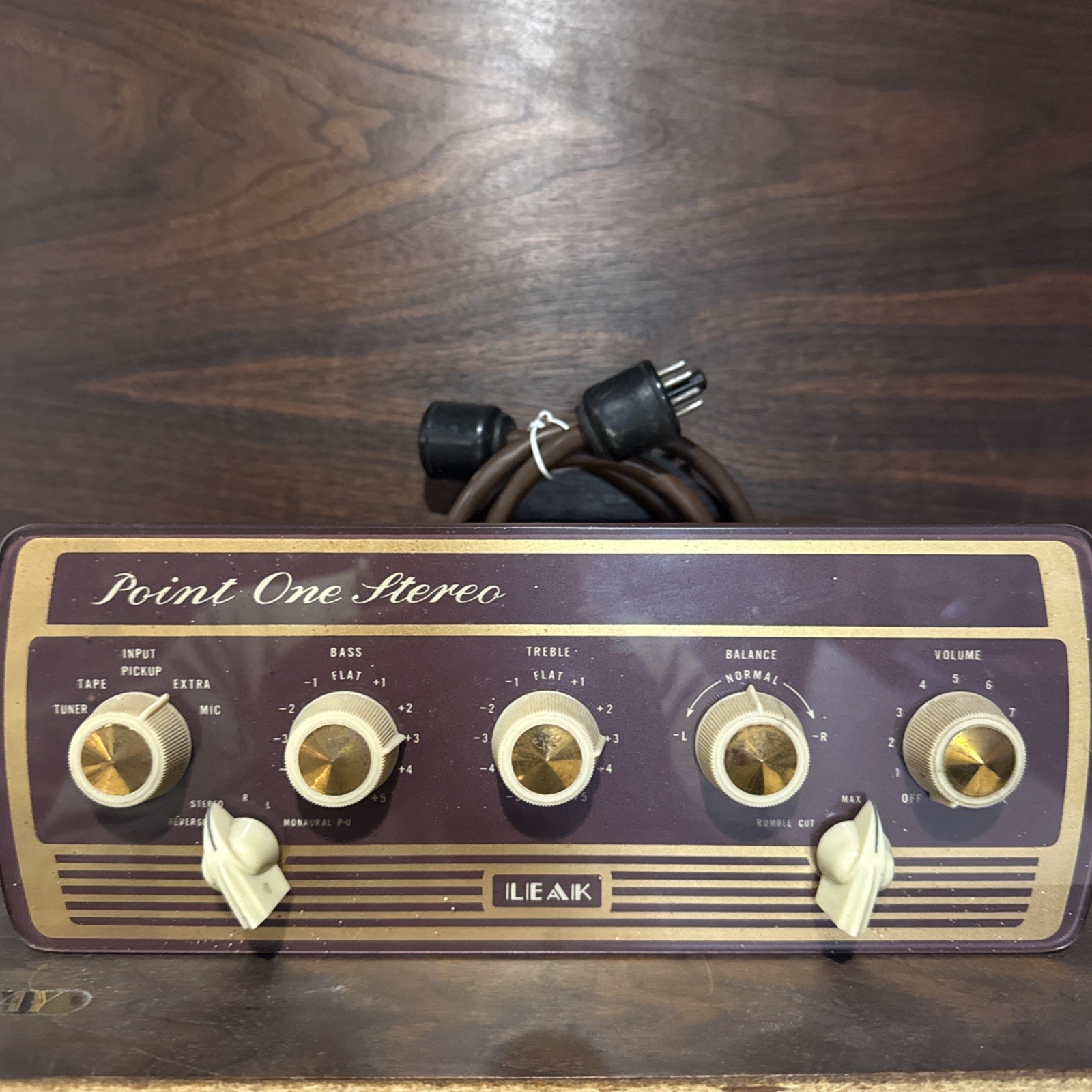
- Leak POINT-ONE-STEREO (1957)
- Leak RC/PA (1952)
- Luxman L-530 (1975)
- Luxman R-404 (1975)
- Luxman RV-371 (1975)
- Luxman SQ-38U (1975)
- Luxman T-14 (1972)