Leak POINT-ONE-STEREO: The British Standard in Passive Preamplification
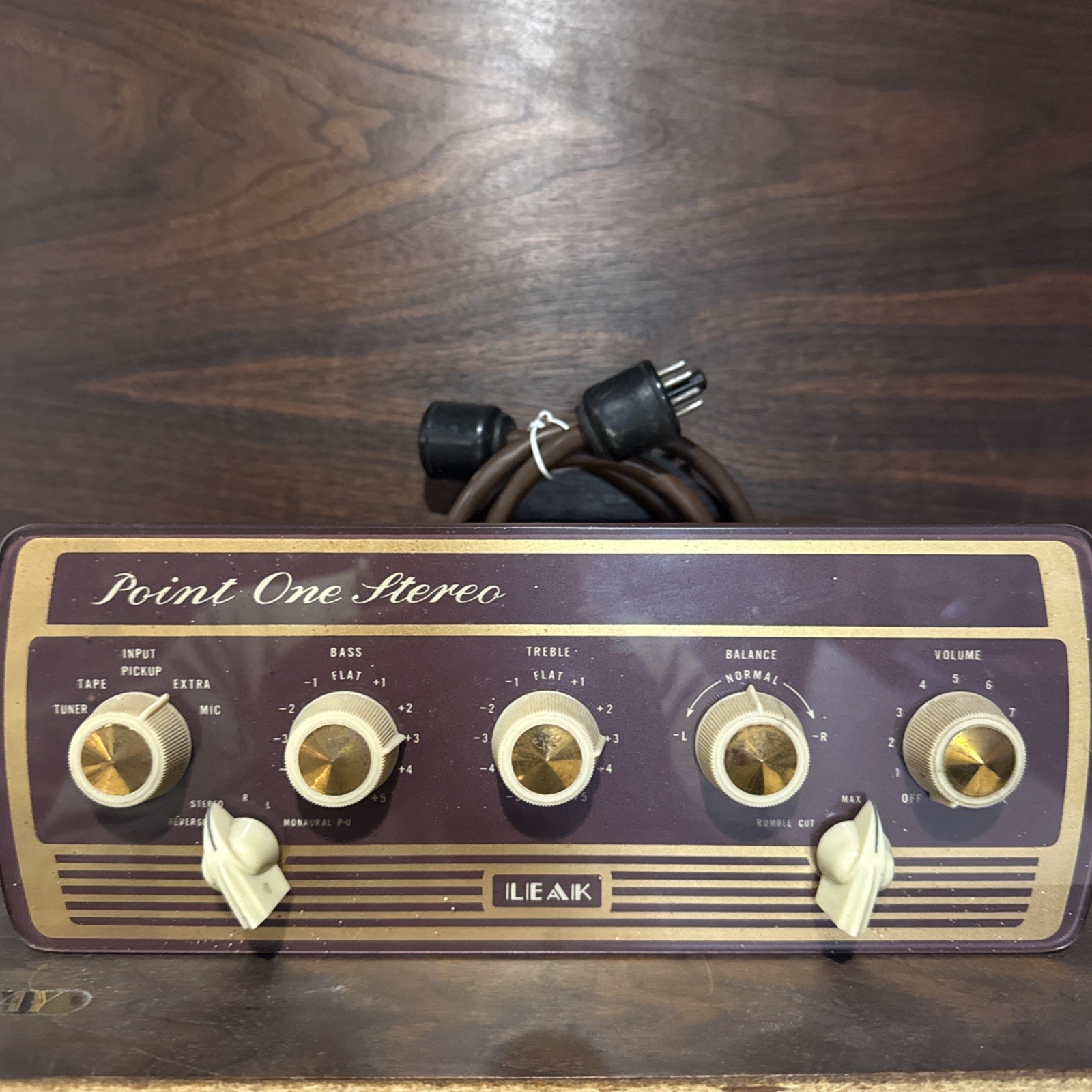
In the pantheon of vintage British audio equipment, few names command the respect and reverence of Leak—a company synonymous with engineering excellence and sonic purity during the mid-20th century. Among its most celebrated creations is the Leak POINT-ONE-STEREO, a passive preamplifier introduced in 1957 that would go on to define a generation of high-fidelity sound reproduction. Though not a power amplifier or receiver, the POINT-ONE-STEREO occupies a unique and revered place in audio history as one of the earliest and most influential stereo passive preamplifiers ever produced.
At a time when stereo broadcasting and recording were just beginning to emerge, Leak—a division of Tannoy Ltd.—stepped forward with a design that prioritized signal integrity, minimalism, and transparency. The POINT-ONE-STEREO wasn’t about power or features; it was about preserving the music. With no active circuitry, no gain stages, and no power supply, it represented a philosophy of audio purity that still resonates with purists today.
Technical Specifications
| Specification | Detail |
| Model | POINT-ONE-STEREO |
| Manufacturer | H. Leak & Co. Ltd. (Tannoy) |
| Year Introduced | 1957 |
| Type | Passive stereo preamplifier |
| Circuit Topology | Passive attenuator (no active gain) |
| Input Impedance | 100 kΩ |
| Output Impedance | 10 kΩ |
| Number of Inputs | 2 (stereo) |
| Controls | Dual-gang logarithmic potentiometer |
| Construction | Steel chassis, Bakelite or metal knobs |
| Dimensions | Approx. 210 x 120 x 70 mm |
| Weight | ~1.2 kg |
| Power Requirement | None (passive device) |
| Original Price | ~£17 10s (UK, 1957) |
The POINT-ONE-STEREO was designed to sit between source components (like a turntable or tuner) and a power amplifier. Its core was a high-quality, dual-gang logarithmic potentiometer—often sourced from Clarostat or Bourns—that provided smooth, balanced volume control across the stereo channels. The unit featured two stereo input pairs, allowing users to switch between two sources via a simple toggle switch on the front panel.
Despite its simplicity, the build quality was exceptional: a rigid steel chassis, clearly labeled controls, and a minimalist aesthetic that reflected the post-war British design ethos—functional, elegant, and enduring.
Sound Characteristics and Performance
The sonic signature of the Leak POINT-ONE-STEREO is best described as transparent, neutral, and uncolored. Because it contains no active electronics, transformers, or power supplies, it adds virtually no noise, distortion, or coloration to the signal path. What you hear is essentially the source material, unadulterated—passed through a high-quality resistive attenuator.
Many vintage audio enthusiasts praise the POINT-ONE-STEREO for its remarkable clarity and stereo imaging. In an era when many preamplifiers introduced their own sonic character—often warm, sometimes veiled—the POINT-ONE stood apart by letting the amplifier and speakers define the sound. Its low output impedance (10 kΩ) ensured good compatibility with the high-input-impedance valve amplifiers of the time, such as those from Leak’s own Stereo 60 or TL/12 series.
Because it’s a passive design, the POINT-ONE-STEREO does not provide gain. This means it works best when paired with high-output sources (like FM tuners or modern phono stages with built-in RIAA amplification) and high-sensitivity power amplifiers. It’s not ideal for use with low-output moving coil cartridges or modern systems requiring remote control or tone controls—but that’s not its purpose. Its strength lies in simplicity and fidelity.
Notable Features and Innovations
While the POINT-ONE-STEREO may seem rudimentary by today’s standards, it was a pioneering product in several ways:
- One of the first commercially successful passive preamplifiers: At a time when most preamps used vacuum tubes and active circuitry, Leak’s decision to go passive was bold and forward-thinking.
- Stereo-ready from the start: Released just as stereo broadcasting began in the UK (BBC began stereo FM tests in 1958), the POINT-ONE-STEREO was perfectly timed to meet the needs of early stereo adopters.
- High-quality potentiometer: The use of a precision dual-gang logarithmic pot ensured excellent channel matching and smooth volume control—critical for stereo balance.
- Minimalist signal path: With only a switch and a potentiometer in the circuit, the signal degradation was minimized, a concept that would later become central to high-end audio design.
Leak also offered a matching input selector switch (the POINT-ONE-SWITCH) for users who wanted more inputs, reinforcing their system-based approach to hi-fi.
Common Issues and Maintenance
Like all vintage electronics, the Leak POINT-ONE-STEREO requires care and occasional maintenance to perform at its best. The most common issues include:
- Noisy or scratchy volume control: This is the most frequent problem, caused by oxidation or wear in the potentiometer. While tempting, do not use contact cleaner—many vintage pots are paper or carbon-based and can be damaged by liquids. Instead, gentle cleaning with a dry fiberglass pen or professional potentiometer restoration is recommended.
- Loose input jacks or switches: Over time, the bakelite or metal connectors can become loose. Tightening or replacing with period-correct parts is advised.
- Oxidized terminals: The soldered or screw terminals can corrode. Light cleaning with isopropyl alcohol and a soft brush usually restores conductivity.
- Wear on selector switch: The front toggle switch can develop intermittent connections. Cleaning with appropriate contact tools or replacement with a NOS (New Old Stock) part is ideal.
Because the unit is passive and contains no capacitors or tubes, there are no components that “age out” in the traditional sense. With proper care, a POINT-ONE-STEREO can function as well today as it did in 1958.
Current Market Value and Collectibility
The Leak POINT-ONE-STEREO is highly collectible among vintage audio enthusiasts, particularly in the UK and Europe. Its reputation for sonic purity, historical significance, and association with the golden age of British hi-fi has kept demand strong.
- Condition-dependent pricing: A fully functional unit in good cosmetic condition typically sells for £200–£400 on the vintage market.
- Rare variants: Units with original Clarostat pots or early production models with specific chassis markings can fetch higher prices.
- Restoration value: Professionally restored units with cleaned pots and replaced jacks may command a premium, especially if documented.
Collectors often seek the POINT-ONE-STEREO not only for use but as a piece of audio history—a symbol of a time when simplicity and engineering integrity were paramount.
Conclusion and Legacy
The Leak POINT-ONE-STEREO is more than just a preamplifier; it’s a statement of philosophy. In an age increasingly obsessed with features, feedback, and complexity, the POINT-ONE-STEREO reminds us that less can be more. It represents a purist approach to audio—no gain, no power, no coloration—just a clean, direct path from source to amplifier.
Its legacy lives on in the countless passive preamps and minimalist designs that followed, from modern high-end brands like Audience and Jung to DIY audiophiles building their own attenuator-based systems. The POINT-ONE-STEREO proved that a simple, well-executed design could stand the test of time—both sonically and historically.
For those building a vintage British hi-fi system, pairing a POINT-ONE-STEREO with a Leak Stereo 60 or a Quad II amplifier is nothing short of magical. It’s a window into the past, yes—but more importantly, it’s a reminder that great sound doesn’t require complexity. Sometimes, all you need is a good potentiometer and the courage to keep it simple.
The Leak POINT-ONE-STEREO: a quiet giant of audio history, still whispering the truth of the music, more than 65 years later.
eBay Listings


As an eBay Partner, we earn from qualifying purchases. This helps support our independent vintage technology research.
Related Models
- Leak TL/10 (1959)
- Leak 2060 (1958)
- Leak POINT-ONE-PLUS (1972)
- Leak RC/PA (1952)
- Leak RC/PA/U (1955)
- Luxman L-530 (1975)
- Luxman R-404 (1975)
- Luxman RV-371 (1975)
- Luxman SQ-38U (1975)
- Luxman T-14 (1972)