Koss ESP9 (Late 1960s – Early 1970s)
There is a distinct electrical hum that greets you when the E-9 Energizer wakes up, a sound that signals the high voltage is ready to dance across the diaphragms.
Overview
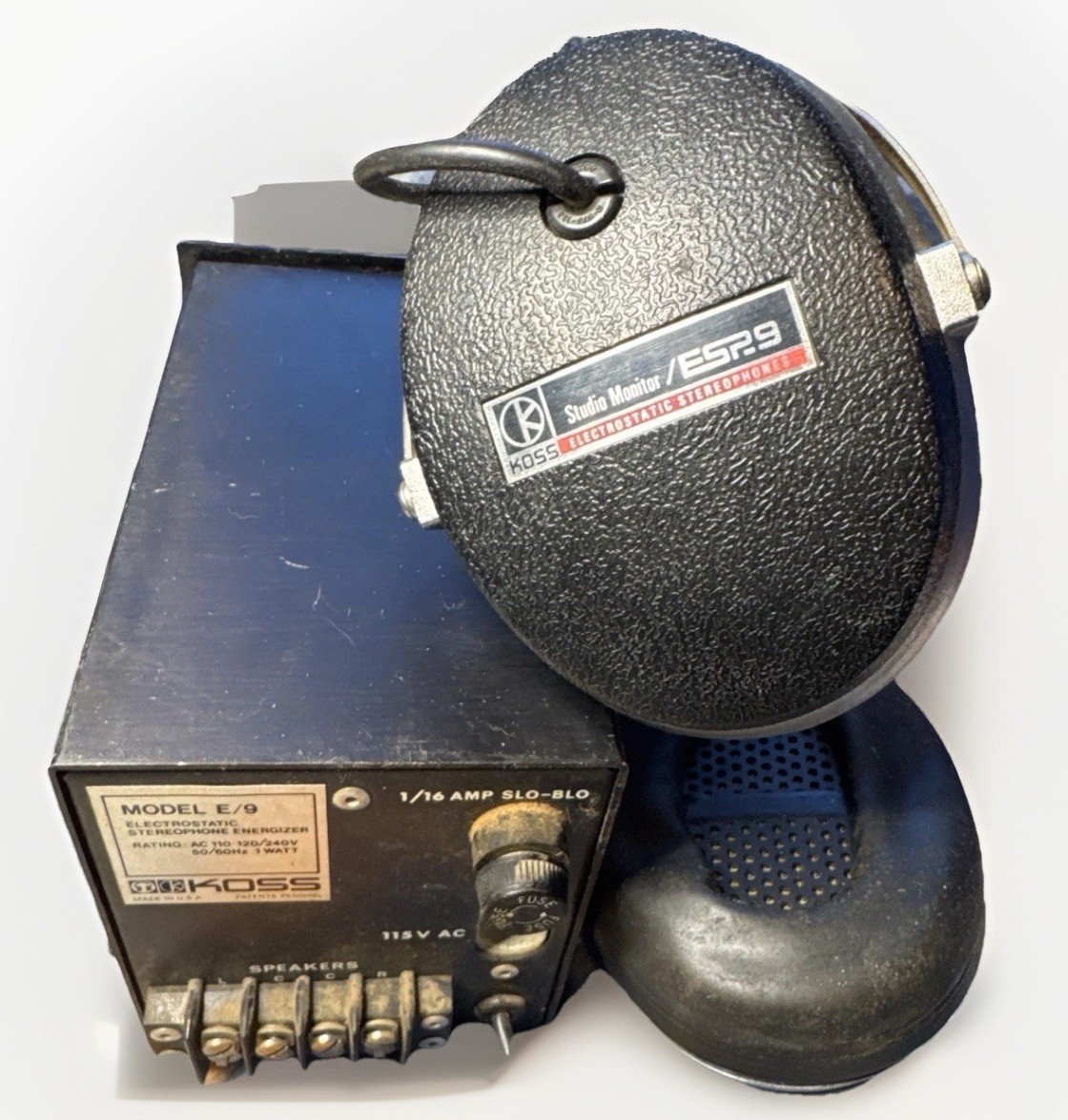
Handling the Koss ESP9 is an exercise in confronting industrial reality. These are not delicate jewelry for the ears; they are bulky, heavy, and very business-like in appearance. Documentation from the era identifies them as the top-of-the-line model from America's leading headphone manufacturer, designed with a purpose that transcends casual listening. The ESP9 was engineered as an electrostatic studio monitor, offering a new tool for improved audiometry with self-bias or AC line energizing. This dual-power capability distinguishes it from many contemporaries, allowing the user to switch on the front panel of the energizer to select AC operation for precision measurements of output, or engage the self-energized switch position where no connection to AC lines is required for maximum convenience.
The physical presence of the system commands attention. The power supply is rather large and heavy, appropriate in scale for the high-voltage demands of electrostatic transducers. Owners report that the headset itself weighs 19 ounces, a substantial figure that requires the extendable stainless steel headband to conform to any head size without slipping. The fluid-filled cushions are not merely a comfort feature but a functional seal, providing 40 dB average isolation from external noise. This isolation eliminates all room reflections and polar distribution problems, delivering a super wide-range response for critical, controlled monitoring of finest recording sources. Collectors note that the appearance is very, very good, matching the performance claims with a chassis that feels like it belongs in a rack of broadcast equipment rather than on a home stereo shelf.
Sound quality from the ESP9 is described by enthusiasts as having a very "present" bass and decent top end, especially on AC power. The precision electrical balancing of push-pull acoustical circuitry gives fatigue-free listening through long, intense recording sessions. Unlike conventional units, the elements cancel all 2nd harmonic distortion. While some modern listeners debate tossing them due to humming issues, others find the detail and clarity absolutely amazing. The system delivers all 10 audible octaves, 10 - 19,000 Hz (±5 dB), which is 4 octaves beyond ordinary headphones of the time. This performance made them top of the heap in 1972, representing something good to say about the 70s audio engineering after all.
Specifications
| Manufacturer | Koss |
| Production Years | Late 1960s – Early 1970s |
| Model Type | Electrostatic Studio Monitor |
| Transducer Principle | Electrostatic Push-Pull |
| Frequency Response (Typical) | 15 - 15,000 Hz ±2 dB |
| Frequency Range (Extended) | 10 - 19,000 Hz ±5 dB |
| Sensitivity | 80 dB SPL at 1 kHz ±1 dB |
| Reference Pressure | 0.0002 dynes/cm² |
| Input Voltage for Sensitivity | 1 Volt |
| Total Harmonic Distortion | Less than 2% at 110 dB SPL |
| Isolation from External Noise | 40 dB Average |
| Power Handling Capability | Max 10 volts (12 watts) |
| Transient Peak Capability | 14 dB beyond continuous level |
| Source Impedance | 4 to 16 Ω amplifier outputs |
| External Power Requirements | None (Self-Energized) or 117 VAC |
| AC Line Current | 1/16 Amp (117 VAC, 50/60 Hz) |
| Energizer Dimensions | 4 ½ H x 3 ¾ W x 6 ¼ D inches |
| Energizer Weight | 3 pounds |
| Ear Cup Dimensions | 4 ¼ H x 3 ¾ W x 1 ¼ D inches |
| Headset Weight | 19 ounces |
| Cushion Type | Fluid-filled |
| Headband Material | Extendable Stainless Steel |
| Headset Cable Length | 6 inches |
| Headset Cable Conductors | 5 conductor shielded |
| Microphone Mount | Knurled anodized aluminum knob |
| Energizer Transformers | 2 coupling transformers |
| Control Switches | Speaker/Headphone Transfer Key |
| Indicator | AC Pilot Light |
Key Features
The E-9 Energizer Architecture
The heart of the ESP9 system is the external E-9 energizer unit, a component that demands respect for its internal complexity. Service technicians observe that the energizer box contains four transformers and fifty wires at least in the earlier models, a labyrinth of copper that dictates the sonic character. This unit contains 2 coupling transformers, self-energizing circuitry, a speaker/headphone transfer key-switch, and an AC pilot light on a black anodized front panel. It also houses AC power transformers, an AC on-off switch, and an AC line fuse. The rear panel features speaker terminals, allowing the system to connect to low-impedance speaker terminals without requiring special amplifiers. A 6'4" conductor input cable terminated with 4 spade lugs connects to amplifier output terminals, ensuring easy, quick hook-up to any rated high-quality amplifier.
Dual-Power Operation
Flexibility in power delivery was a critical design goal for the ESP9. The calibrated, precisely controlled output is ideal for audiometric uses. When the switch on the front panel of the energizer selects AC operation, precision measurements of output are enabled. In the self-energized switch position, no connection to AC lines is required, giving maximum convenience for mobile or simplified setups. However, owners report that if the energizer box is the earlier model, it must be used on an amp that has a common ground, otherwise issues arise that are not very nice for the amplifier. This dual capability allows the user to choose between the stability of wall power and the isolation of self-bias, though the AC operation typically yields the very "present" bass that enthusiasts seek.
Physical Ergonomics and Isolation
Human engineering for comfort was prioritized despite the industrial weight. The headset uses fluid-filled cushions for good, comfortable seal, contributing to the 40 dB average isolation from external noise. The extendable stainless steel headband features wide cushioning for perfect fit and restful listening. Yokes are self-adjusting and pivoting, conforming to any head size. On the left cup, a knurled, anodized aluminum knob with a threaded shaft and 2 compressible rubber washers accepts all standard booms, providing a boom mount for microphone use. This feature underscores the studio monitor intent, allowing the ESP9 to function as a communications headset in professional environments. The headset cable is flexible, polyvinyl, 5 conductor shielded, and 6 inches long, black with a 5 prong plug keyed to the E-9 Energizer receptacle.
Historical Context
The Koss ESP9 emerged during a period when electrostatic headphones were largely dominated by Japanese manufacturers like Stax. As America's leading headphone manufacturer, Koss sought to establish a domestic flagship capable of competing with the best loudspeaker systems in terms of controlled monitoring. The ESP9 was built to eliminate all room reflections and polar distribution problems inherent in speaker monitoring, offering a new tool for improved audiometry. In contrast to the ESP-6 and ESP-7, both cups of the ESP9 are independently energized; the left cup signal is not required to supply bias to the right cup. This architectural advancement marked a technical peak for Koss in the early 1970s.
Industry moments surrounding the ESP9 highlight the transition from consumer convenience to professional utility. While competitors treated 30 watts as luxury in amplifiers, the ESP9 demanded high-power capability in very low bass range, utilizing large, oversize coupling transformers mounted in the external E-9 energizer unit to give good wave form at 30 Hz with up to 10 volts input. This made them excellent for evaluating the spectral character of very low level noise in equipment like tape mastering machines and recording consoles. The existence of the ESP9 proves that there is something good to say about the 70s audio engineering, positioning it as a top-of-the-heap device when these started to hum, debated by engineers tossing them versus keeping them for their unique sonic signature.
Collectibility & Value
Market data indicates that the Koss ESP9 is a vintage one owner collectible and highly desirable item, often found with factory box and manual in collector condition. Current market values for the headphones alone hover around $300, while the amplifier or energizer usually goes for around $400. Complete systems are valued higher, reflecting the necessity of the energizer for operation. Buyers should note that the system is finicky and expensive to maintain compared to modern alternatives. The energizer box if it is the earlier model must be used on an amp that has a common ground, a critical compatibility check before purchase.
Common failures include humming issues, which led some owners to debate tossing them in favor of modern dynamic headphones like the Fostex T50RP. The foam surround crumbles over time, but replacement kits are available and the install is a Saturday project for the dedicated enthusiast. Service technicians observe that the internal wiring of the energizer is dense, with fifty wires at least, making DIY repair daunting without schematic knowledge. When examining a unit for purchase, bring a flashlight and examine the faceplate at a raking angle to check for original anodization and switch integrity. The fluid-filled cushions may leak or dry out, reducing the 40 dB isolation capability. Despite these quirks, the detail and clarity are absolutely amazing when powered correctly, maintaining a strong demand among collectors who appreciate the bulky, heavy, very business-like appearance.
eBay Listings


As an eBay Partner, we earn from qualifying purchases. This helps support our independent vintage technology research.