Klipsch Klipschorn (1946–Present)
They don’t just fill a room with sound—they command it, corner to corner, with the authority of a symphony conductor who refuses to compromise.
Overview
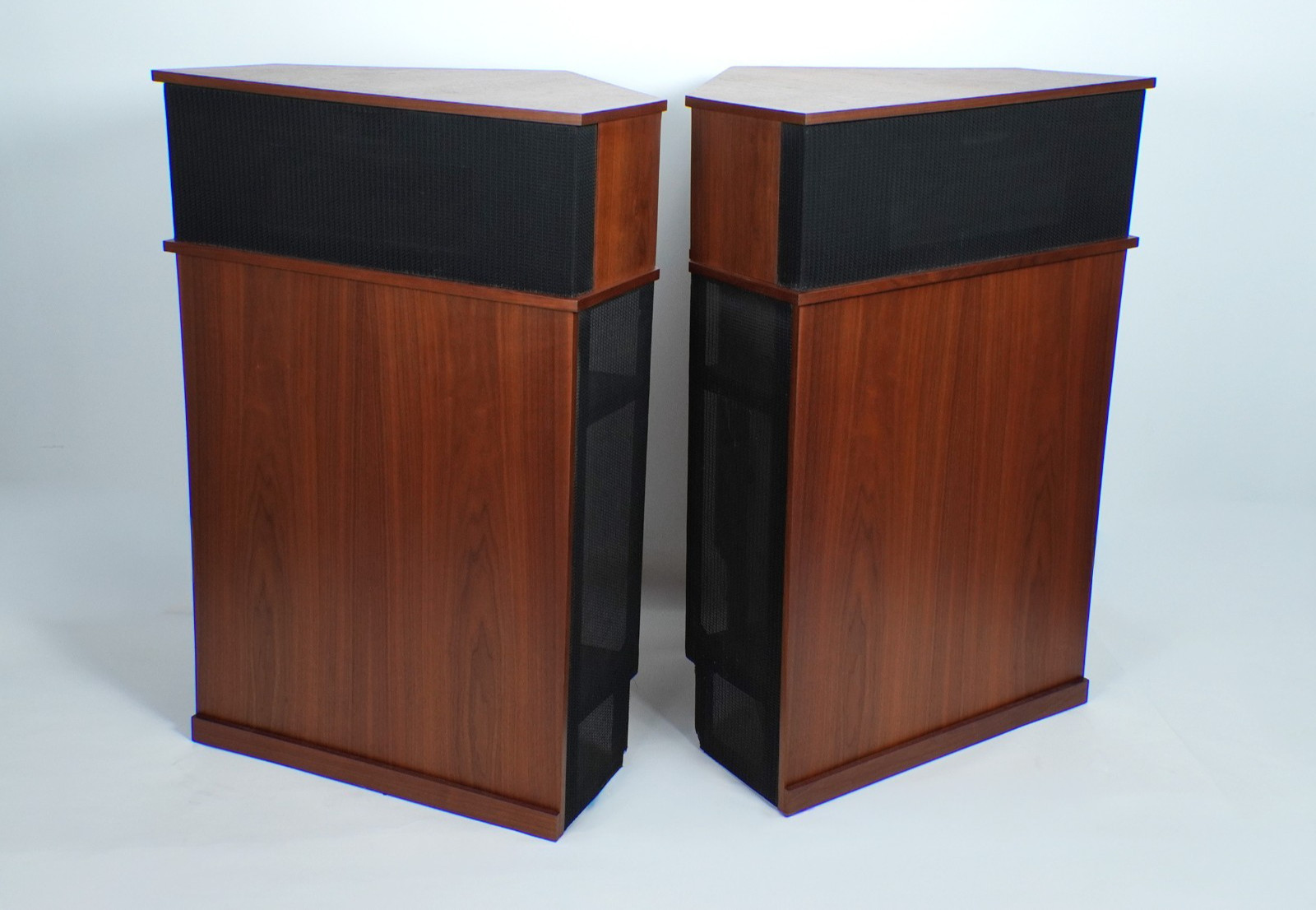
You don’t so much place a Klipschorn in a room as surrender the room to it. From the moment you wrestle one of these 167-pound behemoths into the corner—its back panel flush against two walls, floor anchoring the third—it becomes less a speaker and more a structural element, like a built-in bookshelf that happens to project the crack of a snare drum with the immediacy of a live performance. The first time you hear one, even at moderate volume, you flinch. Not from distortion, but from presence. There’s no gradual immersion; the Klipschorn drops you into the middle of the music like a stagehand shoved onto the pit during act two. That’s by design. Paul W. Klipsch didn’t set out to build a speaker that would blend into your decor or disappear sonically. He wanted to recreate the dynamic range of a live orchestra in a living room, and he did it with physics, folded wood, and an almost fanatical refusal to follow trends.
Born in 1946 and still in production today, the Klipschorn holds the distinction of being the longest continuously manufactured loudspeaker in history—a fact that sounds like marketing hyperbole until you realize it’s true. No redesigns, no reboots, no “modernized” versions that abandon the core principles. The model you can buy new from Klipsch today is functionally identical to the ones assembled in Hope, Arkansas, in the late 1940s. That’s not stagnation; it’s confidence. The design—a trihedral folded horn loaded into room corners—uses the walls and floor as acoustic extensions of the bass horn, effectively turning your listening space into part of the speaker itself. It’s a concept so elegantly simple and ruthlessly effective that it bypasses decades of speaker engineering dogma. While others chased sealed enclosures, ported boxes, and digital room correction, the Klipschorn just kept working, louder and more efficiently than almost anything else on the market.
And efficient it is: 105 dB sensitivity with just one watt means it doesn’t need a powerhouse amplifier to come alive. A 15-watt tube amp can push these to concert levels without breaking a sweat. That’s not just convenient—it’s transformative. It opens the door to vintage and low-powered gear that would be drowned out by modern speakers. But this isn’t a speaker for the timid or the space-constrained. It demands corners, clear wall space, and a tolerance for its imposing physical and sonic footprint. It will not forgive poor placement. If your room has baseboard heaters, crown molding, or a desire for symmetry that doesn’t include giant wooden horns in the corners, the Klipschorn will punish you with loose, flabby bass and a collapsed soundstage. But get it right—snug into the corners, aimed across the room, with clean wall runs—and the payoff is a coherence, scale, and dynamic punch that few speakers, vintage or modern, can match.
Specifications
| Manufacturer | Klipsch & Associates |
| Production Years | 1946–Present |
| Original Price | $137.50 (1947) |
| Current Price (New) | $8,000–$16,000 (varies by finish, limited editions) |
| Weight | 167 lbs (75.8 kg) per speaker |
| Dimensions | 52" H × 31.25" W × 28.5" D (132.1 × 79.4 × 72.4 cm) |
| Driver Complement | 15-inch folded bass horn, 2-inch compression midrange horn, 1-inch compression tweeter horn |
| Frequency Response | 35 Hz – 17.5 kHz |
| Sensitivity | 105 dB @ 1W/1m |
| Nominal Impedance | 8 ohms |
| Power Handling | 100 watts (recommended) |
| Maximum SPL | 121 dB |
| Crossover Frequencies | 450 Hz (bass to midrange), 4.5 kHz (midrange to tweeter) |
| Cabinet Type | Trihedral folded horn, corner-loaded |
| Finish Options | Walnut, cherry, black ash, special editions (e.g., Australian walnut) |
| Terminals | Single binding posts (older models: screw terminals) |
| Production Location | Hope, Arkansas, USA |
| Serial Number Note | First production unit (SN 121) completed June 1, 1948 |
Key Features
The Horn That Eats Rooms
The Klipschorn’s trihedral folded horn isn’t just a cabinet—it’s a resonance chamber that leverages the room as an active component. The bass horn folds upward and backward inside the cabinet, terminating at the rear apex, where the walls and floor complete the horn’s mouth. This design allows the 15-inch woofer to achieve deep bass extension (down to 35 Hz) without requiring massive amplifier power or a large ported box. In fact, corner loading provides an additional 6 dB of gain, effectively quadrupling the perceived output. That’s why a 10-watt amp can drive these to spine-rattling levels. But this advantage comes with a non-negotiable: the speaker must be placed tight into a corner with unobstructed wall surfaces. Any gap—whether from baseboards, molding, or carpet—degrades bass response and timing. Klipsch once provided blueprints for “false corner” panels to solve this, and many owners still build them today. The horn’s exponential flare is carefully calculated to maintain phase coherence and minimize distortion, a rarity in mass-market designs of the era.
High-Efficiency Driver Array
While the bass horn does the heavy lifting, the midrange and tweeter are no afterthoughts. The 2-inch titanium diaphragm compression driver fires into a separate horn chamber mounted atop the bass cabinet, delivering midrange clarity that cuts through without harshness—when properly maintained. The 1-inch compression tweeter, loaded into its own horn, extends to 17.5 kHz with startling speed and detail. Both high-frequency drivers benefit from horn loading, which increases efficiency and directivity, focusing energy toward the listening position. This contributes to the Klipschorn’s legendary “effortless” sound: transients snap with precision, and complex passages remain coherent even at high volumes. However, the trade-off is a narrower sweet spot compared to modern point-source designs. Move too far off-axis, and the balance shifts—bass swells, highs recede. The Klipschorn rewards careful setup and disciplined listening positions.
Modular Construction and Serviceability
Despite their monolithic appearance, Klipschorns are designed for disassembly. The top section (midrange and tweeter) separates from the bass cabinet with a few bolts, making transport and repairs manageable despite the weight. This modularity also allows for incremental upgrades. Many owners retrofit modern crossovers—particularly the Bob Crites designs—to improve integration and reduce midrange glare. Original crossovers used paper capacitors and wire-wound resistors, which degrade over time, leading to uneven response and potential driver damage. Replacing them is almost expected in vintage units. The drivers themselves are serviceable: compression drivers can be reconed, and the bass woofer, while large, is rebuildable by specialty shops. Klipsch still supports the model with replacement parts, a rarity for a 75-year-old product.
Historical Context
The Klipschorn emerged from a postwar era when high-fidelity audio was still a niche pursuit, and most home speakers struggled to play loudly without distortion. Paul W. Klipsch, a Purdue-educated engineer with experience in acoustics, geophysics, and ballistics, applied scientific rigor to speaker design at a time when most manufacturers relied on trial and error. His work on folded horns began in the late 1930s, culminating in a series of patents between 1942 and 1945. The first production run in 1946 consisted of just 12 units built by Baldwin Piano & Organ, using Western Electric tweeters and likely JBL woofers. By 1948, Klipsch had moved production to a repurposed telephone exchange building in Hope, Arkansas—the same facility still used today. The design was revolutionary not for its complexity, but for its intelligence: it used room boundaries as a free acoustic tool, achieving high efficiency and low distortion without exotic materials or massive amplifiers.
At the time, few competitors offered anything comparable. Altec Lansing and JBL focused on professional PA systems, while home speakers from companies like Fisher and Scott were often low-efficiency direct-radiating designs. The Klipschorn stood apart—expensive, imposing, and uncompromising. Yet its efficiency made it a favorite among early audiophiles, many of whom used low-powered tube amps. Over the decades, it became a cult object, adopted by DJs, sound engineers, and collectors. The 1970s saw Klipsch expand the Heritage line with the Cornwall, La Scala, and Heresy—smaller, more portable horn designs that shared the Klipschorn’s DNA. But the K-Horn remained the flagship, a symbol of purist engineering in an industry increasingly driven by fashion and marketing.
Collectibility & Value
The Klipschorn’s collectibility is less about scarcity than about legacy. Because it’s still in production, “vintage” models span decades, and prices vary wildly based on condition, era, and provenance. A well-maintained pair from the 1970s or 1980s might sell for $2,500–$4,500, while pristine originals with original paperwork and rare finishes can fetch $6,000 or more. Modern new-old-stock (NOS) pairs in walnut or cherry list for $8,000, and limited editions—like the 70th-anniversary Australian walnut model—have sold for $16,000. However, condition is everything. These are large, heavy speakers that have often been moved, refinished, or poorly maintained. Common failure points include deteriorated foam surrounds on the bass driver (leading to flapping or no bass), failed capacitors in the crossover (causing harsh highs or dead midrange), and warped cabinets from humidity or improper storage.
Before buying, inspect the following:
- **Cabinet integrity**: Look for cracks, warping, or water damage, especially at the rear apex where the bass horn terminates.
- **Driver condition**: The bass cone should be flat and centered; any sagging or tearing indicates surround failure.
- **Crossover**: Open the access panel and check for bulging capacitors or brittle wiring. Recapping is often necessary, costing $300–$600 per pair.
- **Horn alignment**: Misaligned midrange or tweeter horns can cause phase issues and uneven dispersion.
- **Placement feasibility**: Measure your room. If you can’t place the speakers tight into corners with at least 3 feet of clear wall on each side, reconsider.
Despite their age, Klipschorns are not “set and forget” classics. They require commitment—spatial, financial, and technical. But for those willing to meet the challenge, they offer a listening experience that feels less like playback and more like presence. They don’t flatter poorly recorded music; they expose it. But with good material—live jazz, orchestral works, classic rock—they deliver a sense of scale and realism that few speakers, vintage or modern, can match.
eBay Listings


As an eBay Partner, we earn from qualifying purchases. This helps support our independent vintage technology research.