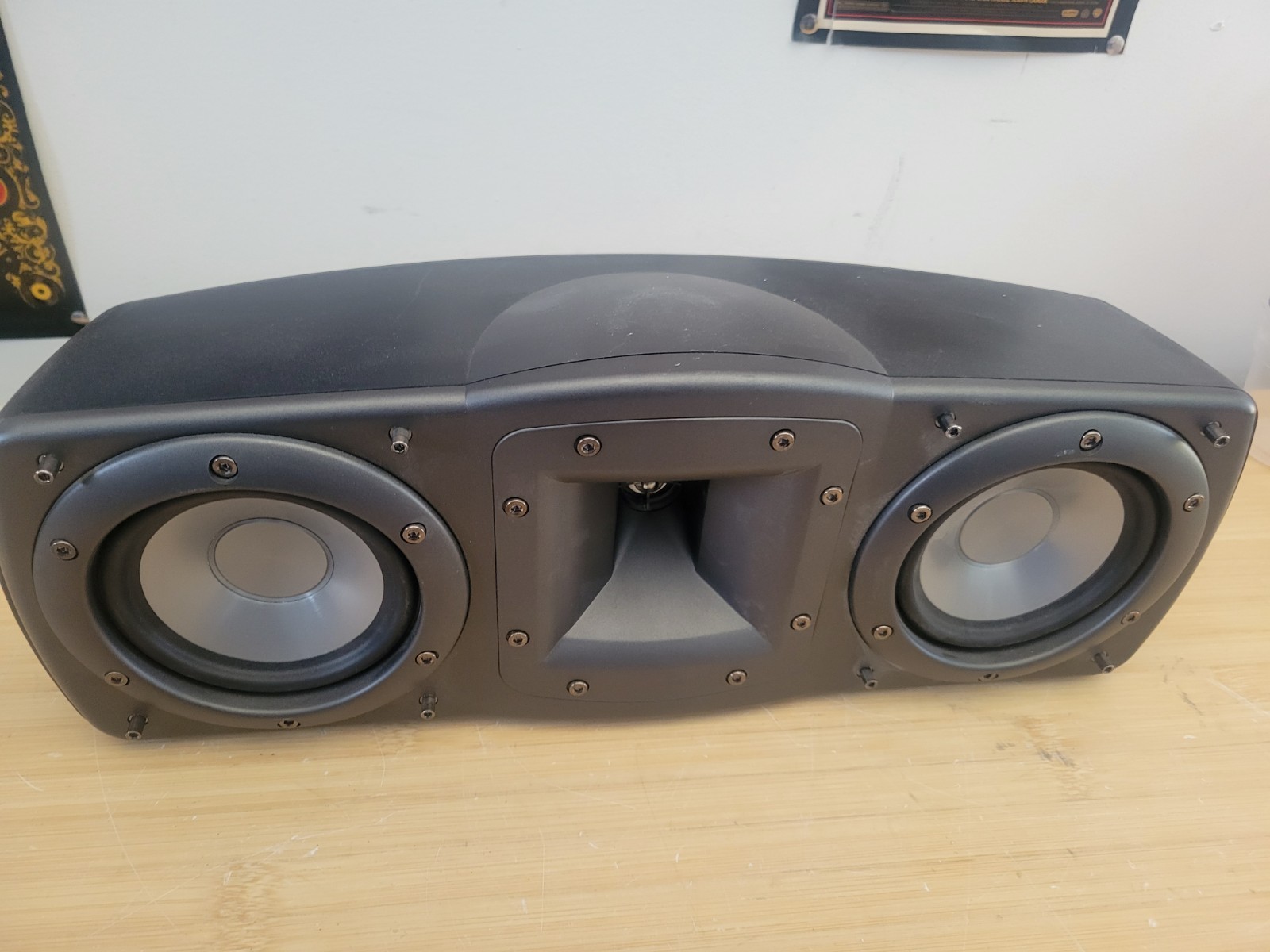
Klipsch KLF-C7 Center (1997) – The Horn-Loaded Heart of a Classic Theater System
In the mid-to-late 1990s, Klipsch was already a legendary name in high-efficiency loudspeaker design, known for its bold horn-loaded technology and cinema-inspired sound. The Klipsch KLF-C7 Center, introduced in 1997 as part of the flagship KLF (Klipsch LaScala Forte) series, stands as a testament to the company’s commitment to dynamic, clear, and powerful audio reproduction—especially in the critical center channel role of a surround sound system.
While not as widely documented as its floor-standing siblings like the KLF-20 or KLF-30, the KLF-C7 Center played a pivotal role in completing the immersive audio experience Klipsch envisioned for home theater enthusiasts. Designed to match the sonic signature of the rest of the KLF lineup, this center channel speaker brought dialogue clarity, dynamic range, and high efficiency to living rooms during the golden age of DVD and early home cinema.
Technical Specifications
The KLF-C7 Center was engineered to deliver consistent, high-output performance with minimal power, thanks to Klipsch’s signature horn-loaded design. Below are the known specifications based on period documentation and Klipsch’s design philosophy of the era:
| Specification | Detail |
| Model | KLF-C7 Center |
| Year Introduced | 1997 |
| Type | 3-way, bass-reflex, center channel speaker |
| Driver Complement | 1" titanium compression driver (tweeter), 1.75" midrange, dual 6.5" woofers |
| Horn Technology | Tractrix Horn (tweeter), Hybrid Horn (midrange) |
| Frequency Response | 38 Hz – 20 kHz |
| Sensitivity | 98 dB @ 1W/1m |
| Nominal Impedance | 8 ohms (compatible with 4-ohm min. receivers) |
| Recommended Power | 10 – 150 watts per channel |
| Crossover Frequencies | 550 Hz (woofer/mid), 3.5 kHz (mid/tweet) |
| Enclosure Finish | Black ash vinyl or real wood veneer (varies) |
| Dimensions (H×W×D) | 20.5" × 26.5" × 12" (52 × 67.3 × 30.5 cm) |
| Weight | 60 lbs (27.2 kg) |
| Mounting Options | Keyhole slots, optional stands or brackets |
Sound Characteristics and Performance
The KLF-C7 Center was built to do one thing exceptionally well: deliver crisp, intelligible dialogue and seamless timbre matching with the rest of the KLF speaker array. Its 98 dB sensitivity meant it could produce high sound pressure levels with modest amplifier power—a hallmark of Klipsch’s design ethos inherited from founder Paul W. Klipsch.
The use of a 1-inch titanium diaphragm compression driver mated to a Tractrix Horn ensured extended high-frequency response with low distortion. This allowed the speaker to reproduce the subtle nuances of vocal performances and on-screen effects with startling realism. The 1.75-inch midrange driver, housed in a separate hybrid horn chamber, provided warmth and presence in the vocal range, crucial for anchoring dialogue in the soundstage.
Dual 6.5-inch Cerametallic woofers handled lower midrange and bass duties, ensuring the speaker could keep up with action sequences without requiring constant subwoofer handoff. While not a full-range sub, the KLF-C7 could reproduce down to 38 Hz, making it more self-sufficient than many center channels of its time.
In a properly calibrated home theater, the KLF-C7 delivered a focused, dynamic center image that locked voices to the screen with precision. Its high efficiency also meant it could handle sudden volume spikes—explosions, musical crescendos, or crowd noise—without compression or strain.
Notable Features and Innovations
The KLF-C7 Center wasn’t just a repackaged bookshelf speaker turned sideways. It was a purpose-built center channel with several standout features:
- Horn-Loaded Design: Klipsch’s Tractrix Horn geometry improved high-frequency dispersion and reduced distortion, offering wider sweet spots and cleaner sound at high volumes.
- Modular Cabinet Construction: The robust MDF enclosure minimized resonance, while the front-baffle design allowed for both horizontal and (in rare configurations) vertical placement without compromising acoustics.
- Bi-Wirable Terminals: Though typically used as a passive center, the KLF-C7 featured dual binding posts, allowing for bi-wiring or bi-amping for advanced setups.
- Timbre Matching: As part of the KLF series, the C7 shared drivers and crossover philosophies with the KLF-20 and KLF-30, ensuring seamless sound across front channels.
- Classic Klipsch Aesthetics: With its distinctive horn mouth, black grille, and optional real wood veneer (cherry or rosewood), the KLF-C7 had a bold, retro-futuristic look that stood out in any room.
Common Issues and Maintenance
As with any vintage speaker from the late '90s, the KLF-C7 Center requires some attention to remain in top condition:
- Tweeter Diaphragm Fatigue: The titanium compression driver is durable, but older units may suffer from fatigue or oxidation in humid environments. A "crackling" sound at high frequencies can indicate a failing tweeter, though many can be rebuilt by specialty technicians.
- Grille Attachment Wear: The original cloth grilles used plastic clips that can become brittle over time. Replacement grilles or DIY solutions are common among restorers.
- Binding Post Corrosion: Especially in coastal areas, the copper terminals may oxidize. Cleaning with contact cleaner and using quality speaker cables can prevent connection issues.
- Crossover Component Aging: While generally robust, electrolytic capacitors in the crossover network may degrade after 25+ years. Recapping by an audio technician can restore clarity and dynamics.
- Cosmetic Wear: The wood veneer, if present, may show scratches or fading. Gentle polishing with non-abrasive products can revive its luster.
Regular dusting, placement away from direct sunlight, and avoiding overdriving the speaker are key to preserving its performance.
Current Market Value and Collectibility
The Klipsch KLF-C7 Center is not as commonly sought after as the KLF-20 or Heresy models, but it holds a niche appeal among vintage home theater collectors and Klipsch enthusiasts aiming to complete a full KLF system.
As of 2024, a fully functional KLF-C7 in good cosmetic condition typically sells for $300–$500 on the secondary market (eBay, Audiogon, Facebook Marketplace). Units with rare wood veneers or original packaging may fetch higher prices. However, non-working or heavily damaged models often sell for parts or restoration projects at $150 or less.
Its value is closely tied to the popularity of the broader KLF series, which has seen a resurgence due to renewed interest in high-efficiency, passive home audio systems. While not a "blue chip" vintage speaker like the Klipschorn, the KLF-C7 is increasingly recognized as a well-engineered, era-defining center channel that deserves respect.
Conclusion and Legacy
The Klipsch KLF-C7 Center (1997) may not be the most famous speaker in the Klipsch catalog, but it was a critical component in one of the most cohesive and powerful home theater systems of its time. Designed with the same engineering rigor as its floor-standing siblings, it delivered exceptional clarity, high efficiency, and seamless integration—hallmarks of Klipsch’s audio philosophy.
In an age where center channels are often afterthoughts—small, underpowered, and timbrally mismatched—the KLF-C7 reminds us that dialogue deserves the same attention as music. It was built for impact, clarity, and longevity, and today, it remains a compelling choice for vintage audio lovers building a period-correct 1990s home theater or seeking a high-sensitivity center with real presence.
For those who value honest engineering, bold design, and cinematic sound, the KLF-C7 Center is more than just a speaker—it’s a piece of audio history, quietly anchoring the soundtrack of a bygone era.
eBay Listings


As an eBay Partner, we earn from qualifying purchases. This helps support our independent vintage technology research.
Related Models
- Klipsch Forte III
- Klipsch KLF-20
- Klipsch KG-2 (1990-1995)
- Klipsch Belle (1985)
- Klipsch Cornwall (1959) (1959)
- Akai AM-2850 (1975)
- Akai AP-206 (1975)
- Nakamichi BX-1 (1985)
- Acoustic Research research-ar-17 (1978)
- Acoustic Research AR-19 (1994)