Klipsch KLF-30: The Thunderous Crown of '90s High-Efficiency Floorstanders
Born in the golden era of high-sensitivity, horn-loaded loudspeaker design, the Klipsch KLF-30, introduced in 1997, stands as a monumental achievement in American audio engineering. Though technically just outside the traditional "vintage" cutoff for pre-1990 gear, the KLF-30 has rapidly ascended to cult status among audiophiles and vintage audio collectors. Its blend of raw acoustic power, legendary Klipsch efficiency, and striking retro-modern aesthetics has cemented its reputation as one of the most compelling floorstanding speakers of the late 20th century.
Historical Context: The Legacy of Paul W. Klipsch
To understand the KLF-30, one must first appreciate the legacy of its founder, Paul W. Klipsch, an audio pioneer whose obsession with efficiency and dynamics revolutionized speaker design. His original Klipschorn (launched in 1946) set the standard for corner-loaded, horn-reflex speakers that could deliver concert-hall dynamics with minimal amplifier power. Decades later, Klipsch Audio Technologies continued this philosophy, culminating in the Klipsch LaFayette (KLF) series of the 1990s—named in homage to Klipsch’s hometown in Louisiana.
The KLF-30, released as the flagship of the KLF line, was designed to bring the sonic authority of the Klipschorn into a more practical, modern floorstanding format. It was part of a broader trend in the mid-to-late '90s where high-end manufacturers began re-embracing high-efficiency designs, partly in response to the resurgence of tube amplifiers and a growing appreciation for dynamic realism over sterile neutrality.
Technical Specifications: Power, Precision, and Presence
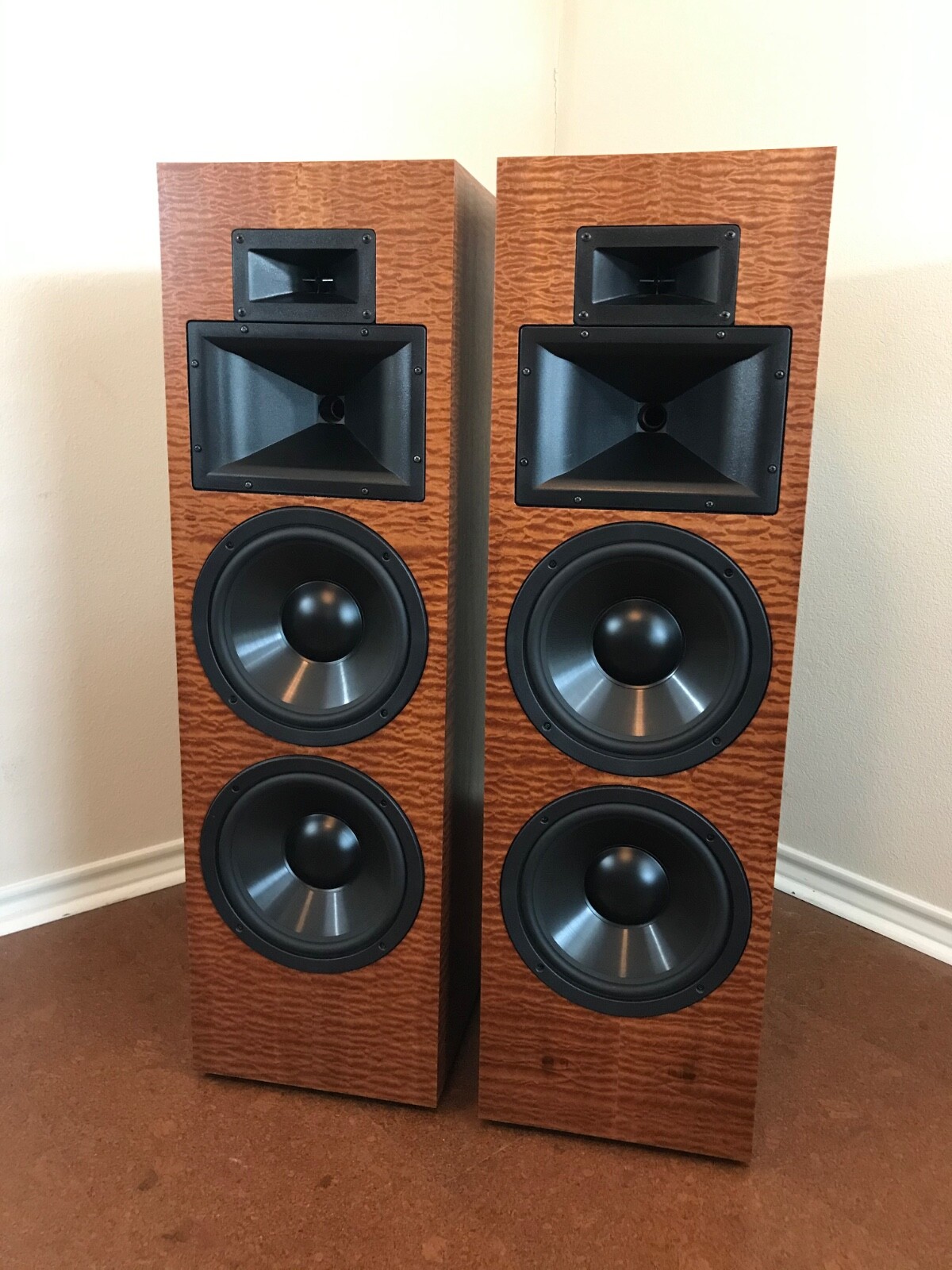
The KLF-30’s technical design is a masterclass in balancing horn-loaded efficiency with deep bass extension. Unlike traditional bookshelf speakers, the KLF-30 employs a three-way, four-driver configuration with a unique hybrid horn system.
| Specification | Detail |
| Type | 3-way, bass-reflex floorstanding |
| Woofer | 12" spun-copper cone, long-throw, dual neodymium magnets |
| Midrange | 9" Tractrix® horn-loaded with titanium diaphragm |
| Tweeter | 1" titanium compression driver on 90° x 90° Tractrix horn |
| Sensitivity | 98 dB (1W/1m) – extremely high |
| Impedance | 8 ohms (nominal), compatible with most amps |
| Frequency Response | 35 Hz – 20 kHz (±3 dB) |
| Crossover Points | 1.8 kHz (midrange/tweeter), 500 Hz (woofer/midrange) |
| Ports | Dual rear-firing bass reflex ports |
| Recommended Amp Power | 20 – 200 watts (excellent with low-power tube amps) |
| Dimensions (H×W×D) | 42.5" × 15.5" × 20.5" (108 × 39.4 × 52.1 cm) |
| Weight | 78 lbs (35.4 kg) per speaker |
The Tractrix horn geometry, a Klipsch innovation, ensures controlled dispersion and reduced diffraction, resulting in precise imaging and reduced coloration. The 12-inch long-throw woofer provides surprising bass depth for a speaker of its era, especially when paired with room gain or a subwoofer.
Sound Quality: Dynamic, Expressive, and Unapologetically Alive
The KLF-30’s sound signature is best described as dynamic, transparent, and emotionally engaging. With a sensitivity of 98 dB, these speakers can sing with just a few watts—making them a favorite among tube amplifier enthusiasts. Whether driven by a 30-watt SET or a robust solid-state powerhouse, the KLF-30 responds with authority and finesse.
- Midrange: The 9" horn-loaded midrange is the soul of the speaker. Vocals are rendered with startling realism, presence, and texture. Instruments like saxophones, violins, and acoustic guitars leap from the soundstage with lifelike immediacy.
- Treble: The titanium tweeter on the Tractrix horn delivers crisp, detailed highs without harshness when properly broken in. Some early units had a slightly aggressive top end, but this typically mellows with age and use.
- Bass: The 12" woofer provides solid, punchy bass down to 35 Hz, though it’s not a substitute for a dedicated subwoofer in large rooms. The bass is tight and fast, avoiding the bloat common in ported designs of the era.
- Soundstage: Exceptionally wide and deep for a non-electrostatic design. The KLF-30 creates a three-dimensional listening experience, with precise instrument placement and excellent front-to-back layering.
These speakers excel with jazz, rock, classical, and vocal recordings, where dynamics and timbral accuracy are paramount. They are less forgiving of poor recordings or bright electronics, as their transparency reveals every flaw in the signal chain.
Notable Features and Innovations
- High-Efficiency Design: 98 dB sensitivity allows use with low-power amplifiers, including vintage tube gear.
- Tractrix Horn Technology: Minimizes horn reflections and improves high-frequency dispersion.
- Dual Rear Ports: Enhance bass response and reduce port noise.
- MDF Cabinet with Real Wood Veneer: Available in elegant finishes—American walnut, black ash, and rosewood—each with a hand-rubbed lacquer finish.
- Bi-Wirable Terminals: Allow separate cabling for bass and mid/high frequencies, offering audiophiles tuning flexibility.
Market Value and Collectibility
Though discontinued in the early 2000s and succeeded by the Synergy S-30, the KLF-30 has seen a steady rise in collectibility. In excellent condition, a pair typically sells for $800–$1,500 on the secondary market, with fully restored or rare finish examples reaching up to $2,000.
Factors influencing value:
- Condition of grilles and finish (original grilles are highly prized)
- Driver integrity (especially the horn tweeter and midrange diaphragm)
- Originality (non-matching pairs or replaced drivers reduce value)
- Market demand in tube-audio and vintage hi-fi circles
While not as rare as vintage Klipschorns, the KLF-30 is increasingly sought after for its unique blend of modern usability and classic Klipsch dynamics.
Common Issues and Maintenance
Despite their robust build, KLF-30s are not immune to age-related issues:
- Tweeter Diaphragm Fatigue: The titanium compression driver can develop a "tired" or harsh sound over decades. Re-foaming or professional reconing may be necessary.
- Port Chuffing: At high volumes, the rear ports can produce audible turbulence. Placing the speakers away from walls (at least 12–18 inches) helps.
- Grille Fabric Deterioration: Original cloth grilles may tear or discolor. Replacement kits are available from specialty audio restoration shops.
- Binding Post Corrosion: Bi-wire terminals can oxidize; cleaning with contact cleaner and proper cabling prevents issues.
Maintenance Tips:
- Break in drivers gradually after long storage.
- Use spike feet to decouple from floor and improve bass control.
- Avoid placing too close to rear walls to prevent bass bloat.
- Consider professional re-foaming every 15–20 years.
Comparison to Similar Models
| Model | Sensitivity | Bass Extension | Horn Design | Notes |
| Klipsch KLF-20 | 97 dB | 40 Hz | Smaller 8" midrange horn | Slightly less bass and dynamics; more compact |
| Klipsch Synergy S-30 | 97 dB | 38 Hz | Rectangular Tractrix | Modern successor; sleeker look, slightly less "vintage" character |
| JBL L100 Classic (2018 reissue) | 88 dB | 45 Hz | Not horn-loaded | Warmer, more colored sound; lower efficiency |
| Tannoy DC6T | 91 dB | 50 Hz | Dual concentric (coaxial) | Smooth, British voicing; less dynamic impact |
| Original Klipschorn (1946) | 105 dB | 31 Hz | Corner-loaded folded horn | Higher efficiency and deeper bass, but room-hogging and less midrange clarity |
The KLF-30 strikes a rare balance—offering near-Klipschorn efficiency and dynamics in a practical, room-friendly cabinet. It outperforms many contemporaries in sheer scale and realism, especially when paired with the right amplifier.
Final Verdict
The Klipsch KLF-30 is more than a speaker—it’s a statement. A bridge between vintage audio philosophy and modern performance, it delivers a thrilling, dynamic listening experience that few speakers of any era can match. For the audiophile who values transparency, power, and emotional engagement, the KLF-30 remains a towering achievement in loudspeaker design. Though no longer in production, its legacy lives on in every note it plays—loud, clear, and utterly alive.
eBay Listings



As an eBay Partner, we earn from qualifying purchases. This helps support our independent vintage technology research.
Related Models
- Klipsch Forte III
- Klipsch KLF-20
- Klipsch KG-2 (1990-1995)
- Klipsch Belle (1985)
- Klipsch Cornwall (1959) (1959)
- Akai AM-2850 (1975)
- Akai AP-206 (1975)
- Nakamichi BX-1 (1985)
- Acoustic Research research-ar-17 (1978)
- Acoustic Research AR-19 (1994)