Klipsch Heresy
1957 – Present
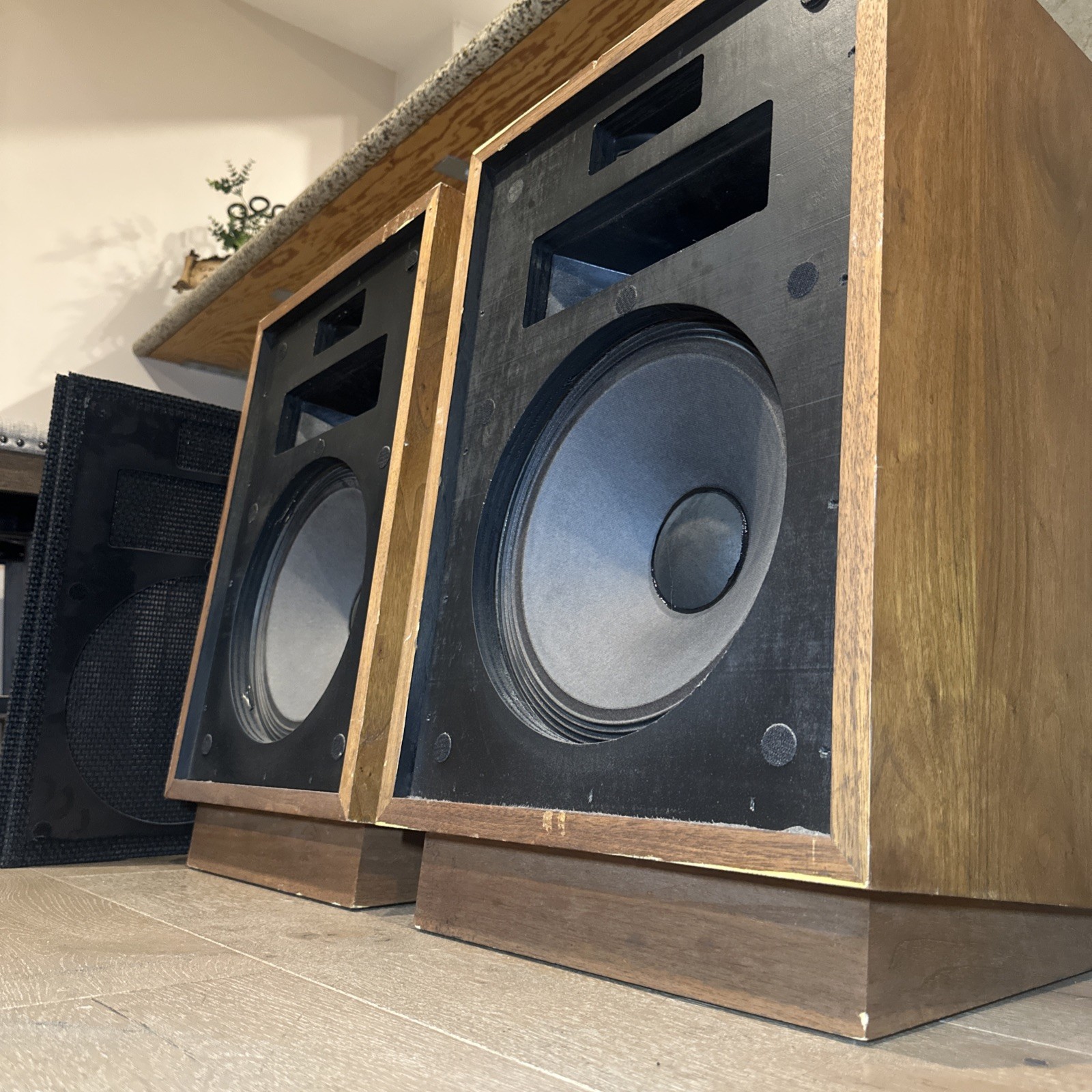
The Klipsch Heresy was originally designed in 1957 as a center channel speaker for Klipschorn stereo systems, hence its provocative name—Paul Klipsch considered it "heretical" to design a Klipsch speaker that didn't use a corner horn. Despite its humble origins, the Heresy became a beloved standalone speaker in its own right and remains in continuous production, making it one of the longest-produced speakers in history.

Wikimedia Commons - CC0
Specifications
| Type | 3-way, acoustic suspension/sealed enclosure |
|---|---|
| Woofer | K-22 12" (30.5cm) fiber-composite cone |
| Midrange | K-55-V, K-55-X, or K-53 2" (5cm) phenolic diaphragm compression driver on K-700 or K-701 exponential horn |
| Tweeter | K-77, K-77-M, or K-77-F 1" (2.54cm) phenolic diaphragm compression driver |
| Crossover Frequencies | Low-Mid: 600-700 Hz, Mid-High: 5000-6000 Hz (varies by generation) |
| Nominal Impedance | 8 Ω or 16 Ω (early models) |
| Power Handling | 100W continuous, 400W peak (vintage models rated at 105W) |
| Sensitivity | 96-99 dB @ 1W/1m (varies by generation) |
| Frequency Response | 50 Hz – 17 kHz (±5 dB, vintage models) |
| Dimensions | 21.375" H x 15.5" W x 13.25" D (54.3 x 39.4 x 33.7 cm) |
| Weight | 75 lbs (34 kg) per speaker |
| Enclosure Material | Birch plywood with book-matched wood veneers |
| Finish Options | Walnut, Cherry, Black Lacquer, Raw Birch (HBR) |
Design Overview
The Heresy represents a departure from the fully horn-loaded philosophy of the Klipschorn. To create a compact center channel that could be placed horizontally between two Klipschorns, Paul Klipsch designed the Heresy with a sealed enclosure and a direct-radiating 12" woofer (the K-22) rather than a horn-loaded 15" woofer.
However, the Heresy maintains the horn-loaded midrange and tweeter that are characteristic of the Heritage series. The K-55 compression driver on its exponential horn provides exceptional clarity and presence, while the K-77 compression driver delivers detailed high frequencies. This hybrid approach—direct-radiating bass with horn-loaded midrange and treble—gives the Heresy a unique sonic character.
The sealed enclosure (acoustic suspension) design provides tight, controlled bass despite the smaller woofer and cabinet compared to the Klipschorn. The angled front baffle is designed for horizontal placement as a center channel, though many owners use Heresies as standalone stereo speakers.
Generational Evolution
- Heresy (1957-1985): Original design with Type E crossover, K-22 woofer, K-55-V midrange, K-77 tweeter
- Heresy II (1985-2005): Updated crossover, improved K-22-E woofer, new grille design
- Heresy III (2006-2019): Major redesign with new drivers, thicker cabinet walls, slant riser for vertical positioning
- Heresy IV (2020-Present): New K-107-TI titanium tweeter, redesigned Tractrix horn, rear port for extended bass
Historical Context
The Heresy was born from necessity. As stereo recordings became popular in the mid-1950s, owners of Klipschorn-based systems needed a center channel speaker for phantom center imaging. Paul Klipsch designed the Heresy specifically for this purpose, creating a speaker that could match the efficiency and tonal balance of the Klipschorn while being compact enough to place between the main speakers.
The name "Heresy" was Paul's own acknowledgment that designing a Klipsch speaker without horn-loaded bass was, in his view, heretical. Yet the speaker proved so popular that it remained in production long after its original purpose became less relevant with the rise of discrete multichannel audio.
Over the decades, the Heresy gained a reputation as a superb near-field monitor and small-room speaker. Its high efficiency, compact size, and exceptional midrange clarity made it popular among audiophiles with modest amplification and listening spaces.
Interestingly, the Heresy has seen a resurgence in popularity in recent years as vintage audio enthusiasts discover its charms. Well-preserved vintage pairs, especially consecutive serial number models, command premium prices on the used market.
Special Versions
- Heresy HBR (Raw Birch): Unfinished birch plywood cabinets, often oiled or left natural
- Industrial Heresy: Black painted finish for commercial installations
- Heresy 1.5: Transitional model between Heresy I and II with some updated components
eBay Listings



As an eBay Partner, we earn from qualifying purchases. This helps support our independent vintage technology research.
Listening Impressions
The Heresy is renowned for its exceptional midrange clarity and presence. The horn-loaded midrange driver delivers vocals and instruments with a palpability and immediacy that few other speakers can match. While the sealed 12" woofer doesn't reach as low as larger ported designs or horn-loaded speakers, the bass it does produce is tight, articulate, and well-integrated with the midrange.
The Heresy excels as a near-field monitor or in small-to-medium rooms. Its high efficiency (96-99 dB) means it can be driven to satisfying levels with just a few watts, making it an excellent match for low-powered tube amplifiers. Many owners pair vintage Heresies with vintage Marantz, McIntosh, or Dynaco tube amps for a classic high-efficiency system.
Documentation
- Heresy IV Technical Specifications (PDF)
- Klipsch Heritage Series Brochure (PDF) - Includes Heresy information
- Official Heresy Product Page
External Resources
- Klipsch Museum of Audio History - Official museum in Hope, Arkansas
- Klipsch Audio Community - Official forums and community
- HiFi Engine Heresy Manual - Scanned original documentation
Related Models
- Klipsch Forte III
- Klipsch KLF-20
- Klipsch KG-2 (1990-1995)
- Klipsch Belle (1985)
- Klipsch Cornwall (1959) (1959)
- Akai AM-2850 (1975)
- Akai AP-206 (1975)
- Nakamichi BX-1 (1985)
- Acoustic Research research-ar-17 (1978)
- Acoustic Research AR-19 (1994)