Klipsch Cornwall
1959 – Present
The Klipsch Cornwall was introduced in 1959 as a full-range alternative to the Heresy, designed specifically for use as a center channel between widely spaced Klipschorns or as a standalone speaker in larger rooms. Named after its birthplace—Cornwall, England, where Paul Klipsch first demonstrated the prototype—the Cornwall offers the high output capability and full-range performance that the smaller Heresy couldn't quite achieve.

Wikimedia Commons - CC0
Specifications
| Type | 3-way, bass-reflex/vented enclosure |
|---|---|
| Woofer | K-33 or K-33-E 15" (38cm) fiber-composite cone |
| Midrange | K-55-V, K-55-X, or K-55-M 2" (5cm) phenolic diaphragm compression driver on K-700 exponential horn |
| Tweeter | K-77, K-77-M, or K-77-F 1" (2.54cm) phenolic diaphragm compression driver |
| Crossover Frequencies | MF: 700 Hz, HF: 5000 Hz (varies by generation) |
| Nominal Impedance | 8 Ω |
| Power Handling | 100W continuous, 400W peak |
| Sensitivity | 101-102 dB @ 2.83V / 1m |
| Frequency Response | 34-38 Hz – 20 kHz (±4 dB, varies by generation) |
| Maximum Acoustic Output | 119 dB SPL continuous |
| Dimensions | 38" H x 25.5" W x 15" D (96.5 x 64.8 x 38.1 cm) |
| Weight | 98 lbs (44.5 kg) per speaker |
| Enclosure Material | Birch plywood with book-matched wood veneers |
| Finish Options | Walnut, Cherry, Black Ash, Raw Birch |
Design Overview
The Cornwall represents a middle ground in the Heritage lineup. Like the Heresy, it uses horn-loaded midrange and tweeter drivers for exceptional clarity and efficiency. However, the Cornwall steps up to a 15" woofer (the same K-33 used in the Klipschorn) and a vented enclosure design that extends bass response significantly below what the sealed Heresy can achieve.
The Cornwall's design philosophy combines the direct-radiating bass approach of the Heresy with the larger woofer and higher output capability needed for bigger rooms. The vented enclosure (bass-reflex) extends the low-frequency response into the mid-30 Hz range, providing satisfying bass for most music without requiring corner placement like the Klipschorn.
The Cornwall was designed to be placed between two Klipschorns in a stereo system, providing the center channel information with similar tonal characteristics but in a more placement-friendly package. Its higher sensitivity (101-102 dB) allows it to keep up with the extremely efficient Klipschorns in multi-channel setups.
Generational Evolution
- Cornwall (1959-1990): Original design with Type B or C crossover, K-33 woofer, K-55-V midrange, K-77 tweeter
- Cornwall II (1990-2005): Updated crossover network, improved cabinet construction
- Cornwall III (2006-2019): Major redesign with new drivers, redesigned horn, thicker cabinet walls
- Cornwall IV (2020-Present): New K-107-TI titanium tweeter on Tractrix horn, redesigned crossover, improved woofer
Historical Context
The Cornwall's origin story is a bit more international than other Klipsch designs. Paul Klipsch first demonstrated the prototype at the Cornwall Hotel in London, England in 1958, hence the name. The speaker was created to fill a specific need: providing high-output, full-range center channel performance in Klipschorn-based stereo systems where the Heresy's smaller 12" woofer and sealed enclosure couldn't deliver enough output or bass extension.
As home audio evolved, the Cornwall found a new life as a standalone stereo speaker. Its combination of high efficiency, full-range response, and placement flexibility (no corner required) made it popular among audiophiles who wanted the Klipsch "live music" sound without the room constraints of the Klipschorn.
The Cornwall also became popular in commercial installations, particularly in restaurants, clubs, and small theaters where its high efficiency and robust construction were valued. Many vintage Cornwall cabinets show the battle scars of years of commercial service.
Production of the original Cornwall continued until 1990, making it one of the longest-produced speakers of its era. When it was discontinued, many enthusiasts mourned its passing, leading to its triumphant return in 2005 with the Cornwall III.
Special Versions
- Cornwall HBR: Raw birch finish, popular among DIY finishers
- Cornwall Industrial: Black painted finish for commercial installations
- Cornwall III SE: Special Edition with premium finishes and upgraded components
- Cornwall IV Special Edition: Premium veneers and upgraded binding posts
eBay Listings
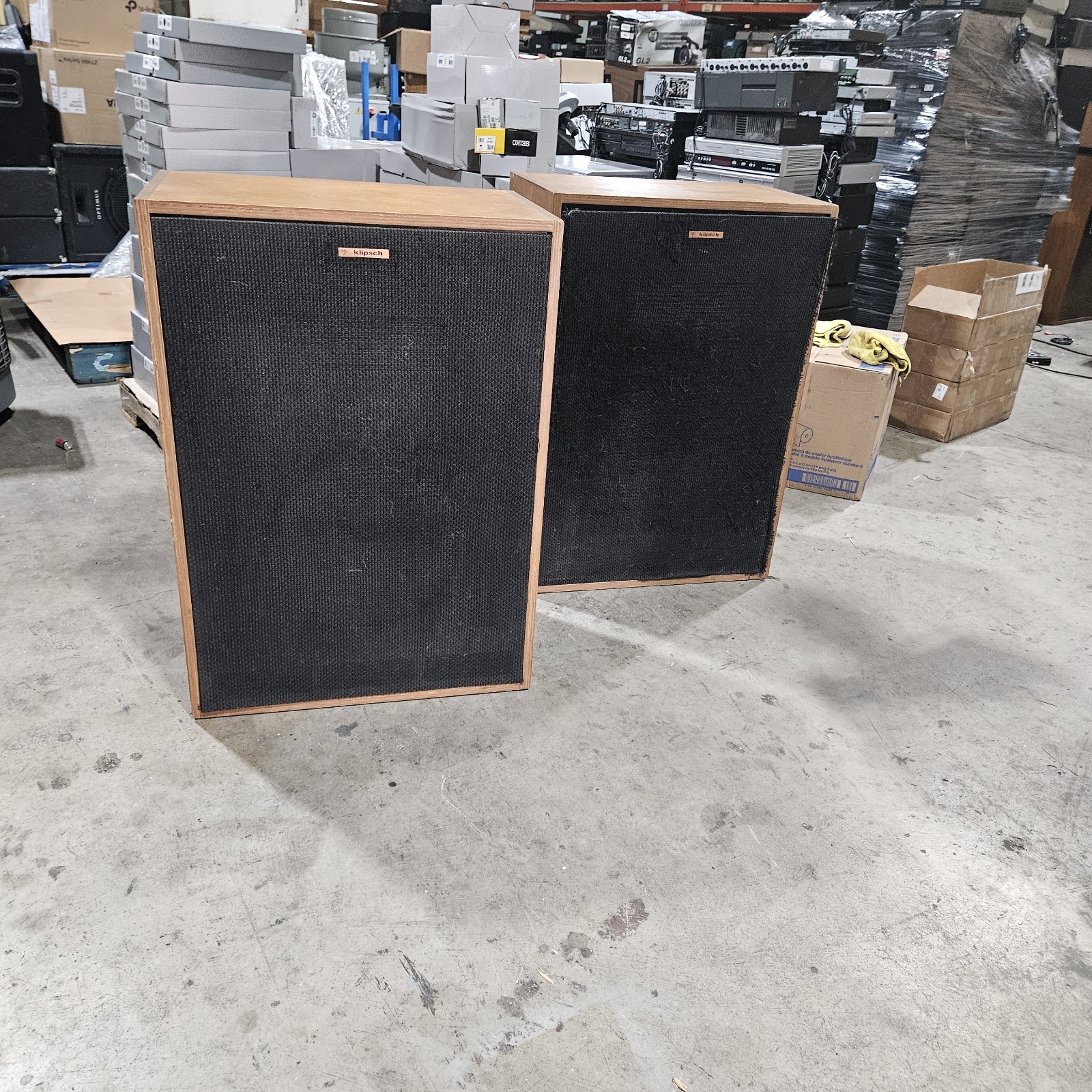


As an eBay Partner, we earn from qualifying purchases. This helps support our independent vintage technology research.
Listening Impressions
The Cornwall delivers the dynamic, uncompressed sound that Klipsch speakers are famous for, with bass response that satisfies for most music genres. While it doesn't reach the subterranean depths of the Klipschorn's corner-loaded bass, the Cornwall's vented 15" woofer provides authoritative low-end that's rare in speakers of this size and efficiency.
The horn-loaded midrange and treble maintain the characteristic Klipsch clarity and presence, with vocals and instruments projecting with a lifelike immediacy. The Cornwall's higher sensitivity (101-102 dB) means that even low-powered tube amplifiers can drive it to satisfying volume levels.
Many enthusiasts consider the Cornwall to be the "sweet spot" in the Heritage lineup—it offers most of the Klipschorn's dynamic capabilities with none of the placement constraints, while providing significantly more bass extension than the Heresy. It's an excellent choice for larger rooms or for those who want the Klipsch sound without needing to rearrange their living space around speaker placement.
Documentation
- Cornwall Technical Specifications (PDF)
- Klipsch Heritage Series Brochure (PDF) - Includes Cornwall information
- Official Cornwall Product Page
External Resources
- Klipsch Museum of Audio History - Official museum in Hope, Arkansas
- Klipsch Audio Community - Official forums and community
- Tone Audio Heritage Series Article - In-depth review and history
Related Models
- Klipsch Forte III
- Klipsch KLF-20
- Klipsch KG-2 (1990-1995)
- Klipsch Belle (1985)
- Klipsch Cornwall (1959) (1959)
- Akai AM-2850 (1975)
- Akai AP-206 (1975)
- Nakamichi BX-1 (1985)
- Acoustic Research research-ar-17 (1978)
- Acoustic Research AR-19 (1994)