Kenwood TS-950SDX (1992–2000)
Fifty kilos of Japanese HF iron with two receivers inside, a built-in power supply, and a price tag that once ran to nearly SEK 55,000.
Overview
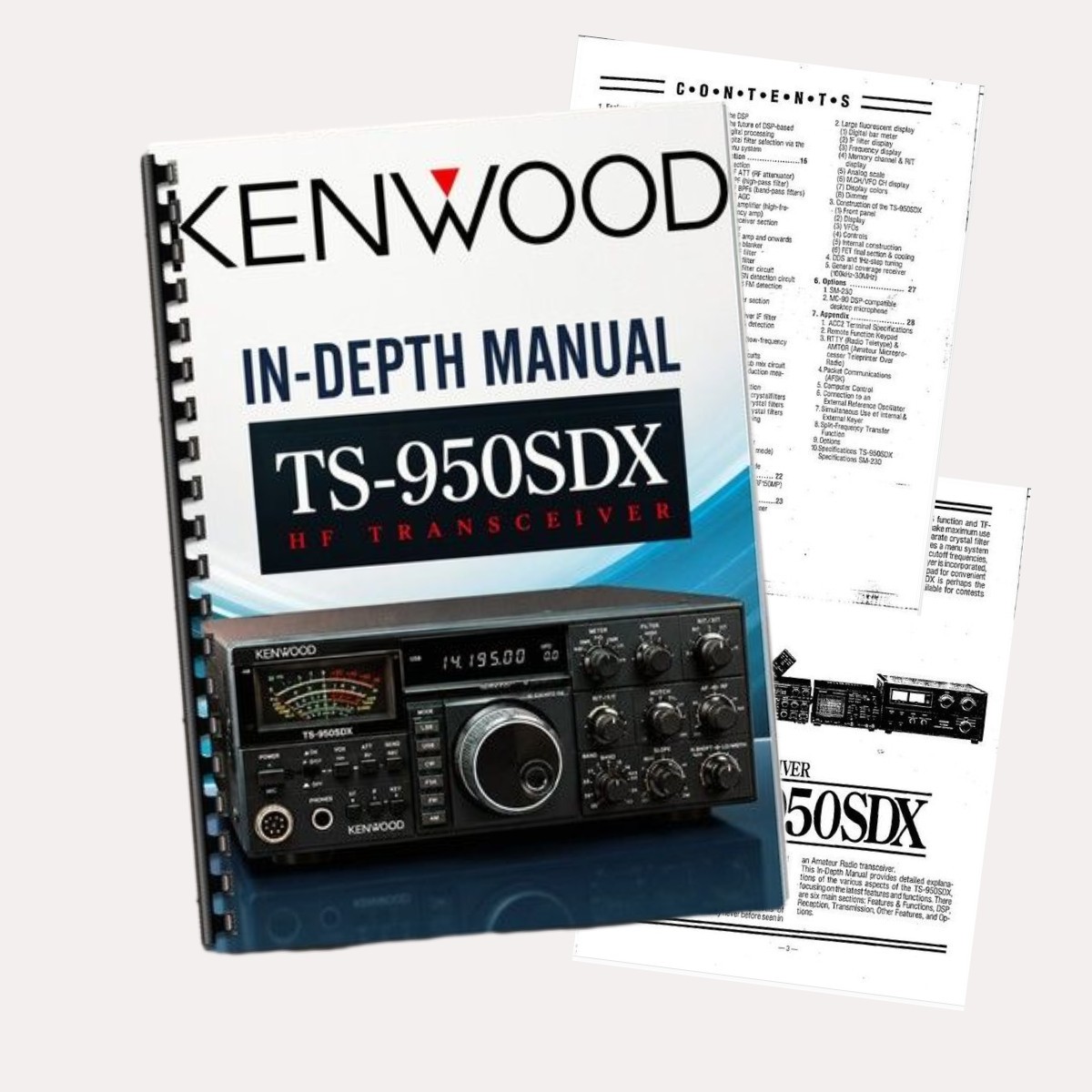
The TS-950SDX is the heaviest big Kenwood HF rig the company ever shipped. It weighs 23 Kg (50.6 lb) and measures 409 × 154 × 446 mm including projections, so it is not a desk accessory. It is a station. The chassis houses a mains power supply that accepts 120, 220, 230, or 240 VAC depending on market. It draws 110 W on receive with no signal present and pulls as much as 700 W on transmit. Plug it into a wall outlet and it does what a separate transceiver, power supply, antenna tuner, and keyer would otherwise do in four boxes.
The radio was launched in 1992 and, according to eHam.net's review listing, remained in production until 2000. The RigPix Database is more cautious and lists the run only as "1992-199x (Discontinued)." Either way, it sat at the top of Kenwood's HF lineup through the 1990s, described by Universal Radio and RigReference.com as "redesigned and enhanced for the serious contester and DX'er." The TS-950S and TS-950SD came first, and the SDX shares a good deal of its architecture with them. Universal Radio notes the line was eventually "replaced by the TS-990S."
The twin receiver is what made it expensive, and it is still what makes the radio interesting. The main receiver runs quadruple conversion superheterodyne for AM, SSB, CW, and FSK (73.05 MHz, 8.83 MHz, 455 kHz, and 100 kHz IFs), switching to triple conversion for FM. The sub receiver is a separate double-conversion design on its own IF chain (40.055 MHz and 10.695 MHz). RigReference.com describes the dual-receiver function as having independent IF circuits, frequency selectors with independent step sizes, noise blankers with level controls, AF controls, and frequency displays. Universal Radio puts it plainly: the general coverage receiver "is capable of receiving two frequencies simultaneously." So you can work a pileup on one band and watch another, or listen to your own transmit audio on the sub while the main receiver stays parked on the DX.
The sensitivity figures back up the contester positioning. On SSB and CW, the main receiver is rated at 0.2 µV for 10 dB S+N/N across 1.62-30 MHz. That rises to 4 µV in the 0.49-1.62 MHz broadcast region and 1 µV down at 0.15-0.49 MHz. AM sensitivity across the same top band is 2 µV, and FM on 28-30 MHz comes in at 0.5 µV for 12 dB SINAD. Image rejection is quoted at 80 dB, and first IF rejection at more than 70 dB. Selectivity is switchable by mode: SSB and FSK at 2.4 kHz ( - 6 dB) and 3.4 kHz ( - 60 dB), CW wide at 400 Hz ( - 6 dB) and 900 Hz ( - 60 dB), AM wide at 6 kHz and 15 kHz, FM at 12 kHz and 24 kHz. A notch filter is rated at more than 45 dB of attenuation, and the RIT range runs ±9.99 kHz.
RF output on 12-160 m is 20-150 W on SSB (PEP), CW, and FSK. On 10 m it drops to 20-110 W, which is a deliberate design choice, not a fault. AM runs 10-40 W on both ranges. RadioMasterList.com summarises the radio simply as a "HF transceiver with DSP, DDS Synthesizer, 150 Watt output." Modulation is low-level for AM, reactance for FM, and balanced for SSB. Factory-set FM deviation is ±5 kHz, spurious emissions are better than - 40 dB, and the microphone input takes a 250-600 ohm source through an 8-pin metal locking-ring connector. AF output is 1.5 W into 8 ohms at 10% distortion, with a 3.5 mm external speaker jack on the rear.
Key Features
Twin Receiver with Independent Controls
The dual-receiver architecture is the reason this radio exists and the reason it weighed what it did. The main and sub receivers do not share IF chains, frequency step selectors, noise blankers, or AF gain. RigReference.com is explicit that each side has its own. That means you can run the main receiver at 10 Hz tuning resolution on a weak CW signal while the sub receiver scans a completely different band at whatever step size suits it. Universal Radio's used listing describes the radio as having "a built-in tuner and power supply" alongside its standard modes, digital readout, and sub-display. That all-in-one approach was unusual at the price point even in 1992.
Built-in DSP on Transmit and Receive
Kenwood's own documentation emphasises "the digital accuracy and reliability offered by the built-in DSP, for both TX and RX." This is early-1990s DSP, so it is not the brick-wall filtering of a modern SDR. The DSP sits alongside a DDS synthesizer, and together they give the radio a frequency stability spec of ±0.5 ppm across - 10 to +50°C (14 to 122°F). That is a handy number when you are chasing a weak signal on 160 m in a cold shack.
Memory, Scanning, and Split Operation
The RigPix Database lists "90 regular with split 10 Programmable VFO tuning limit," stored in RAM with lithium battery backup. The QST review from 1992 (conducted by James W. Healy, NJ2L) counted 100 memories, so the exact tally depends on how you count the split and programmable-VFO slots. There is no dedicated repeater shift. The manual's own phrasing is "No dedicated. Use VFO A/B split or memory split instead." Scanning is more capable than that suggests. Kenwood's documentation notes the radio "can scan up to 10 groups automatically within the limits specified by the programmable band marker, and can also scan sub-receive frequencies."
Built-in Keyer, Auto ATU, and Interface
The rear panel and firmware include a built-in electronic keyer, an automatic antenna tuner that extends the usable load range from a flat 50 ohms out to 20-150 ohms, an RS-232C port for computer control, and a CTCSS/PL encoder. The antenna connector is a standard SO-239. That 20-150 ohm tuner range covers a lot of real-world wire and vertical installations that a 50-ohm-only rig would refuse.
Morse and Voice Announcements
The TS-950SDX will announce front-panel switch status in Morse code. Turn the power on while holding the VOICE key and the radio begins sending band and switch information as CW through the speaker, which helps operators who cannot easily watch the display. The manual also describes an SSB auto mode shift that automatically selects LSB or USB depending on frequency (USB above 9.5 MHz), though the auto selection does not function when RIT is engaged. A separate CW pitch control shifts the 100 kHz IF just before product detection, letting you set a comfortable sidetone without moving the actual transmit or receive frequency.
Data Transfer Between Two Units
The manual devotes a section to transferring operating data between two TS-950SDX transceivers over a 6-pin DIN cable connected to the ACC1 jacks on each radio. One unit acts as master, the other as slave, and operation data, including VFO contents, can be copied across. Kenwood's own notes warn that other functions slow down during the transfer, and that the transfer will not complete if the master is in memory channel mode or the slave is in Quick memory mode. It is a niche feature, and it suggests the radio was designed with multi-op contest stations in mind, where two operators might want matching setups.
Historical Context
The TS-950SDX arrived in 1992 as the third iteration of Kenwood's flagship HF platform, following the TS-950S and TS-950SD. The QST review from that year notes the SDX "shares with the TS-950S/SD" aspects. The most visible changes are that the top hatch of the earlier models is gone and the separate AF gain controls were reworked. Universal Radio and RigReference.com both describe the SDX as "redesigned and enhanced for the serious contester and DX'er." That is marketing language, but it tracks with the twin receiver, the built-in keyer and tuner, and the DSP.
In 1995, a new TS-950SDX sold in Sweden for SEK 54,995, which puts it firmly in the flagship bracket for its market and year. The line was eventually discontinued and, per Universal Radio, replaced by the TS-990S. Operators who used the SDX on the bands have been open about their affection. A YouTube description from PD2AHQ calls it "the best HF transceiver kenwood ever made," and dxzone.com describes it as a "classic HF transceiver" that is "highly regarded by many operators for its performance on the bands." Not every owner's experience was positive, though. A RadioReference.com forum thread is titled "My Kenwood TS-950SDX Nightmare," and a mods.dk entry from August 2011 documents a "TS-950 Jumping S-meter, RF-gain closing, AGC voltage swinging" fault.
Collectibility & Value
The TS-950SDX has held its value better than most 1990s transceivers. Universal Radio's used/sold page records a unit selling for $1,799.95, which is a substantial sum for a radio of this vintage. Accessories trade separately. A used YG-455CN-1 CW crystal filter, which fits the TS-870, TS-950SDX, TS-940S, and TS-850S, sold for $118 on May 28, 2024.
The modification community is active. Documented mods include a 6 kHz eSSB receiver modification with menu and filter changes for both TX and RX (nu9n.com), ESSB audio mods attributed to "voodoo labs," and a general coverage modification dated January 2010 (mods.dk). A service manual is available, and spare parts, including a sub encoder, turn up on eBay.
Two caveats for anyone shopping. First, ask about the known AGC and S-meter fault documented on mods.dk before purchase. It is not a universal problem, but it is a real one. Second, the lithium battery that backs up the RAM storage will eventually fail, and on a radio of this age that is a maintenance item, not a surprise. The fact sheet does not document common failure modes or parts availability in detail, so buyers should do their own checking on any specific unit. The radio is heavy, complex, and full of custom parts, and servicing it is not a casual job.
eBay Listings


As an eBay Partner, we earn from qualifying purchases. This helps support our independent vintage technology research.