Kenwood TS-950S (1990–1991)
Twenty-three kilograms of 1990 HF engineering that still asks for two people and a cleared desk before it moves.
Overview
A big Kenwood makes a solid, final thunk when you set it on a bench. That's the transformer doing real work. The TS-950S is that kind of radio. It weighs 23 kg (50.71 lb) and measures 409 × 154 × 446 mm, so it was never going to sit on a shelf next to a portable QRP rig. Kenwood built it for the operator who wanted one box to do everything on the HF bands. It's an amateur HF transceiver, manufactured 1990-1991 before being discontinued, and it belongs to a family that also includes the TS-950SD and TS-950SDX.
The receiver is where the money went. For AM, SSB, CW, and FSK the main receiver runs a quadruple conversion superheterodyne at 73.05 MHz / 8.83 MHz / 455 kHz / 100 kHz. Switch to FM and it drops to a triple conversion path (73.05 MHz / 8.83 MHz / 455 kHz). There's also a separate sub-receiver running double conversion at 40.055 MHz / 10.695 MHz for SSB, CW, and FSK. That sub-receiver separates the 950S from a lot of its contemporaries. You can monitor a second frequency while working the main VFO, which helps on a crowded band. Kenwood's own documentation groups it alongside general-coverage transmit and the speech processor.
The sensitivity figures show a serious front end. On SSB, CW, and FSK the 1.62-30 MHz range is rated at 0.2 µV for 10 dB S+N/N, which puts it in the top tier of its era. Below 1.62 MHz things get looser, as you'd expect: 4 µV from 0.5-1.62 MHz, 1 µV from 0.15-0.5 MHz, and 2.5 µV down at 0.1-0.15 MHz. AM sensitivity on the same 1.62-30 MHz span is 2 µV. FM, measured at 12 dB SINAD across 28-30 MHz, comes in at 0.5 µV. Selectivity is switchable. Wide AM is 6 kHz (-6 dB) and 15 kHz (-50 dB), narrow AM is 2.4 kHz (-6 dB) and 3.8 kHz (-60 dB), and SSB/CW-wide/FSK all share the 2.4 kHz / 3.8 kHz shape. FM selectivity is 12 kHz (-6 dB) and 24 kHz (-60 dB). Image rejection is rated at 80 dB.
On transmit, the 950S is a full 100-watt-class rig. RF output runs 20-150 W on SSB PEP, CW, and FSK across 12-160 m, dropping to 20-110 W on 10 m. FM matches those figures. AM is the outlier at 10-40 W, which is normal for low-level AM modulation. Spurious emissions are rated better than -40 dB, and maximum FM deviation is factory-set at ±5 kHz. Modulation is low-level for AM, reactance for FM, and balanced for SSB.
Key Features
Quadruple and Triple Conversion Receiver Paths
The 73.05 MHz first IF is the design decision that makes the rest of the receiver work. A high first IF pushes image responses far away from the passband, and the 80 dB image rejection figure reflects that. The 8.83 MHz second IF is where the optional crystal filters live - the YK-88 series. The 455 kHz third IF is where the YG-455 filters go. The 100 kHz fourth IF in the AM/SSB/CW/FSK path is what enables the narrow selectivity settings. This layering is why the radio can be configured with such a wide range of filter options.
Sub-Receiver with Independent Double Conversion
The sub-receiver isn't a stripped-down afterthought. It's a proper double-conversion section with its own 40.055 MHz and 10.695 MHz IFs, covering SSB, CW, and FSK. Kenwood's documentation lists sub-receiver capabilities as one of the headline features.
Built-in Auto-ATU and Keyer
Having the automatic antenna tuner and keyer built in, rather than as outboard boxes, was a real convenience in 1990. It means one power cord, one antenna feed, and no extra shelf space for a tuner that would otherwise cost real money on its own. The tuner is listed as an internal feature on surviving examples, and eBay listings for the 950S Digital specifically call out the internal antenna tuner as a selling point.
100 Memory Channels with Lithium Backup
One hundred regular RAM channels backed by a lithium battery is generous for the period. The battery is also the part most likely to need attention on a 30-plus-year-old example. When it goes, the memories go with it. Check it before buying. It's a maintenance item, not a design flaw.
CTCSS/PL Encoder, 1750 Hz Tone, and 500 kHz Marker
The CTCSS/PL encoder and 1750 Hz repeater tone are there for the FM side, and the 500 kHz marker is a calibration aid that lets you verify dial accuracy against a known reference.
DSP-10 Option and the "TS-950S Digital" Variant
The DSP-10 was an optional DSP unit for the base 950S. Kenwood also shipped a variant called the TS-950S Digital, which the sources describe as identical to the TS-950S but with a set of options installed at the factory: the DSP-10, the SO-2 TCXO, and four crystal filters - the YK-88C-1, YG-455C-1, YG-455CN-1, and YG-455S-1. If you're shopping, the "Digital" badge matters because the expensive optional filters and the high-stability TCXO are already inside. The SO-2 TCXO is rated at ±0.5 ppm, a big step up from the stock ±10 ppm stability spec.
Filter Options Across Two IFs
The filter lineup spans both the 8.83 MHz and 455 kHz IFs. At 8.83 MHz: the YK-88C-1 (CW narrow, 500 Hz), YK-88CN-1 (CW narrow, 270 Hz), and YK-88SN-1 (SSB, 1.8 kHz). At 455 kHz: the YG-455C-1 (CW narrow, 500 Hz), YG-455CN-1 (CW narrow, 250 Hz), and YG-455S-1 (SSB, 2.4 kHz). A radio loaded with the full set is a very different machine from a bare one, and that's the biggest factor in what a used example is worth.
Power Supply and Physical Presence
The 950S runs on mains - 120 / 220 / 230 / 240 VAC ±10%, with a fixed power cord and the voltage depending on which market the unit was sold into. There's no internal switching supply to worry about, which is one less failure point, but it also chains the radio to a wall outlet. Current drain is 110 W on receive with no signal and a maximum of 700 W on transmit. The main antenna connection is a 50 ohm SO-239 for RX/TX, with a separate 50 ohm phono/RCA jack for receive-only use. AF output is 1.5 W into 8 ohms at 10% distortion, and the external speaker jack is a 3.5 mm, 8 ohm connection. The matching SP-950 was the factory option.
Historical Context
The TS-950S was manufactured in 1990 and 1991, and then discontinued. It sits in a family alongside the TS-950SD and TS-950SDX, which Kenwood's own manual documentation describes as transceivers offering "a variety of features for amateur radio operators." That's about as much as the sources commit to on how the three relate. The SD and SDX are named as related models, and a comparison video exists pitting the 950S against the 950SDX, but no explicit lineage or positioning statement was found. What is clear is that the 950S Digital was the factory-loaded version of the base 950S.
A Russian-language listing describes the 950S as "one of the best base HF transceivers from Japan," and DXZone's page on HF radio modifications offers a blunter assessment: "The Kenwood TS-950S and TS-950SD HF transceivers are fine radios." Those are enthusiast and listing-source opinions, not measured review verdicts, so treat them as sentiment rather than specification.
Collectibility & Value
Pricing data is thin. One Avito listing puts a 120 V Kenwood TS-950S at 95,000 ₽. An eBay listing for a "Near Mint KENWOOD HF100W Fixed Mic TS-950S DIGITAL" with internal antenna tuner exists, but the price was not captured in the research. A Collectors and Vintage Technology Auction lot offered a TS-950S Digital described as untested. That's the entire current market picture. It's not enough to establish a reliable price band, so treat any single figure with caution.
On the failure side, a Russian repair-shop order log records a 950S that wouldn't power on ("не включается"). There are also two repair videos: "#143 Kenwood TS950S Part 1(2)" by DL7MAJ (SK) Stefan, and a video titled "Kenwood TS-950 Repair 'TX/RX' Issues." One transmit-related note appears on a Kenwood user manual page, but the source attributes it to TS-950SD owners rather than 950S owners specifically: a transmit image at 18.115 MHz that causes the receiving station to hear distortion on the carrier. Whether that applies to the 950S is not established.
No spare parts availability information, no recap guidance, and no belt or cleaning procedures were found in the research. Buyers should plan on the usual 30-year-old-radio checklist - memory backup battery, electrolytics, and a careful listen on the bands before committing. The sources don't document specific restoration procedures for this model.
The power supply voltage varies by market, and at least one surviving example is a 120 V Japan-market unit. Anyone outside North America should confirm the mains configuration before buying. The fixed power cord means there's no easy voltage switch to flip.
eBay Listings

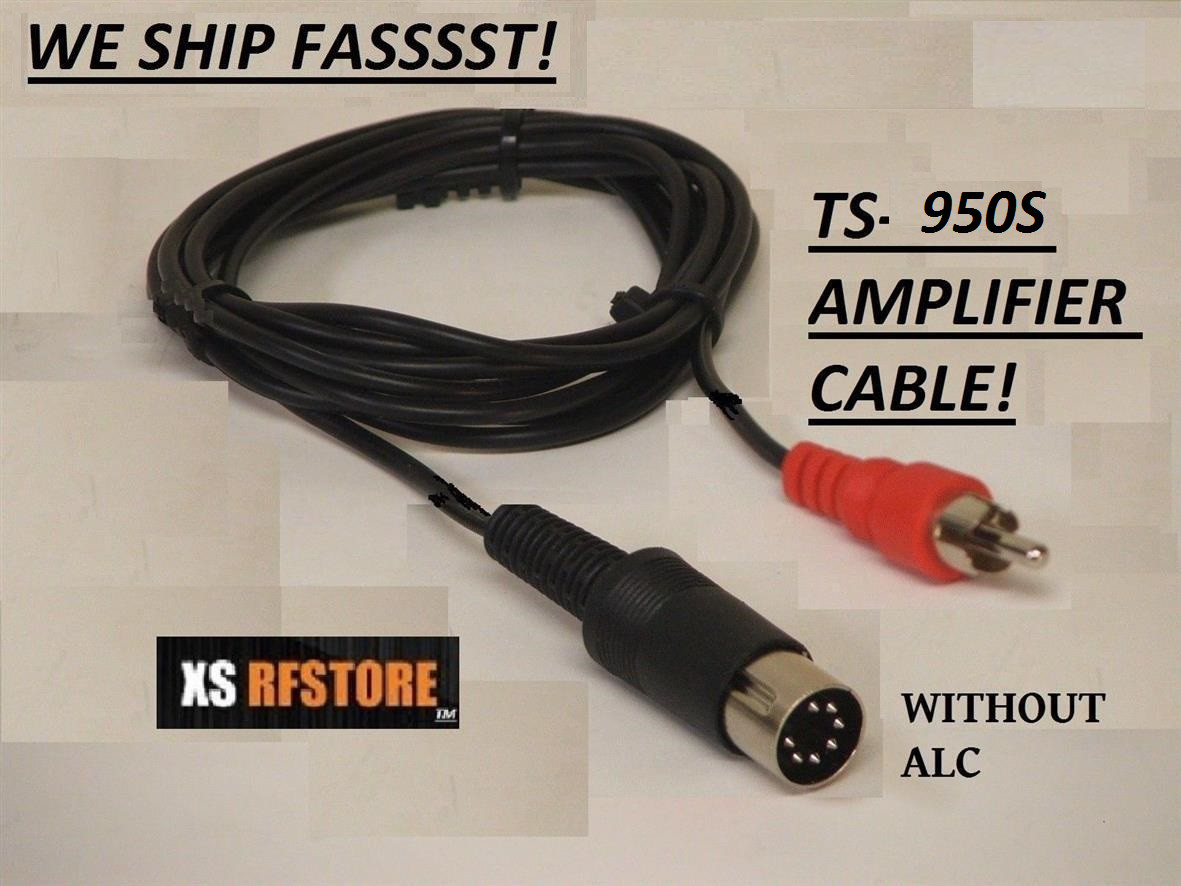


As an eBay Partner, we earn from qualifying purchases. This helps support our independent vintage technology research.