Kenwood TS-440 (Mid-1980s)
A 100-watt HF transceiver that earned a cult following the hard way, and then a reputation as a repair project.
Overview
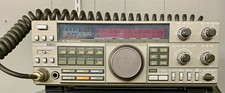
The TS-440 is the kind of radio that shows up at hamfests with a story attached. Kenwood built it as a mobile HF transceiver - the fact sheet cites it as "designed as a mobile transceiver" - and that explains almost everything about how it ages. To survive vibration in a moving vehicle, Kenwood coated parts of the circuit boards in a glue compound, called "goop" in the service documentation, to keep components from shaking loose and drifting the frequency. It was a reasonable engineering decision at the time. Decades later, it became the defining problem of the model.
Production is generally placed in the mid-1980s, with one listing citing an approximately 1985-1988 window, and the radio is long out of production. The core spec is simple: 100 watts of output on the amateur bands from 1.8 to 30 MHz, covering 160 through 10 meters. Most sources agree on the 100-watt figure. The fact sheet does flag a variant, the TS-440V, listed at 10 watts, so buyers comparing listings should confirm which version they're looking at. Original pricing is quoted as an "MSRP: 1200 price class," with no currency specified, which puts it alongside other mid-80s HF rigs of its class. Units were built in Japan.
Mode coverage is broad for the era: SSB, CW, AM, FM, and RTTY, with at least one source listing FSK and AFSK as well. The radio has dual VFOs and memory channels, a built-in antenna tuner, and DSP filtering. The tuner gets talked about a lot, and not always fondly. One owner review notes that it doesn't cover 160 meters, calling it "a strange omission," and points out that unlike newer rigs with tuner memories, the TS-440 needs retuning whenever you change frequency. That mattered less in 1986 than it does now.
The depth of the repair documentation that has built up around the TS-440 is what keeps it interesting. This is not a radio you buy and forget. You buy it with a service manual open, a soldering iron warm, and a realistic idea of how many hours you're willing to put in.
Key Features
100 Watts on 160 Through 10 Meters
The TS-440's headline number is 100 watts of transmit output, across the amateur bands from 1.8 to 30 MHz. The QST review of December 1986 describes coverage from 100 kHz through 30 MHz, which conflicts with the more commonly cited 1.8 MHz low end. The discrepancy likely reflects general-coverage receive versus transmit range, and one listing does separate the two, specifying a 0.5-30 MHz receiver with 1.8-30 MHz transmit. Band coverage is listed as 160, 80, 40, 20, 17, 15, 12, and 10 meters. The 100-watt rating is standard for this class of rig, and it's enough to work serious DX with a decent antenna. The TS-440V variant, listed at 10 watts, appears to be a lower-power version, so verify which model a listing describes before assuming full output.
Built-In Antenna Tuner — With Caveats
Kenwood fitted the TS-440 with a built-in automatic antenna tuner, marketed under the "Auto Tune" name. It's a real convenience for portable and mobile operation, but owner feedback is mixed. The tuner doesn't cover 160 meters, and it lacks the tuner memories found on later radios, so every frequency change needs a fresh tune cycle. Operators used to modern rigs will notice that. Anyone running a single-band or fixed-frequency setup won't.
Dual VFOs, Memory Channels, and DSP Filtering
The radio has dual VFOs and memory channels, so you can flip between two frequencies quickly, which is useful for split operation and for chasing DX. DSP filtering is listed among the features, but the fact sheet has no detailed DSP specifications, so the specifics of filter selection and performance aren't documented here. The DSP mention confirms a feature and nothing more.
The Serial ASCII Interface Option
The TS-440 supports an optional serial ASCII interface. That's computer control, at a time when it was far from standard. Enabling it requires inserting two chips into sockets on the back of the control unit board: IC54, an 8251A UART, and IC55, a CD4040 divider. The same documentation notes that the interface instructions, while written for the TS-440, also apply in their basics to the TS-940, TS-811, and TS-711.
VCO1 and the Four-Oscillator Design
The VCO1 circuit contains four oscillators, each covering a slice of the tuning range: Q21 handles 67-75 MHz, Q22 covers 59.5-67 MHz, Q23 spans 52.5-59.5 MHz, and Q24 covers 45-52.5 MHz. These are the oscillators most vulnerable to the glue problem, because they sit in a circuit where the varicap diode is extremely sensitive to any change in voltage. The fact sheet documents that when the brown glue turns conductive, it can introduce leak currents that throw the oscillator off, producing distortion on receive and strange-sounding SSB on transmit. When the display shows only dots, VCO1 is the first suspect.
Glue Construction — and Why It Matters
Kenwood used two types of glue in the TS-440. One is brown and absorbs water. The other is white and doesn't have that problem. According to the service documentation, Kenwood eventually recognized the issue and switched to a different compound. The brown glue is the one to worry about. Over time it becomes slightly conductive, and in the VCO circuits that conductivity causes leak currents that disrupt the varicap diodes. The test is simple: if you open a TS-440 and see brown glue, you could be headed for trouble. If it's white, that particular problem isn't there. The fact sheet credits this information to W9RWF.
Collectibility & Value
The TS-440 sits in an odd spot in the collector market. It's not a rare radio, and it's not a particularly valuable one. The fact sheet contains no current market prices, and the only pricing data is the original "MSRP: 1200 price class" with no currency specified. Interest comes from the repair documentation and from bringing one back to full function. The radio has a dedicated following, and a repair ecosystem has grown up around it, including a service specifically for "Kenwood TS-440 Dot Repair / Keybounce Service" operating out of Green Bay, Wisconsin.
Buyers should go in with eyes open. The central documented failure is the brown glue turning conductive, which produces distorted receive audio and odd-sounding SSB transmit. The dots-in-display fault traces to VCO1 or to leaky diodes in the Band Pass Filter on the RF unit. Power output can be intermittent, and the keypad can become bouncy. One owner reported buying a direct replacement from Kenwood at the time, though the word "then" suggests that path may no longer be open. Uneven power across bands and loss of reception or transmission above 24 MHz with dots on the display are also documented in forum reports.
Repairing the glue problem is not a casual job. The service documentation warns that the work takes several hours of intensive labor and recommends regular breaks. It also cautions that the glue removal process will probably destroy many components, and that it's easier to clean the board with everything removed. The 2SC2668(Y) transistors are scarce enough that the documentation explicitly warns against destroying them, though they do turn up on eBay. One owner, VK5NNT Neville, documented a gentler approach: pure eucalyptus oil to soften the glue to a jelly-like state, then a scalpel and tweezers to remove it without pulling components. Others have reported success resoldering T22 and surrounding components to fix intermittent problems, and replacing a faulty Q44 to cure PLL oscillator death. A rebuild method note advises building and testing one VCO at a time rather than tackling all four at once.
Parts do surface: switch units, phone parts, handgrips, and IF units appear in the spare-parts market, and manuals exist in Russian and German editions. The TS-440S Repair FAQ by Mike Freeman KC8QNO and the TS-440 Yahoo group are both recommended resources.
eBay Listings



As an eBay Partner, we earn from qualifying purchases. This helps support our independent vintage technology research.