Kenwood TS-430S (1983–198x)
A 6.5 kg all-solid-state HF transceiver that sold for SEK 9,565 in February 1983 and earned a reputation for being fixable - which is not the same thing as being flawless.
Overview
The TS-430S is a Kenwood/Trio amateur HF transceiver built in Japan starting in 1983. Collectors describe it as "popular for its reliability, simplicity, and serviceability." Serviceability is the word that counts. Most 1980s transceivers can be made to work again, but owners report actually enjoying the process on the TS-430S, because the layout is straightforward and the failure modes are documented.
It is an all-solid-state design, which by 1983 was no longer novel but was still the marker of a modern rig. Frequency coverage runs from 160 through 10 meters on transmit, including the WARC bands, and 0.15 to 30 MHz on receive, so it doubles as a general-coverage shortwave receiver. Tuning steps are switchable between 10 Hz, 100 Hz, and 1 MHz. The digital frequency display reads out at 100 Hz or 10 Hz resolution depending on how the operator sets it up. Standard modes are AM, SSB, and CW, with FM available only through the optional FM-430 module.
The radio is not small. It measures 270 × 96 × 275 mm and weighs 6.5 kg (14.3 lb), which makes it "portable if you're motivated" rather than "throw it in a go-bag." It runs on 12-16 VDC and draws about 1.2 A on receive, up to a maximum of 20 A on transmit. That means it wants a real power supply, not a wall wart. The matching PS-430 supply was rated at 13.8 VDC, 20 A (25% duty cycle), which says Kenwood expected contest-style bursts, not continuous carrier.
QST reviewed the TS-430S in 1984, which is a useful anchor for dating the model's active market life. Production is documented as running from 1983 into the later 1980s before discontinuation, though the exact end year is not confirmed in available sources.
Key Features
Double Conversion Superheterodyne Receiver
For SSB, CW, and AM, the TS-430S uses a double conversion superheterodyne receiver with a 48.055 MHz first IF and an 8.83 MHz second IF. With the optional FM-430 module installed, the receiver adds a third conversion stage at 455 kHz, so FM gets its own triple-conversion path. The high first IF is a deliberate choice. It pushes the image response far enough from the passband that a reasonable front-end filter can reject it, without needing an elaborate one. Kenwood rates image rejection at 70 dB and IF rejection at 70 dB or better.
Sensitivity depends on the band, and the numbers show where the receiver is strongest. On SSB and CW, sensitivity is 1 µV from 0.15-0.5 MHz, 4 µV from 0.5-1.8 MHz, and 0.25 µV from 1.8-30 MHz at 10 dB S/N. On AM the same bands measure 13 µV, 40 µV, and 2.5 µV respectively. The HF amateur bands are where this receiver performs. The broadcast and low-frequency coverage is usable but not the point of the radio. With the FM-430 fitted, FM sensitivity is 0.7 µV from 1.8-30 MHz at 12 dB SINAD.
Selectivity on the standard SSB/CW filter is 2.4 kHz at −6 dB and 4.4 kHz at −60 dB. AM selectivity is 6 kHz at −6 dB and 12 kHz at −60 dB. FM, again with the optional module, is 15 kHz at −6 dB and 32 kHz at −60 dB. The SSB figures describe a receiver that passes a clean signal but will not win a pileup against a modern DSP rig. That is why the optional YK-88 series filters exist.
Optional YK-88 Crystal Filters
The TS-430S accepts a family of plug-in crystal filters that let an owner tailor the IF passband to the mode. The YK-88A is a 6 kHz AM filter, the YK-88SN is a 1.8 kHz SSB filter, and the YK-88C and YK-88CN are CW filters at 500 Hz and 270 Hz respectively. Owners who installed the narrow CW filters describe the difference as transformative for crowded-band work. The 270 Hz filter in particular is the difference between hearing one signal and hearing five.
Dual VFOs and Eight Memory Channels
Frequency control is handled by dual digital VFOs, A and B, which can be used for split operation or for recalling two stored frequencies. There are eight regular memory channels backed by RAM with lithium battery backup. Channels 6 and 7 are not ordinary memories. They set the upper and lower band search limits for the programmable band scan. There is no dedicated repeater shift, so split operation goes through the VFO A/B system instead.
Transmitter: 100 Watts on SSB and CW
Final output is rated at a maximum of 100 W on SSB and CW. AM output is roughly 40 W, and FM through the optional module is roughly 60 W. The final amplifier uses two 2SC2290 bipolar transistors, a pair that shows up repeatedly in repair discussions. Modulation differs by mode: SSB uses balanced modulation, AM uses low-level modulation at the IF stage, and FM uses variable reactance direct shift. Maximum FM deviation is factory-set at ±5 kHz.
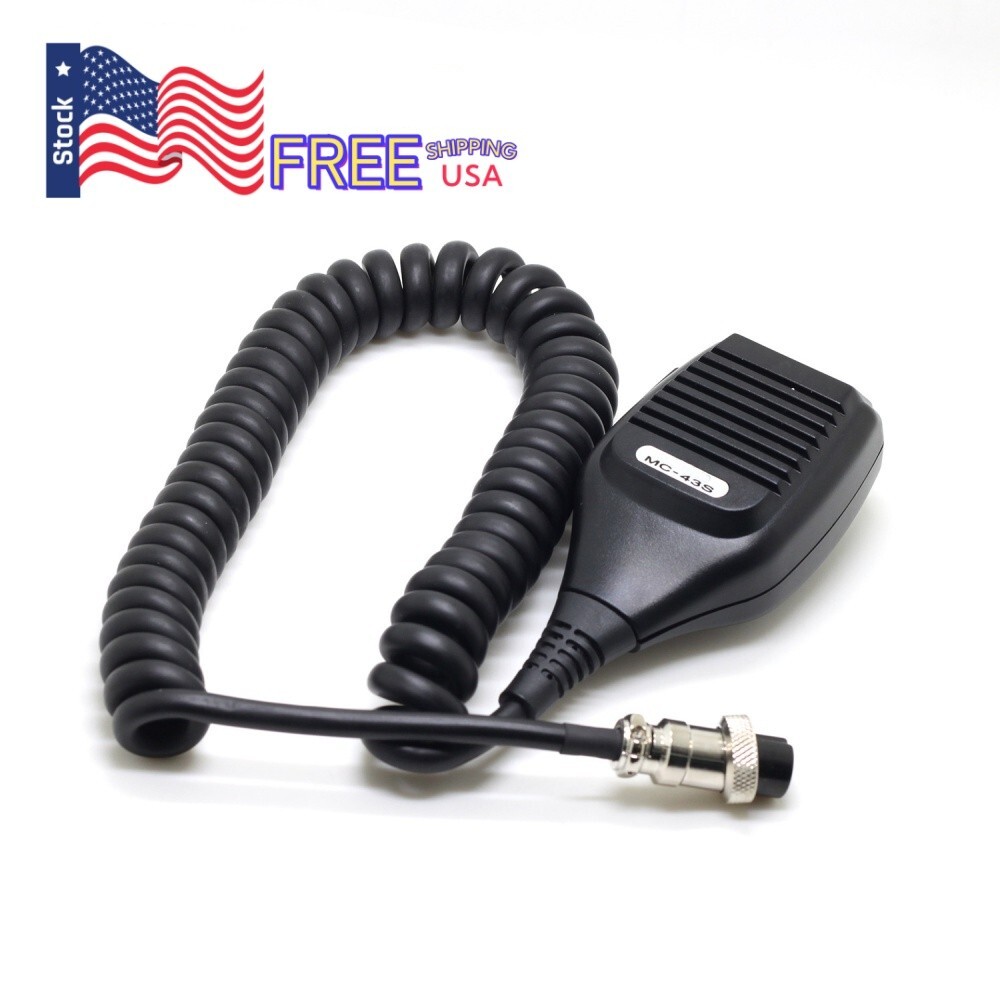
Carrier suppression is better than 40 dB and spurious emissions are better than −40 dB. Audio response is 400-2600 Hz on SSB and 300-2300 Hz on AM. The microphone input accepts 500 ohm to 5 kohm impedance through an 8-pin metal locking ring connector. That is the standard Kenwood wiring of the period, so MC-60A desk mics and most period-correct Kenwood hand mics plug straight in.
Operating Features: IF Shift, Notch, VOX, Noise Blanker
The front panel carries the operating controls. IF shift lets the operator slide the passband to reject an adjacent signal without retuning. A manual analog notch filter handles heterodynes. VOX is built in. The noise blanker has a front-panel adjustable threshold, which is the version you want, since a fixed-threshold blanker is either doing nothing or mangling your audio. AGC is selectable between fast, slow, and off. There is also a +10 dB preamp and a −20 dB attenuator available at the front end.
Rear Panel: What's Actually Back There
The rear apron carries the ANT connector (50 ohm SO-239), a DRV output for transverters or driver stages, a SEND line that grounds on transmit for keying a linear amplifier, ACC jacks for digital-mode interfaces and modems, an EXT SPKR jack that disables the internal speaker when used, and a KEY jack for CW. The KEY jack accepts a straight key or a keyer paddle depending on menu setup. The external speaker connector is 3.5 mm and accepts 4-16 ohm loads. Internal audio output is 1.5 W into 8 ohms at 10% distortion. That is adequate for a shack, not for a noisy field day tent.
Frequency Stability
Kenwood's stability specification is unusually specific: within ±200 Hz from one to sixty minutes after power-on, and within ±30 Hz for any thirty-minute period thereafter. That warm-up drift is the honest part of the spec. The radio is stable once it's warm, but it needs a few minutes before you trust it on a narrow CW signal.
Historical Context
The TS-430S launched in Japan in 1983 at a Swedish price of SEK 9,565 in February of that year. QST reviewed it in 1984, which places the model in the middle of the 1980s HF transceiver market. Production is documented as running from 1983 into the later 1980s before discontinuation, though no source confirms the exact final year.
Kenwood supported the rig with a substantial accessory lineup. The AT-130 covered 10-80 m and the AT-250 covered 10-160 m as automatic antenna tuners. The PS-430 provided matching 13.8 VDC power at 20 A. The SP-430 was the matching 8-ohm external speaker. The MB-430 was a mobile mounting bracket for operators who wanted the rig in a vehicle. The MC-60A was the desk microphone, and the HC-10 was a digital world clock. HS-5 and HS-6 communications headphones rounded out the lineup. The YK-88 filter family let owners upgrade selectivity without replacing the radio. The FM-430 module added FM operation to a rig that otherwise covered only AM, SSB, and CW.
That's a lot of first-party support for a single transceiver, and it tells you Kenwood expected the TS-430S to be a long-term platform rather than a one-season product.
Collectibility & Value
Current market data is messy, as vintage ham gear always is. An aggregator tracking 96 listings reported prices ranging from $9.99 to $674.91 with an average of $86.93, a spread that reflects the gap between parts rigs and working examples with filters installed. A YouTube seller listed one at $475 plus postage. The FM-430 module alone has been listed at $50 plus shipping and PayPal fees, so the accessories sometimes hold value independently of the radio.
The serviceability reputation is real, but so are the failure modes. Documented issues include intermittent power, erratic ALC behavior, and distorted SSB signals. A blank display with no receive on power-up is a reported failure. Memory problems are common enough to have their own modification threads. There is a "No display and high pitch noise" symptom documented from 2015, and a "SSB variable RF power output" issue documented from 2012. The PA transistors and their vias are a known repair area, with a dedicated repair procedure circulating in the community. Kenwood issued service bulletins covering the noise blanker and AGC circuits.
Owner sentiment runs strongly positive despite the faults. One eham.net reviewer recommended picking up a TS-430S for portable use or a small home shack. Another described selling a working TS-430S to buy a modern rig and calling it "a mistake." A third ran one from 1997 to 1999 with both the 500 Hz and 1.8 kHz filters and the FM unit installed. On the negative side, at least one buyer received a unit with only 20 W output and a defective transmitter.
Spare parts do circulate. Original front memory button boards and used encoders have both appeared for sale. The service manual is available through community sources. For anyone considering a TS-430S today, the practical advice is the same as for any 1980s transceiver: assume you will need to open it, assume the PA transistors may need attention, and price accordingly.
eBay Listings


As an eBay Partner, we earn from qualifying purchases. This helps support our independent vintage technology research.