Kenwood PS-53 (1992–199x)
A 15-pound transformer brick that feeds Kenwood's HF rigs and, decades later, still refuses to quit.
Overview
The first thing you notice when a PS-53 lands on the bench is the weight: 6.9 kg, or 15.2 lb, in a chassis measuring 173 × 96 × 296 mm. That's a lot of iron for a box that only has to deliver 13.8 VDC. But the PS-53 is a linear regulated supply, and that means a real transformer, real heatsinking, and real mass. Radio operators trusted this kind of design to sit under a transceiver for years without drama.
Kenwood built the PS-53 in Japan starting in 1992. It was discontinued sometime in the 1990s, and the exact end of production isn't documented. It was sold worldwide in region-specific versions, so check before buying one sight-unseen. The U.S.A. and Canada version takes 120 VAC ±10%. The Europe and general-markets version is switchable between 120 and 220-230 VAC ±10%. The U.K. and Oceania version runs on 240 VAC ±10%. Universal Radio's catalog listing describes the North American input as 120 VAC 60 Hz. If the wall voltage doesn't match the chassis label, the supply needs a step-up or step-down transformer in front of it.
The output side is where the PS-53 earns its keep. It delivers 13.8 VDC at three different duty-cycle ratings: 16 A at 50% duty cycle, 20.5 A continuous for a maximum of one hour, and 22.5 A at 25% duty cycle. That ladder shows what the supply was built for. Amateur radio transmission is intermittent, and the supply can rest between overs. A 20-amp-class HF transceiver on SSB or CW is the load profile it was designed around. Parking it at 22.5 A indefinitely is not.
Ripple is specified at less than 20 mV RMS at 13.8 VDC / 16 A, and regulation holds within ±0.7 V across a 240 VAC ±10% input variation. For a radio, clean DC means no hum on the audio, and tight regulation means the transceiver's finals see a stable rail even when the mains sag.
Key Features
Linear Regulation with a Real Transformer
The PS-53 is consistently described as a transformer-type supply. eHam.net classified listings call it a "transformer type power supply," and one owner on eHam.net sums it up as "a great linear PS." A linear supply regulates by dissipating excess voltage as heat rather than switching it at high frequency. That is why the PS-53 weighs what it weighs and why it runs warm. The upside is a clean, quiet output that RF operators have traditionally preferred over switchers, particularly on HF where switching noise can show up as birdies across the band.
Three-Tier Duty Cycle Rating
Kenwood didn't publish a single output current figure for the PS-53. It published three. The 16 A figure at 50% duty cycle is the everyday continuous-ish rating. The 20.5 A figure is good for continuous operation up to one hour, which covers a long ragchew or a contest run before the supply needs to cool. The 22.5 A figure at 25% duty cycle is the peak capability for short bursts. Universal Radio's catalog copy lays out the same numbers: "13.8 VDC at 20.5 Amps (max continuous operation one hour)" or "22.5 Amps at 25% duty cycle." Owners who treat 22.5 A as a continuous number will cook something.
Region-Specific Input Configurations
Three distinct input versions shipped: 120 VAC ±10% for the U.S.A. and Canada, a switchable 120 / 220-230 VAC ±10% version for Europe and general markets, and 240 VAC ±10% for the U.K. and Oceania. The service documentation notes that fuse ratings differ by region as well. The fuse holder sits on the rear panel on the U.S.A. version but inside the top cover on other versions. Anyone servicing a PS-53 from a market other than their own should check the fuse rating before powering it up.
Bail and Front-Panel Controls
The owner's manual lists a bail for elevating the front panel, a power switch, a power-on indicator, output terminals, a fuse holder, and the captive AC power cable. The front panel is minimal - no meters, no voltage trim. The manual's operating note is specific about sequencing: turn the power supply on before the radio, and when the protection circuit trips, turn both the radio and the supply off before restarting the sequence.
Historical Context
Kenwood manufactured the PS-53 in Japan from 1992 into the 1990s, when it was discontinued. The supply was aimed squarely at Kenwood's HF transceiver line. An eHam.net classified listing states it "matches Kenwood TS450/850 line," and a MEDAN RADIO listing describes it as suitable for the Kenwood TS450S, TS690S, and TS570. The PS-33 and PS-53 are documented together. An instruction manual covering both models exists, and the two are frequently listed side by side in parts catalogs. The relationship between the two models isn't documented beyond that shared manual title, so it's not possible to say which was the higher or lower model in a lineup.
One point of comparison survives in the record: an owner on eHam.net noted that the Icom PS-125 is "definitely more compact than the Kenwood power supply." That's a size observation, not a performance verdict.
Collectibility & Value
The PS-53 has a modest following among operators running older Kenwood HF gear. A working example was listed on eHam.net classifieds at $150 shipped and insured within the continental U.S., which is a reasonable anchor for the current used market. A MEDAN RADIO listing marked "terjual" (sold) shows there's demand in overseas markets as well, though no price was shown.
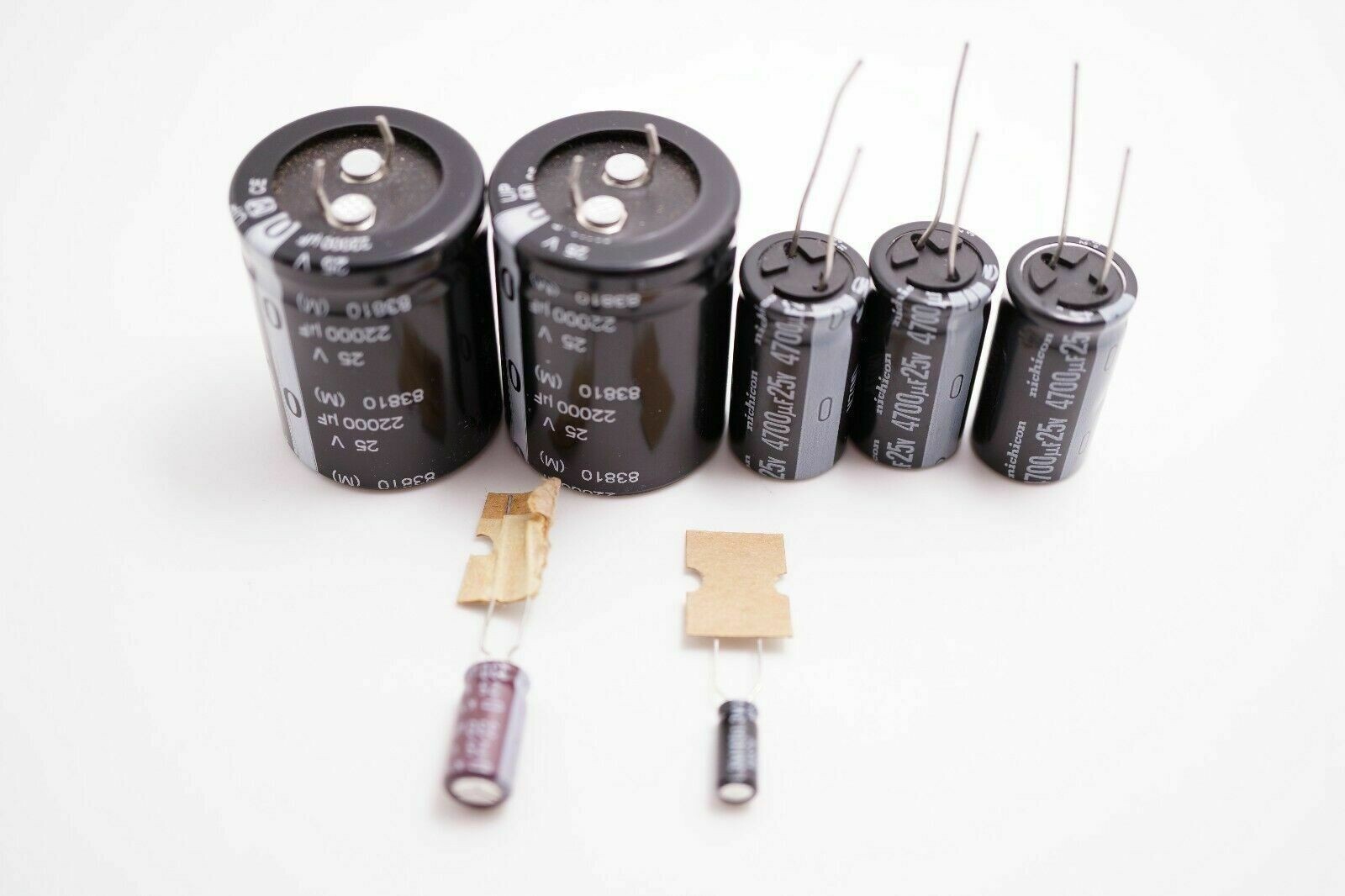
A capacitor replacement kit covering the PS-53, PS-50, and PS-33 is available, listed on eBay and priced at 16,335 rubles from a Russian vendor. That implies the electrolytics are the known service item on these supplies. No source explicitly documents common failure modes. Anyone buying a PS-53 should expect to inspect the capacitors, particularly if the unit has been sitting unused.
Cosmetic condition varies widely. One seller noted the original paint on the top cover had gone dull, and another flagged a slight dent on a cover corner. These are cosmetic issues on a 15-pound brick, not functional ones, but they affect what a buyer should pay. Manuals are easy to find: ManualsLib lists four free PDF downloads of the instruction manual, and the document runs five pages.
eBay Listings



As an eBay Partner, we earn from qualifying purchases. This helps support our independent vintage technology research.