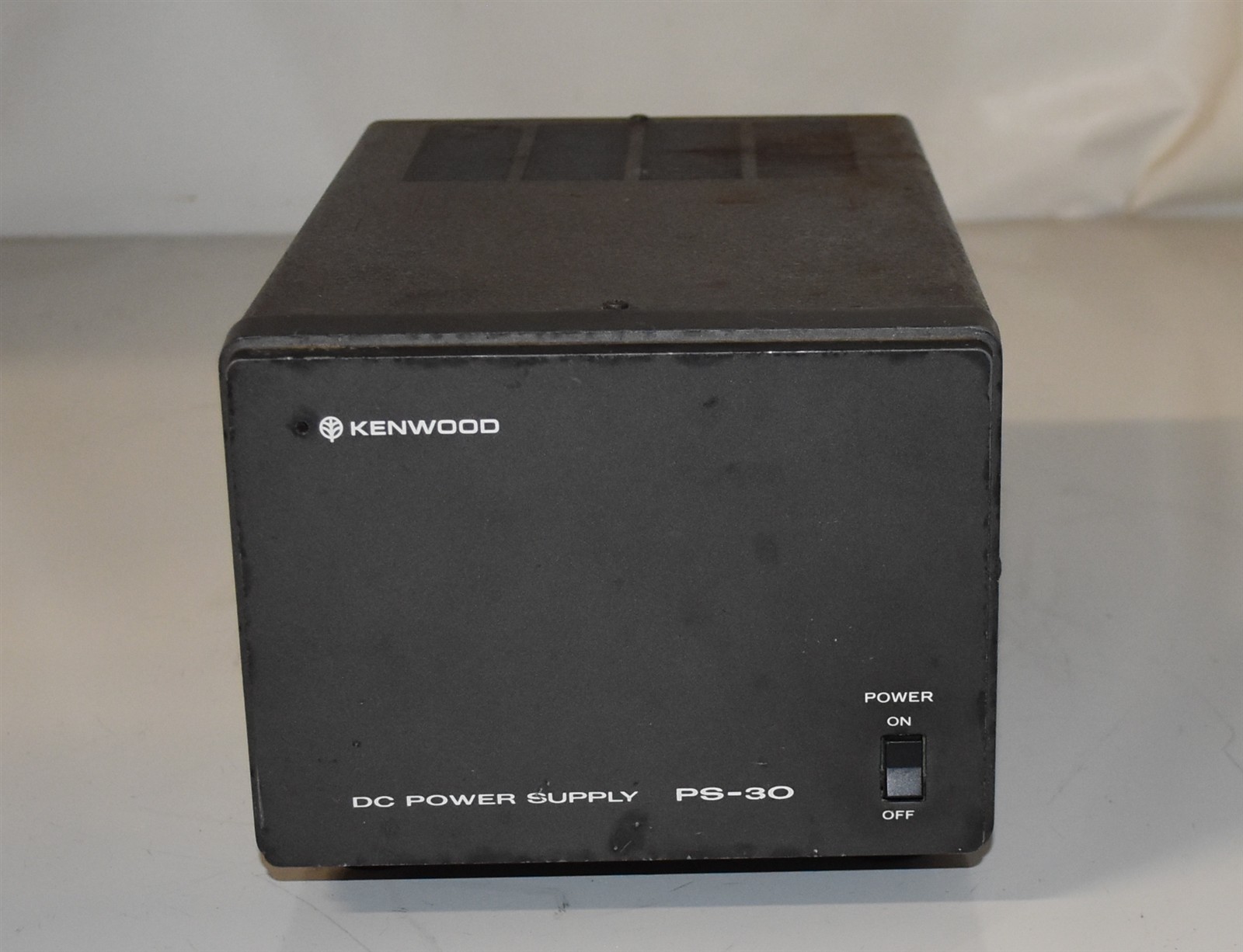
Kenwood PS-30
A 20-amp regulated DC supply built to feed a transceiver - and anything else you hang off its binding posts.
HiFI-Stereo (September 1986, p.16) noted in its letters column that a notable exception to the assumption that most Audio-Technica products are made in Japan had been observed. Country-of-origin assumptions about Japanese audio gear of this era were not always reliable.
Overview
It delivers 13.8 VDC at 20 A on a 50% duty cycle, with a continuous load current of 15 A max. That 15 A ceiling includes whatever you draw from the external output terminals, so count your accessories. The 20 A figure is the intermittent rating. The 15 A is the number you live with hour after hour. Output voltage fluctuation is held to within ±0.7 V at AC 120 V, 220 V, or 240 V ± 10%, and within 0.7 V across a 2-15 A load swing. No-load output voltage sits below 16 V. The manual flags that as normal behavior, not a fault, so if you power it up with nothing connected and see roughly 16 V on a meter, that's the design.
Ripple is specified at less than 20 mV (rms) at 13.8 V and 15 A. For a transceiver that's the number that matters most in practice, because dirty DC gets into the RF chain and you hear it as hash on receive. Twenty millivolts is a respectable figure for a supply of this class. Power consumption runs approximately 470 W at 120/220/240 VAC with a 20 A load, so it draws real current from the wall when it's working hard.
The physical package is modest: 180 mm wide, 133 mm high, and 287 mm deep (that's 7-1/8" × 5-1/4" × 11-5/16"), weighing in at approximately 8.9 kg - about 20 lbs. That weight is a decent proxy for what's inside. A supply this size at nearly nine kilos has a substantial transformer and heatsinking, not a switching brick's worth of components.
Two line-voltage versions exist: a 120/220 V model and a 220/240 V model. Confirm which one you're getting before plugging in, because the wrong one is not a trivial mistake. Input tolerance is ±10% at 50/60 Hz, so it's not fussy about modest line sag, but it is fussy about being wired for the correct mains voltage.
The manual is emphatic about one quirk: turn the PS-30 on *before* the transceiver. If the transceiver's power switch is already on when the supply comes up, more than 2 A flows into the rig immediately, and if the transceiver is sitting in transmit mode it will actually transmit. The PS-30 has a protection circuit that refuses to operate if you turn it on after a transmitting transceiver is already powered. So the sequence decides whether the supply works or shuts itself down. The unit also won't operate into shorted output terminals, and the fuses will blow under overload. Kenwood recommends the heaviest and shortest DC power cable you can manage. Excessive cable length drops output voltage or lets induced RF trigger premature protective shutdown.
Beyond the transceiver, the PS-30 offers external output terminals rated for 5 A max for running additional equipment. Between that and the 15 A continuous ceiling, there's headroom for a modest accessory load alongside the rig. The manual is clear, though, that when connecting two or more transceivers or using the supply for any other purpose, you check the operating current against the rated limit first.
Service documentation is thorough by the standards of the era. The manual covers ordering spare parts by model and serial number, schematic number, PCB number, and part number, and it instructs owners to pack the unit in its original box for repair. Factory adjustments are preset, and Kenwood warns that attempting service without factory authorization can void the warranty. This is not a user-serviceable piece of gear in the way a turntable or a cassette deck might be.
For anyone running a TS-120S or TS-180S today, the PS-30 remains the correct matching supply, and its 13.8 V / 15 A continuous output makes it useful well beyond that one pairing. Collectors note that the two mains-voltage variants complicate sourcing - a 220/240 V unit is useless on North American mains without a step-up transformer, and vice versa. As with any supply of this age, the electrolytics and the pass transistors are the parts to inspect. Understand the protection circuit behavior described in the manual before you assume a dead unit is actually dead.
eBay Listings


As an eBay Partner, we earn from qualifying purchases. This helps support our independent vintage technology research.