Kenwood KM 205 (1980–1982)
When those red LED power meters flare to life, you know you’re not dealing with some polite audiophile amplifier — this is a raw, unapologetic muscle amp from the dawn of the 150-watt era.
Overview
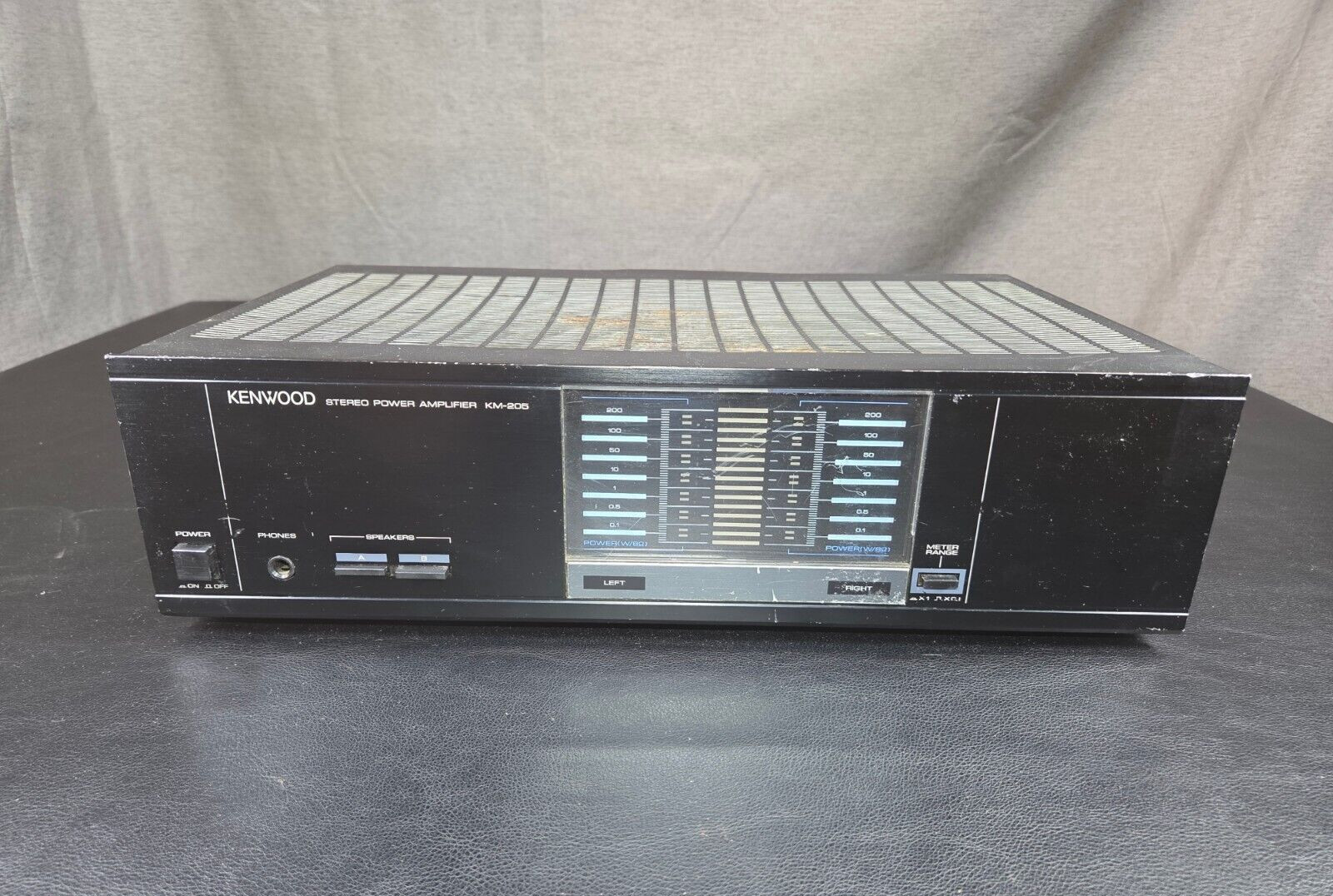
Flip the power switch on a Kenwood KM 205 and the front panel erupts in crimson — twin LED VU-style meters climb with a faint relay click, glowing like embers in a black-and-silver chassis that looks more like a piece of industrial test equipment than home audio gear. This isn’t subtle. It’s not trying to disappear into your rack. The KM 205 announces itself, and once you crank it, you understand why: 150 watts per channel into 8 ohms, delivered with a brute-force confidence that defined early '80s Japanese power amplification. For its time, that number was borderline excessive — a spec-sheet flex aimed squarely at the muscle-bound end of the market, where "more watts" still meant "better sound" to most buyers.
But behind the theatrical lighting and bold power claims lies a surprisingly serious amplifier. The KM 205 wasn’t just a wattage demo; it was a high-current design with a robust toroidal transformer, substantial filter capacitance, and a fully discrete output stage built to handle demanding speaker loads without flinching. It’s the kind of amp that can slam a pair of AR-3acs into submission or breathe fire into inefficient vintage horns without breaking a sweat. Transient response is sharp, bass is deep and tightly controlled, and the midrange carries a slight forwardness that keeps vocals and guitars from getting lost in the mix — a sonic signature that feels more "live" than "hi-fi."
Positioned in Kenwood’s lineup as a standalone power amplifier, the KM 205 sat above their integrated receivers and below the more refined, higher-end models like the KM-991. It wasn’t the company’s flagship, but it was their statement piece for buyers who wanted maximum power and visual drama without stepping into exotic (and expensive) DC-coupled or fully balanced designs. It shared DNA with Kenwood’s "Basic Series" preamps and integrated amps — clean signal paths, conservative feedback topology, and an emphasis on reliability — but with the volume turned all the way up, both literally and figuratively.
One thing becomes clear after spending time with this amp: it was built for driving, not dissecting. It doesn’t offer the velvet-smooth refinement of a late-'70s Luxman or the surgical neutrality of a high-end Accuphase. Instead, it delivers energy, slam, and a sense of immediacy that feels more rock concert than recital hall. That makes it a favorite among owners pairing it with dynamic, mid-centric speakers — think vintage Tannoys, Altecs, or even modern high-efficiency designs that thrive on current. It’s not the most nuanced amplifier ever made, but when you want your system to punch you in the chest, few vintage amps do it with this much authority.
Specifications
| Manufacturer | Kenwood Corporation |
| Production Years | 1980–1982 |
| Original Price | Not available |
| Power Output (RMS) | 150 watts per channel into 8Ω |
| Power Output (RMS) | 200 watts per channel into 4Ω |
| Frequency Response | 20Hz–20kHz (±0.5dB) |
| Total Harmonic Distortion (THD) | 0.05% at full power |
| Input Sensitivity | 0.5V for full output |
| Input Impedance | 47kΩ |
| Damping Factor | 100 (8Ω, 1kHz) |
| Slew Rate | Not available |
| S/N Ratio | 105dB (IHF-A weighted) |
| Channel Separation | 50dB at 1kHz |
| Inputs | 1 pair RCA (unbalanced) |
| Outputs | Speaker terminals (binding posts) |
| Headphone Output | Yes (¼" jack on front panel) |
| Protection Circuitry | DC offset, thermal, short-circuit |
| Power Supply | Discrete regulated dual rail |
| Weight | 12.5 kg (27.6 lbs) |
| Dimensions (W×H×D) | 435 × 149 × 335 mm (17.1 × 5.9 × 13.2 in) |
| Front Panel Display | Red LED power meters (dual channel) |
Key Features
The Red LED Power Meters: More Than Just Show
Those twin red LED arrays aren’t just for show — they’re functional power meters calibrated to reflect real-time output levels, and they’re one of the most distinctive visual elements of the KM 205. Unlike simple clip indicators or static LED bars, these meters actually track the dynamics of the music, climbing and falling with the signal in a way that feels almost analog despite being solid-state. They’re satisfying to watch during a loud passage, and they serve a practical purpose: catching clipping or imbalance before it damages speakers. But let’s be honest — most owners love them because they look cool. In a dim room, the KM 205 glows like a piece of retro-futuristic lab gear, and that visual drama is part of its charm. Service technicians observe that the LED driver circuits are generally reliable, but aging can cause uneven illumination or dimming, often due to failing current-limiting resistors or dried solder joints.
High-Current Discrete Output Stage
Under the hood, the KM 205 relies on a fully discrete amplifier design with no ICs in the signal path — a point of pride for Kenwood at the time. The output stage uses multiple parallel pairs of high-current bipolar transistors per channel, fed by a hefty toroidal transformer and large electrolytic capacitor banks. This architecture delivers excellent current delivery, which translates to strong control over speaker cones, especially with low-impedance or reactive loads. The high damping factor of 100 helps tighten bass response, reducing flab and improving articulation. While not a DC-coupled design like some contemporaries, the KM 205 uses direct-coupled voltage amplification stages to minimize phase shift and preserve transient detail. The result is an amp that feels fast and responsive, even if it doesn’t quite match the micro-detail retrieval of more refined designs.
Front-Panel Headphone Amplifier and Monitoring
A rare feature for a standalone power amp of this era, the KM 205 includes a dedicated ¼" headphone output on the front panel — a nod to its dual role as both a high-power amplifier and a monitoring tool. The headphone amp is driven directly from the preamp-level signal, bypassing the main output stage, and delivers clean, high-volume output suitable for most dynamic headphones. While not a match for modern dedicated headphone amps, it’s surprisingly capable and adds real utility. Owners report using it for late-night listening or quick speaker comparisons without needing an external preamp. The inclusion of this feature suggests Kenwood was targeting not just home stereo enthusiasts but also semi-pro users and studio tinkerers who valued flexibility.
Historical Context
The early 1980s were a transitional period in high-fidelity audio — the tail end of the "power wars" where manufacturers competed to offer ever-higher wattage ratings, often at the expense of measured performance. The Kenwood KM 205 arrived in 1980, right in the middle of this trend, and its 150-watt rating was a bold claim at a time when many competing amps were still hovering around 50–80 watts. Kenwood wasn’t alone — brands like Pioneer, Sony, and Yamaha were pushing similar power figures — but the KM 205 stood out for delivering that power with a more conservative, high-current design rather than relying on inflated peak ratings or narrow bandwidth measurements.
It competed directly with amplifiers like the Pioneer SA-7800, the Yamaha B-7, and the Sansui AU-D30000 — all high-power, feature-laden amps aimed at the performance-conscious buyer. Unlike some of its rivals, the KM 205 avoided exotic (and failure-prone) technologies like quasi-complementary output stages or full DC coupling, opting instead for a proven, robust topology. This made it more reliable than some contemporaries, though it lacked the cutting-edge refinement of higher-end models from Accuphase or Luxman.
Kenwood’s broader product strategy at the time emphasized integration — their "Basic Series" included matching preamps, tuners, and power amps designed to work together. The KM 205 was the muscle car of that lineup, intended to be paired with a control amp like the KC-207 or KC-209. While it could function as a standalone power amp in a separates system, it was clearly designed with Kenwood’s ecosystem in mind. This integration philosophy helped Kenwood maintain consistency in sound character and build quality across their range, even as they pushed into higher power categories.
Collectibility & Value
Today, the Kenwood KM 205 occupies a curious niche in the vintage audio market — not quite rare, not quite legendary, but increasingly appreciated for what it does well. It’s not a "holy grail" amp, but it’s a solid performer that offers real value for buyers seeking high power and a distinctive look. Prices on the used market typically range from $100 to $250, depending on condition, with fully functional units in excellent cosmetic shape commanding the upper end. Non-working or "for parts" units can be found for under $80, making them tempting restoration projects.
The most common failure points are predictable for an amp of this age. Aging electrolytic capacitors — especially in the power supply and output stage — are the primary concern. If an KM 205 has never been recapped, it should be assumed that it needs it. Failure to address this can lead to hum, instability, or even catastrophic failure. The red LED meters, while robust, can suffer from dimming or uneven response due to failing current-limiting resistors or cold solder joints on the display PCB. The front-panel headphone jack is another weak point — mechanical stress over decades can crack solder joints or damage internal switching contacts.
Relay contacts in the speaker protection circuit are also prone to oxidation, which can cause intermittent sound or complete channel dropouts. This is often misdiagnosed as an output transistor failure, but cleaning or replacing the relay usually resolves the issue. Thermal paste on the output transistor heatsinks tends to dry out after 40+ years, reducing heat transfer efficiency and increasing the risk of thermal shutdown or transistor failure — a simple repaste is essential during any restoration.
Buyers should always verify that both channels are functioning at full volume, that the LED meters respond symmetrically, and that there’s no excessive hum or buzz at idle. A functioning headphone output is a good sign of healthy pre-driver stages. While not a high-maintenance amp by vintage standards, the KM 205 rewards proactive servicing. A properly restored unit can deliver decades of reliable performance — and turn heads every time you hit play.
eBay Listings



As an eBay Partner, we earn from qualifying purchases. This helps support our independent vintage technology research.
Related Models
- Kenwood KA 990EX (1980-1981)
- Kenwood KA 400 (1970-1972)
- Kenwood KR 7020 (1977-1979)
- Kenwood kx-1010 (1982-1984)
- Kenwood kx-630 (1980-1982)
- Akai AM-2850 (1975)
- Akai AP-206 (1975)
- Nakamichi BX-1 (1985)
- Acoustic Research research-ar-17 (1978)
- Acoustic Research AR-19 (1994)