Kenwood KA 400 (1980)
That rare early '80s integrated amp that feels like it was built to outlive you—solid, quiet, and smooth as glass, if you can get the switches to stay put.
Overview
The Kenwood KA-400 isn’t flashy, but it doesn’t need to be. It’s a DC-coupled, all-transistor integrated amplifier that arrived in April 1980 and quietly carried forward Kenwood’s reputation for building gear that just works. Owners report a smooth, natural sound signature—nothing hyped, nothing missing—making it a great companion for vinyl playback and ideal for pairing with vintage speakers or high-efficiency modern systems. It doesn’t shout, but it speaks clearly, with a tonal balance that feels honest rather than engineered for effect. At 45 watts per channel into 8 ohms, it’s not a powerhouse, but it’s more than capable when matched with the right load. This was Kenwood during their quiet peak—post-golden-era buzz, pre-digital transition—putting out solid, no-nonsense components for listeners who cared more about longevity than flash.
It’s easy to mistake the KA-400 for a late '70s design, and that’s not wrong aesthetically. It has that clean, robust look typical of the decade before—brushed aluminum faceplate, chunky push-button switches, and a layout that’s logical without being flashy. But don’t let the retro styling fool you: this is an early '80s machine, built with the reliability focus of a company that had already proven itself in the high-fidelity arena. It’s part of the KA series of integrated amplifiers, a line that included the more powerful KA-9100, and shares design DNA with models like the KA-300. The KA-400 was also part of what some sources call the "System 300 400 405" and "V Series," though its exact hierarchy within the lineup isn’t documented. What is clear: it was built to last, with a weighty 7 kg chassis and a no-compromise internal layout.
Specifications
| Manufacturer | Kenwood Corporation |
| Model | KA-400 |
| Product Type | DC Stereo Integrated Amplifier |
| Year of Production | 1980 |
| Power Output | 2 x 45 W RMS into 8 ohms |
| Frequency Response | 20 Hz – 20 kHz |
| Total Harmonic Distortion (THD) | < 0.1% |
| Inputs | Phono (MM), Tuner, Aux, Tape |
| Tone Controls | Bass, Treble, Balance, Loudness |
| Switches | Mono/Stereo switch, phase reverse toggle |
| Headphone Output | Front-panel 6.35 mm |
| Dimensions | 400 x 139 x 340 mm |
| Weight | 7 kg |
| Speaker Load Impedance | 4Ω to 16Ω |
Key Features
Push-Button Simplicity (With a Catch)
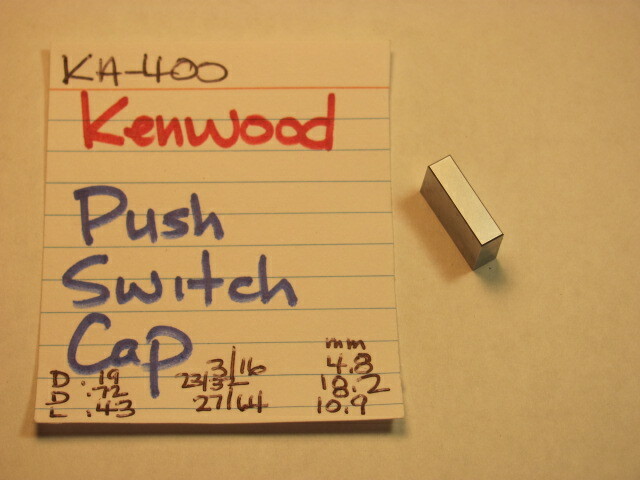
The front panel is dominated by a bank of five push switches for input selection and functions like Mono/Stereo and phase reverse. They’re tactile, positive, and satisfying when they work—but that’s the rub. A common problem with the KA-400 is switch failure; owners report that the mechanisms can collapse internally over time. The switches can be removed independently, which helps during servicing, but replacement switch assemblies are “extremely unlikely” to be available. If they’re not sealed, some users have had success cleaning them with appropriate contact cleaners like Caig products, but it’s a gamble. Once they fail, you’re either repairing the original or facing a long hunt for NOS parts.
DC-Coupled Design and Clean Signal Path
As a DC stereo integrated amplifier, the KA-400 eliminates coupling capacitors from the signal path, which Kenwood likely intended to improve transient response and low-frequency linearity. The result is a stable, quiet background and a sense of immediacy in the midrange. It’s not clinical—far from it—but there’s a clarity and neutrality that stands out among its peers. The all-silicon-transistorized circuitry (as described in related models) suggests a design focused on reliability and consistency, though the exact topology isn’t documented. What owners notice is the lack of hum, the stable operation, and the way it drives difficult loads without breaking a sweat.
Phono Stage and Practical Features
It includes a dedicated MM phono input, making it a natural partner for turntables of the era. The tone controls are comprehensive—bass, treble, balance, and loudness contour—giving users flexibility without sacrificing signal integrity. The front-panel 6.35 mm headphone output is a thoughtful touch, rare on amps in this class at the time. And while it doesn’t have remote control (confirmed), it doesn’t feel like it’s missing one—the hands-on interface is part of its charm.
Collectibility & Value
The Kenwood KA-400 trades in a wide price range depending on region and condition. Listings show prices as low as €45 and as high as €449, with a notable listing at 189,00 € TTC from La Fée du Vintage that includes a 6-month warranty. On Reverb, one was listed at $149 (Mar 2026), while in Argentina, it’s been priced at ARS 399,000. These are listed prices, not confirmed sale prices, so actual market value likely clusters in the €100–€200 range for fully tested and cleaned units. Original pricing has been estimated at around 500 DM, placing it as a mid-tier offering in its day.
Collectors value it for its build quality and sonic character, but the switch issue is a real deterrent. Units that have been serviced and tested are worth the premium—especially if they come with a warranty. The availability of a service manual (documented on sites like elektrotanya.com and Audiofanzine) helps DIY repairs, but the lack of replacement switches means prevention—like gentle use and periodic cleaning—is the best strategy. It’s not a rare showpiece, but it’s a respected workhorse with a loyal following among those who’ve kept one running.
eBay Listings


As an eBay Partner, we earn from qualifying purchases. This helps support our independent vintage technology research.
Related Models
- Kenwood KA 990EX (1980-1981)
- Kenwood KR 7020 (1977-1979)
- Kenwood kx-1010 (1982-1984)
- Kenwood kx-630 (1980-1982)
- Kenwood L 1000T (1980-1982)
- Akai AM-2850 (1975)
- Akai AP-206 (1975)
- Nakamichi BX-1 (1985)
- Acoustic Research research-ar-17 (1978)
- Acoustic Research AR-19 (1994)