Kenwood BASIC-C-2 (1979)
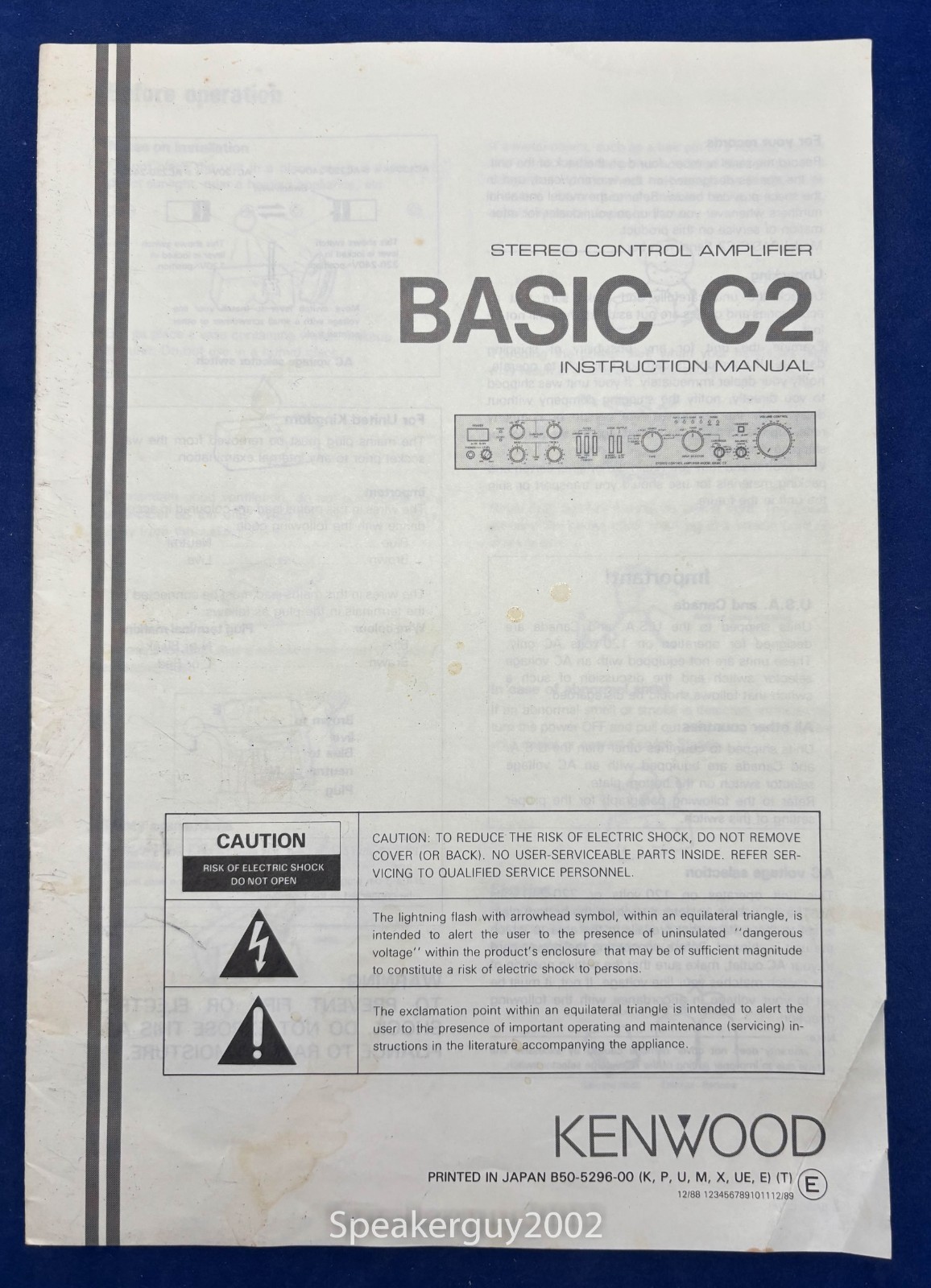
The Kenwood BASIC-C-2 is a vintage integrated amplifier introduced in 1979 as part of Kenwood's minimalist and cost-conscious BASIC series. Designed for the discerning listener who valued sonic clarity and functional simplicity, the BASIC-C-2 occupies a niche in the late 1970s Japanese audio market that emphasized reliability, clean engineering, and unobtrusive performance. Though overshadowed by higher-end models from Kenwood and competitors like Pioneer, Yamaha, and Sony, the BASIC-C-2 has earned a quiet reputation among vintage audio enthusiasts for its balanced sound signature and solid build quality.
Design and Aesthetic Philosophy
The BASIC-C-2 reflects the design ethos of Kenwood’s BASIC line: no-nonsense functionality with a clean, utilitarian appearance. It features a compact chassis with a brushed aluminum front panel, a large central volume knob, and smaller, evenly spaced controls for input selection, tone adjustment, and balance. The layout is intuitive, with clearly labeled functions and minimal visual clutter. Unlike the flashy VU meters or illuminated displays found on higher-end receivers of the era, the BASIC-C-2 uses simple LED indicators and rotary switches, reinforcing its role as a no-frills amplifier.
The rear panel includes standard inputs for the time: two sets of RCA inputs for tuner, tape, and auxiliary sources, a moving magnet (MM) phono input, and speaker binding posts for two sets of 8-ohm speakers. It supports both A and B speaker outputs, allowing users to drive two pairs of speakers independently or simultaneously, a feature uncommon in budget amplifiers of the period. The inclusion of a tape monitor loop also enables basic tape recording and monitoring functions, appealing to users who still relied on cassette decks for music recording and playback.
Technical Specifications and Performance
The Kenwood BASIC-C-2 delivers 45 watts per channel into 8 ohms with a total harmonic distortion (THD) of less than 0.05%, a respectable figure for its class and era. Its frequency response spans from 20 Hz to 20 kHz, ±1 dB, ensuring full-range audio reproduction that aligns well with most bookshelf and floor-standing speakers of the late 1970s. The signal-to-noise ratio is rated at 80 dB, which, while not class-leading, is sufficient for a quiet listening background in typical home environments.
The amplifier employs a dual power supply design with discrete transistor circuitry—common in Japanese amplifiers of the time—avoiding the use of integrated circuits in critical audio paths. This contributes to a more linear response and better control over speaker drivers. The phono stage is specifically tuned for moving magnet cartridges, offering standard RIAA equalization and a sensitivity of 4 mV, compatible with most popular cartridges like the Shure M97xE or Audio-Technica AT-95E.
One of the more notable aspects of the BASIC-C-2 is its damping factor, which exceeds 40 at 1 kHz. This indicates strong control over speaker cone movement, particularly in the bass region, resulting in tighter, more articulate low-end performance. While not as high as some high-end contemporaries, this damping factor is impressive for a mid-tier amplifier and contributes to its reputation for clarity and precision.
Sound Characteristics
The sonic signature of the Kenwood BASIC-C-2 leans toward neutrality with a slight warmth in the midrange, characteristic of well-designed Japanese amplifiers from the period. It does not color the sound aggressively, making it a versatile match for a wide range of speakers. Vocals are rendered with clarity and presence, while instrumental separation is above average for its class. The stereo imaging is well-defined, with a stable soundstage that places instruments accurately across the front plane.
Compared to more aggressive-sounding competitors like certain Pioneer or Sansui models, the BASIC-C-2 is more reserved and refined. It excels in reproducing acoustic and jazz recordings, where tonal accuracy and dynamic nuance are paramount. Rock and electronic music are handled competently, though the amplifier’s 45-watt output may struggle to drive inefficient speakers at high volumes in larger rooms.
Build Quality and Reliability
Kenwood was known for robust build quality during the 1970s and 1980s, and the BASIC-C-2 is no exception. Its internal layout is clean and well-organized, with point-to-point wiring and high-quality capacitors. The heat sink is modest but adequate for the power output, and the amplifier runs relatively cool under normal operating conditions. Like most electronics of its era, it uses through-hole components, which are easier to service and repair than modern surface-mount designs.
Over time, common maintenance issues include worn potentiometers (particularly the volume and balance controls), which can cause channel imbalance or crackling. Replacing these with modern equivalents or cleaning them with contact cleaner can restore full functionality. Electrolytic capacitors may also need replacement after decades of use, especially if the unit has been powered on infrequently or stored in humid conditions.
Market Position and Legacy
The BASIC-C-2 was positioned as a mid-tier integrated amplifier, priced below Kenwood’s higher-end L- and K-series models but above entry-level offerings. It competed directly with amplifiers like the Yamaha B-100, Pioneer A-303, and Sony TA-2200. While it lacked the prestige or power output of flagship models, it offered a compelling balance of performance, features, and value.
Today, the Kenwood BASIC-C-2 is not widely recognized outside of dedicated vintage audio circles, but it has developed a small but loyal following. Its appeal lies in its simplicity, reliability, and honest sound reproduction. It is particularly favored by listeners building minimalist vintage systems or seeking a compact amplifier for small to medium-sized rooms.
Conclusion
The Kenwood BASIC-C-2 stands as a quiet achiever in the landscape of late-1970s Japanese audio equipment. It may not boast the power, features, or glamour of more famous contemporaries, but it delivers consistent, high-quality performance with minimal fuss. For collectors and audiophiles interested in understated vintage gear, the BASIC-C-2 represents excellent value and a testament to Kenwood’s engineering discipline during a golden era of analog audio.
Its combination of clean design, solid specifications, and enduring reliability makes it a worthy addition to any vintage setup. Whether used as a primary amplifier in a compact system or as a secondary unit for casual listening, the Kenwood BASIC-C-2 continues to offer a satisfying and authentic analog experience decades after its release.
eBay Listings


As an eBay Partner, we earn from qualifying purchases. This helps support our independent vintage technology research.
Related Models
- Kenwood kx-600 (1987-1989)
- Kenwood kx-1060 (1982-1984)
- Kenwood kx-2060 (1980-1982)
- Kenwood kx-1200 (1983-1985)
- Kenwood kx-3010 (1988-1990)
- Luxman L-530 (1975)
- Luxman R-404 (1975)
- Luxman RV-371 (1975)
- Luxman SQ-38U (1975)
- Luxman T-14 (1972)