Kenwood AT-250
A 4.2-kilogram box that listens to your transmitter, hunts for a match, and stops the motors when it hears one.
Overview
Four point two kilograms. A hundred watts of continuous pass-through. A motor that will not stop until it hears an SWR of 1.2:1 or better. The AT-250 is Kenwood's automatic antenna tuner for the HF amateur bands, and it does one thing: match the load, then quit.
The tuning range covers all amateur bands from 1.8 to 29.7 MHz. Input impedance is 50 ohms unbalanced. Output impedance is specified at 20 to 50 ohms unbalanced, but the manual's caution section gives a broader figure - the tuner will match a 20-150 ohm load, or roughly up to a 2.5:1 SWR. Past that range the tuner may never stop, because the load is outside what it can handle. Owners chasing a stubborn piece of wire find this out the hard way.
Insertion loss is rated at 0.8 dB or less. The pass-through rating is 100W continuous, 200W PEP. The manual is explicit that during auto tuning, very high voltage appears in the tuning circuit and the reflected impedance swings hard, so the recommended practice is to dial the transmitter back to 50W or less before hitting the TUNE switch. That protects the radio sitting behind the tuner.
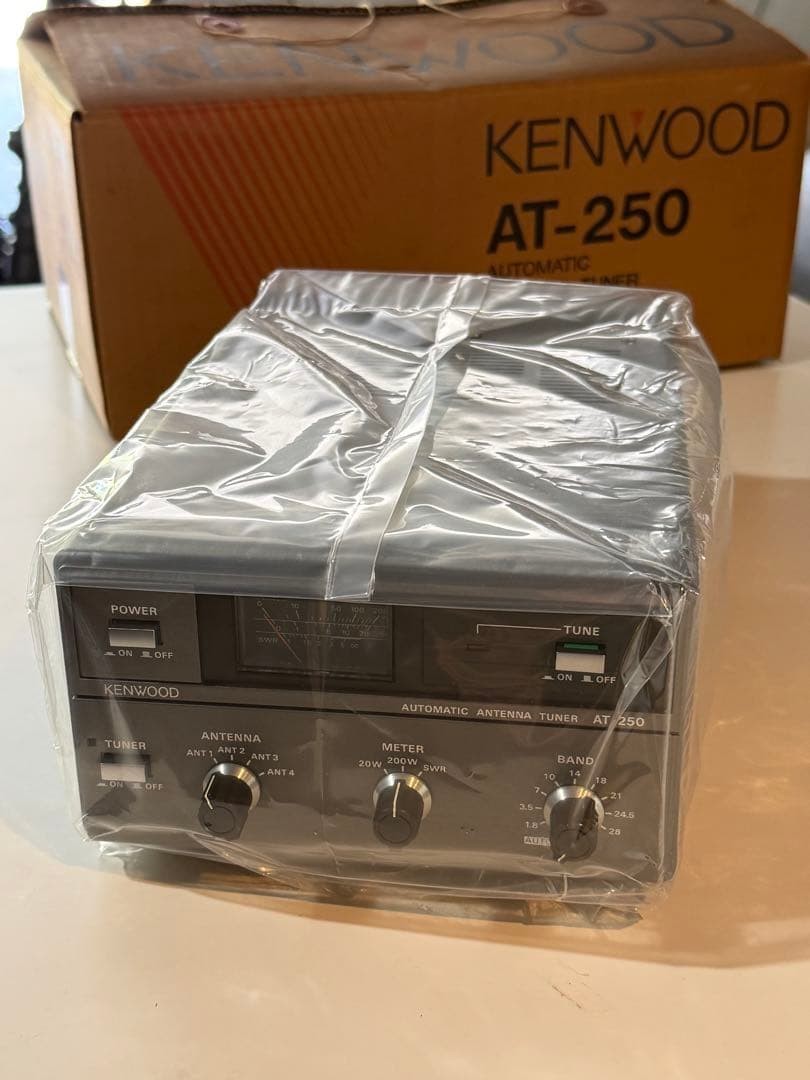
Activation is automatic. The tuner needs only 3W of RF to wake up, and it will complete a match within 15 seconds. The SWR threshold for motor stop is 1.2:1 or less - the motors run until they hit it, then quit. The TUNE indicator lights during the hunt and goes dark when the match is found. There is a POWER-SWR meter on the front with two power scales, up to 20W and up to 200W, selected by the METER switch. The manual specifies peak-reading accuracy of ±10% at 100W on the 100W position and ±10% at 10W on the 10W position. No calibration is required.
The control set is complete for a box this size. Four antennas can be connected and selected via the ANTENNA switch. A BAND switch covers 1.9 through 28 MHz manually, but when paired with a TS-430 transceiver, the switch goes to AUTO and the radio selects the band. The TUNER switch routes the transmit signal through the tuner or bypasses it entirely. The RX IN-OUT switch on the rear panel determines whether the receive signal also passes through. It ships in the OUT position, so by default only transmit goes through the tuner. The TUNE switch initiates auto tuning, and the manual warns that leaving it ON during operation can cause the motor to activate mid-transmission. The DC/AC switch selects between AC and 13.8V DC power. The power requirement is 120V, 220V, or 240V AC selectable, or 13.8V (12-16V) DC. Power consumption is 15W on AC or 600 mA on 13.8V DC.
Inside, the parts count is substantial for a tuner: 13 ICs, 2 FETs, 31 transistors, and 77 diodes. That is a lot of silicon for a device whose job is to move a motor until the SWR drops. It also explains the 4.2 kg (9.24 lb.) weight. Dimensions are 174mm wide, 96mm high, and 257mm deep, with projections bringing those to 107mm and 289mm respectively.
The ACC jack connects to a TS-430 with the supplied control cable, and the band information table in the manual shows the exact logic levels fed across that connector for each band from 1.8 through 28 MHz. With a TS-430, the AT-250 is essentially a slave - the radio tells it what band it is on. With other transceivers, the ACC jack connects to the REMOTE jack, and pin 3 must be grounded when transmitting. The manual names the TS-130, TS-530, and TS-930 as compatible, with a note that the TS-930 requires removing the 7-pin wire and inserting the 4-pin wire into the 7-pin connector to operate the tuner from the TS-930 control relay. With any transceiver other than the TS-430, the AUTO band setting is disregarded and the band must be set manually.
Linear amplifier users get their own warning. When connecting to a Kenwood TL-922 or TL-922A, the connecting cable must be 1 meter or less. The manual is blunt about polarity: a linear amplifier controlled by plus voltage can be used, but a linear amp controlled by minus voltage must never be connected.
The AT-250 is not a wide-range tuner. The 20-150 ohm window and the 2.5:1 SWR ceiling are real limits. If the antenna and feed system fall outside that range, the tuner may hunt indefinitely, and the manual's advice is to stop, fix the antenna, and try again.
With a TS-430 or one of the other compatible transceivers, the AT-250 is close to a set-and-forget accessory. It handles four antennas, tracks the band automatically with the right radio, reads both power and SWR without calibration, and stops the motor once the match is good enough.
eBay Listings


As an eBay Partner, we earn from qualifying purchases. This helps support our independent vintage technology research.