KEF LS3/5A (1975–1998): The BBC’s Pocket-Sized Sonic Scalpel
A compact monitor so ruthlessly accurate it became the unspoken ruler of high-fidelity audio—trusted by broadcasters, coveted by audiophiles, and copied by nearly everyone.
Overview
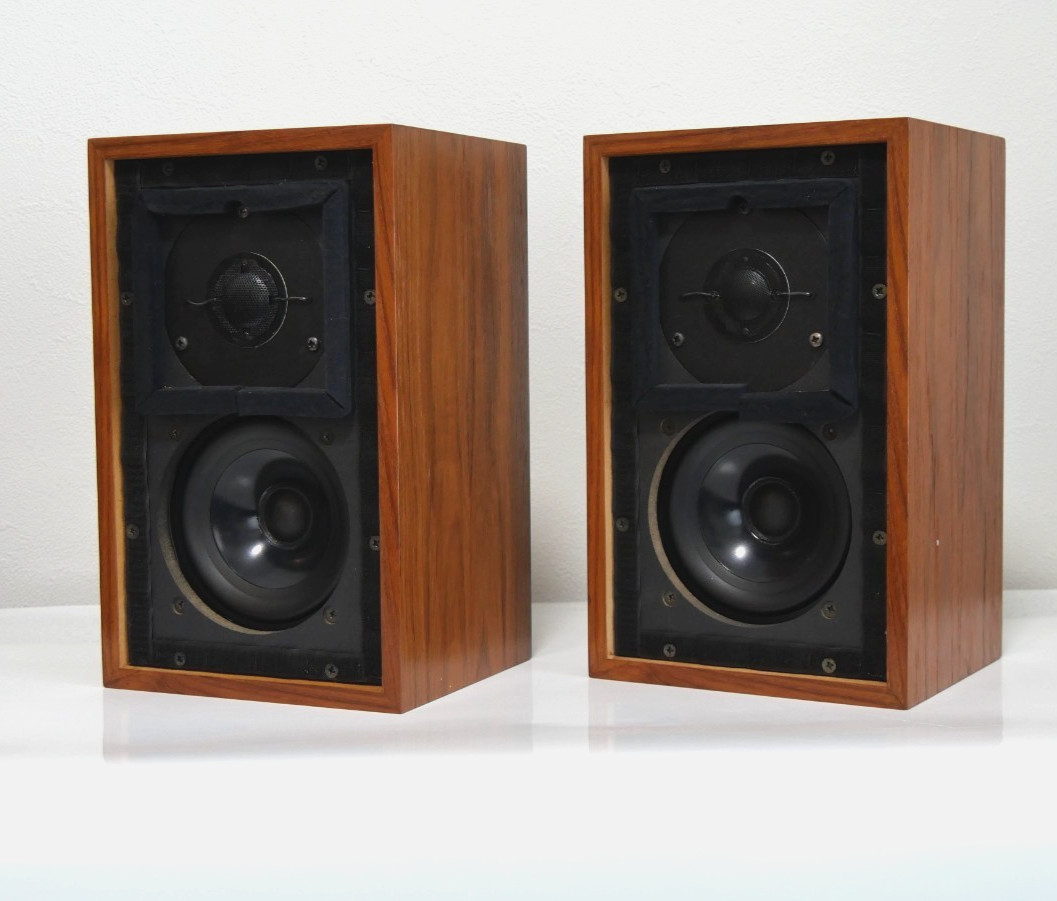
The KEF LS3/5A isn’t just a speaker. It’s a cultural artifact disguised as a teak-clad box. Born in the back of a BBC outside broadcast van in 1975, this 11.5 cm tall monitor was engineered to do one thing: reproduce sound with such neutrality and precision that engineers could trust it under field conditions. No flattery. No coloration. Just truth. And in doing so, KEF—alongside the BBC’s Research & Development department—accidentally created one of the most influential loudspeakers in history. Over its 23-year production run, the LS3/5A transcended its utilitarian origins, becoming a benchmark in both professional studios and living rooms from London to Tokyo.
What made the LS3/5A revolutionary wasn’t raw power or flashy design—it was its obsessive time and phase coherence, achieved through a painstakingly optimized 115 mm Bextrene cone driver and a 19 mm soft dome tweeter, crossed over at exactly 3.5 kHz. The BBC had a problem: they needed a small speaker that could fit in cramped OB vans but still deliver reliable midrange clarity for voice and acoustic music. The LS3/5A solved it. And when word got out that the BBC was using them, the audiophile world took notice. Suddenly, this modest two-way wasn’t just for engineers—it was for anyone who wanted to hear exactly what was on the tape. Its 15-ohm impedance made it picky about amplifiers (don’t even think about pairing it with a flea-powered amp below 10 watts), but when properly driven, it delivered a soundstage so coherent and transparent it felt like the walls had vanished.
Specifications
| Type | 2-way vented compact monitor |
| Drivers | 1x 115mm bass/midrange, 1x 19mm dome tweeter |
| Frequency Response | 75 Hz - 20 kHz (±3 dB) |
| Crossover Frequency | 3.5 kHz |
| Nominal Impedance | 15 ohms |
| Minimum Impedance | 11 ohms |
| Sensitivity | 84 dB (2.83V/1m) |
| Recommended Amp Power | 10-50 watts |
| Box Type | Bass reflex (vented) |
| Dimensions | 305 mm (H) × 175 mm (W) × 175 mm (D) |
| Weight | 5.5 kg per speaker |
| Cabinet Finish | Teak or walnut veneer |
Key Features
- BBC LS3/5A Specification Compliance: Unlike most consumer speakers, the LS3/5A wasn’t designed for market appeal—it was built to meet a strict BBC engineering standard (originally issued in 1975, revised in 1978). Every unit had to pass rigorous tolerance checks for frequency response, directivity, and time alignment. This wasn’t marketing—it was certification.
- Bextrene Cone Driver: The 115 mm B110 driver used a Bextrene cone—a lightweight, non-resonant plastic that didn’t ring like paper or metal. This gave the LS3/5A its famously “dry” midrange, free from the coloration that plagued other small speakers. It also aged poorly (more on that later), but when fresh, it was revelatory.
- 15-Ohm Nominal Impedance: Unusual in a world of 8-ohm speakers, this higher impedance reduced current demand and allowed for better control from low-powered tube amps—perfect for the Quad 33/303 or Leak TL/25. But it also meant solid-state amps needed to be current-stable down to 11 ohms at worst.
- Time-Accurate Crossover: The 3.5 kHz crossover wasn’t arbitrary. It was chosen so the tweeter and mid/bass driver would integrate seamlessly in both frequency and time, minimizing phase distortion. The result? A “point source” illusion that made imaging uncannily precise.
- Compact Bass Reflex Cabinet: At just 175 mm deep, it fit on shelves and desks, but the rear-firing port extended bass response down to 75 Hz—astonishing for its size. The internal damping and cabinet bracing were over-engineered for the era, minimizing cabinet coloration.
Historical Context
Before the LS3/5A, broadcast monitors were either large, full-range beasts or compromised “desktop” speakers with muddy mids. The BBC needed something portable, consistent, and accurate—especially for remote classical recordings where a presenter’s voice had to cut through without sibilance. The original LS3/5 (1972) was a step in that direction, but it used a different tweeter and was less refined. The LS3/5A, revised in 1975 with KEF’s B110 driver and T27 tweeter, was the answer. KEF didn’t invent the speaker alone—the BBC specified every parameter—but KEF had the manufacturing precision to deliver it at scale.
The LS3/5A arrived at a time when high-fidelity was becoming democratized. Audiophiles were moving away from massive floor-standers toward compact monitors, inspired by the BBC’s reputation for neutrality. Competitors like the Spendor BC1 and the original Spendor LS3/5A (produced from 1975–1977) offered similar voicing, but KEF’s tighter quality control and wider distribution made the KEF version the de facto standard. By the 1980s, the LS3/5A had become a global phenomenon—used in radio stations from the CBC to NHK, and in homes from Stockholm to Sydney. Its influence stretched far beyond its size: nearly every “mini monitor” that followed, from the KEF LS50 to the Harbeth PPM, owes it a debt.
Collectibility & Value
Today, the KEF LS3/5A is a blue-chip vintage audio collectible. While not rare in absolute terms—tens of thousands were made—original, well-maintained pairs in teak or walnut veneer command serious money. As of 2025, prices range from $1,500 to $3,500 USD, with early KEF Mk I models (1977–1980) and unmodified Spendor-built units at the top end. The 1988 “Suggested Retail Price” version, with cost-cutting changes like revised crossover components and updated grilles, is less desirable but still respected.
But buyer beware: time is not kind to the LS3/5A. The Bextrene cones degrade over decades, especially in humid climates, leading to a characteristic “rubbery” or flabby bass response. Original foam grille surrounds and port damping foam almost always disintegrate—replacing them is essential. Re-coning services exist, but purists insist on original drivers with verified low usage. Look for serial numbers, original documentation, and signs of careful storage. And never trust a pair that hasn’t been tested with a midrange-heavy acoustic track—this speaker lives or dies by its vocal clarity. When it’s right? It’s magic. When it’s tired? It’s a museum piece in need of surgery.
eBay Listings



As an eBay Partner, we earn from qualifying purchases. This helps support our independent vintage technology research.
Related Models
- KEF Reference 104/2 (1984-1991)
- Akai AM-2850 (1975)
- Akai AP-206 (1975)
- Nakamichi BX-1 (1985)
- Acoustic Research research-ar-17 (1978)
- Acoustic Research AR-19 (1994)
- Acoustic Research AR-1W (1954)
- Acoustic Research AR-28S (1992)
- Acoustic Research AR-303a (1994)
- Acoustic Research AR-8BX (1983)