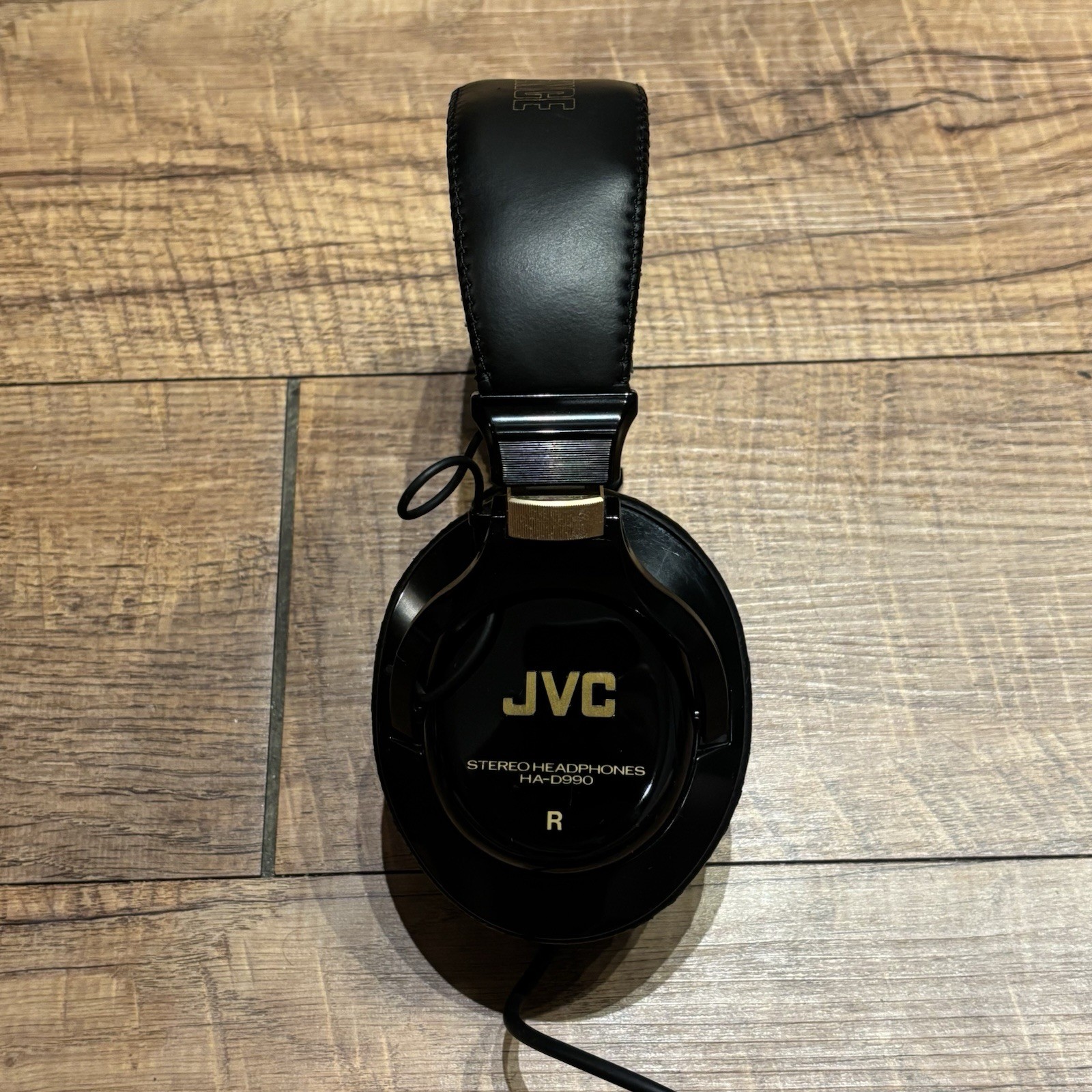
JVC HA-D990
JVC's top non-wireless headphone of the early '90s wanted a sealed fit and a little patience. In return it gave a diffuse-field response that measured better than anything the reviewers had put on a bench.
Overview
The cord is a straight 10¼-foot run of oxygen-free copper ending in a 24-karat gold-plated plug. The voice coils use copper-clad aluminum wire. The gold plug is there to keep the connection corrosion-free. The OFC cord is the kind of detail a buyer notices only when comparing against a lesser cable.
That is a strong claim from a publication that measured a lot of headphones, and it explains why the D990 picked up a small cult following among people who care about binaural recordings. One panelist in that same review, an expert on binaural sound, specifically praised the "very good binaural localization."
The measured response runs flat to roughly 12 kHz, then rolls off gently - down about 10 dB at 18 kHz. That top-end taper produced a touch of ringing on a 20-kHz cosine pulse test. The reviewer tied it to panel comments that voices weren't quite as articulate as on the reference Stax SR-Lambda. It's a real limitation if you expect electrostatic-level detail.
The bass is more complicated. The D990 is a sealed design, but the seal is easily broken by leaks around the outer ear, and that can knock down the 100-300 Hz region relative to the midrange. Panelists described the bass as "good, but not tight," "diminished," and "reduced" before being asked to press the cups tighter. After that, the same listeners called the sound "richer" and "fuller." The transducers appear to have been voiced to make up in part for a loose seal. Below 64 Hz the response rolls off gradually, with output at 32 Hz down only about 8 dB. Bass drums and double bass come across as very good, just at a lower level than the mids and highs.
Efficiency is where the D990 does well. Its 65-ohm impedance (measured 65 left, 64 right) means it gets loud on very little input, which helps with the low-voltage headphone outputs on portable CD players and cassette machines. The impedance is also high enough that the output impedance of most sources has negligible effect on the shape of the frequency response. He also found them better than some earphones costing two or three times as much, and rated them "very good" overall for sound quality. As HiFi-Stereo (1999, p.218) noted in its headphone roundup, the D990 paired a 9¾-foot cord with a 24k gold-plated plug and 40-mm plasma-evaporated-ruby diaphragms in a closed circumaural design.
The physical design is a one-piece headband and bail arrangement, not the separate headband-and-bail construction of some competitors. The metal bails carry detent notches at roughly 4-mm intervals for fine size adjustment and slide into plastic retainers at the headband ends. The yokes swivel for fit. The cups are plastic with a slot to retain the earcushions, and the dynamic elements mount into removable plates held by four screws. Foam buffers top and bottom of each element reduce reflection and diffraction. The earcushions use an acoustically transparent foam insert over the driver. Weight is 8.0 ounces. The right-ear wire exits the rear of the cup, runs through the headband, and enters the left cup, where the main cord exits through a flexible strain relief.
Two practical notes for anyone shopping today. First, the seal is everything. If the earcushions are flattened or hardened, the bass will sound thin and the whole character of the headphone changes. Replacement cushions are the single biggest sonic upgrade on a used pair. Second, the D990 shows up in period dealer listings at $89 (see the Audio clearance ads of 1994), though it also appeared at $119 in some listings, which shows where street pricing sat late in its run. A period reviewer described it as a very good value at full price.
It is not a neutral monitor and it is not an electrostatic. It is a closed, efficient, diffuse-field-tuned dynamic headphone from JVC's digital-reference era.
eBay Listings
As an eBay Partner, we earn from qualifying purchases. This helps support our independent vintage technology research.