JBL SC99 Athena: The Crown Jewel of 1990s High-End Loudspeakers
The JBL SC99 Athena stands as one of the most ambitious and sonically accomplished floorstanding loudspeakers ever produced by the legendary American audio company JBL. Introduced in 1991 as the flagship of the ill-fated Athena Series, the SC99 represented a bold fusion of high-end audiophile aspirations and JBL’s storied heritage in professional sound reinforcement. Though the Athena line was short-lived—discontinued by 1995 due to its premium pricing and niche appeal—the SC99 has since emerged as a cult classic, revered by vintage audio enthusiasts for its dynamic punch, studio-monitor transparency, and striking visual design.
Historical Context and Release
The early 1990s marked a pivotal era for JBL. Under the parentage of Harman International, the company sought to reposition itself in the high-end consumer audio market, which was increasingly dominated by European brands like B&W, Thiel, and KEF. The Athena Series, launched in 1991, was JBL’s answer to this challenge—a line of speakers designed not only for sonic excellence but also for aesthetic refinement, a departure from the industrial look of earlier JBL models.
The SC99 Athena was the centerpiece of this series, developed at JBL’s Northridge, California engineering facility. It was designed by a team led by James B. Lansing’s spiritual successors, incorporating decades of research in transducer design and cabinet engineering. The name “Athena” itself evoked wisdom and artistry—fitting for a speaker intended to blend technical precision with musical grace.
Despite its acclaim among critics and a small but devoted following, the SC99 was a commercial rarity. Priced at over $6,000 per pair at launch (equivalent to nearly $13,000 today), it struggled to compete in a market skeptical of JBL’s “pro sound” image. Production ended around 1995, making original, well-preserved SC99s increasingly rare and sought after.
Technical Specifications
The SC99’s engineering reflects a no-compromise approach to loudspeaker design. Its 3-way, 5-driver configuration ensures a seamless frequency response and exceptional dynamic range.
| Specification | Detail |
| Type | 3-way, 5-driver floorstanding loudspeaker |
| Drivers | 2 × 8" Polyplas woofers, 1 × 5.25" Polyplas midrange, 1 × 1" titanium dome tweeter |
| Crossover Frequency | 1.5 kHz (midrange to tweeter), 500 Hz (woofer to midrange) |
| Frequency Response | 25 Hz – 40 kHz (±3 dB) |
| Sensitivity | 92 dB (2.83V/1m) |
| Nominal Impedance | 8 ohms (compatible with most amplifiers) |
| Recommended Power | 20–300 watts |
| Enclosure | Dual rear-firing bass-reflex ports, constrained-layer damping |
| Dimensions (H×W×D) | 45.5" × 13.5" × 18.5" (115.6 × 34.3 × 47 cm) |
| Weight | 78 lbs (35.4 kg) each |
| Finish Options | Black ash, rosewood, cherry veneer |
The SC99 employed JBL’s proprietary Polyplas cone material—a mica-filled polypropylene blend offering stiffness, low mass, and excellent damping. The titanium dome tweeter, coupled with a unique HRTF (Head-Related Transfer Function) waveguide, was engineered to deliver extended high-frequency response with minimal diffraction and a wide, stable stereo image.
Sound Quality Characteristics
The JBL SC99 Athena is celebrated for its dynamic authority, spacious soundstage, and remarkable neutrality. Unlike many vintage JBLs known for a forward midrange and aggressive highs, the SC99 was tuned for audiophile refinement.
- Bass: Deep, articulate, and tightly controlled. The dual 8-inch woofers and dual port design allow the SC99 to reach down to 25 Hz, delivering sub-bass presence rare in non-powered floorstanders of its era.
- Midrange: Smooth and natural, with the 5.25-inch midrange driver avoiding the "honk" sometimes associated with JBL’s earlier designs. Vocals and acoustic instruments are rendered with lifelike presence.
- Treble: The titanium tweeter offers exceptional extension and detail, though some listeners note a slight brightness with poorly recorded material. The HRTF waveguide enhances off-axis response, making the speaker more forgiving in asymmetric room placements.
- Soundstage: Exceptionally wide and deep, with precise imaging. The SC99 excels at recreating the spatial cues of live recordings, making it a favorite among classical and jazz enthusiasts.
Paired with high-current solid-state amplifiers or neutral tube gear, the SC99 reveals its full potential—offering a rare balance of power, clarity, and musicality.
Notable Features and Innovations
- HRTF Waveguide: One of the first consumer speakers to incorporate psychoacoustic research into tweeter design, improving spatial realism.
- Dual Woofer Configuration: Allows for greater cone area and lower distortion, enhancing bass dynamics without requiring a separate subwoofer.
- Constrained-Layer Damped Cabinet: Multi-layer MDF construction with internal damping reduces cabinet resonance, contributing to a clean, uncolored sound.
- Bi-Wirable Terminals: Gold-plated binding posts allow for bi-amping or bi-wiring, giving advanced users greater control over tonal balance.
Market Value and Collectibility
Today, the JBL SC99 Athena is a prized collectible. Original pairs in good condition typically sell for $1,200 to $2,500, with mint, never-used examples fetching higher prices. Factors influencing value include:
- Original finish (rosewood and cherry are rarer than black ash)
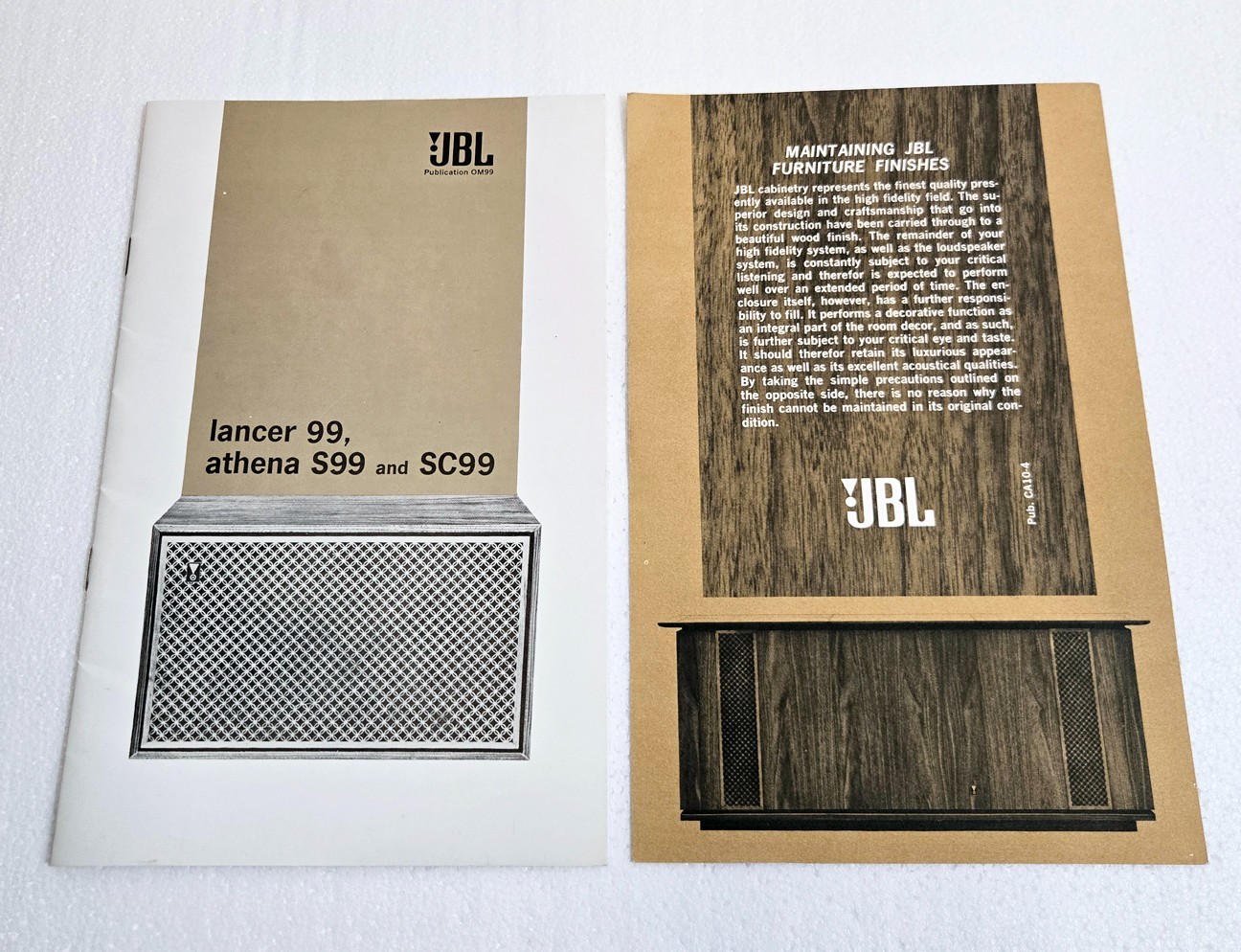
- Presence of original grilles and documentation
- Condition of drivers and cabinet (check for scratches, port bungs, and tweeter oxidation)
While not as widely collected as vintage Klipschorns or AR speakers, the SC99 has a loyal following among JBL aficionados and 1990s audio historians. Its status as a “last great flagship” before JBL shifted focus to more commercial lines adds to its allure.
Common Issues and Maintenance
Despite their robust build, SC99s require attention after three decades:
- Tweeter Oxidation: The titanium dome can develop a hazy film over time. Gentle cleaning with isopropyl alcohol may restore clarity, but avoid abrasives.
- Surround Deterioration: The foam surrounds on the woofers and midrange may dry out. Re-foaming by a specialist is recommended every 20–25 years.
- Port Blockages: Dust and debris can clog the rear-firing ports. Use a vacuum with a soft brush attachment.
- Crossover Components: Electrolytic capacitors may degrade. Consider a professional recapping if sound becomes thin or distorted.
Regular dusting and placement away from direct sunlight will preserve both cosmetics and performance.
Comparison to Similar Models
| Model | Key Differences |
| JBL L100 Classic | More colored, "hi-fi" sound; less accurate; iconic 1970s design |
| KEF Reference 104/2 | Softer bass, silk dome tweeter; more "British" warmth |
| B&W 802 (1990s) | Higher price, Nautilus tube tweeter; more refined but less dynamic |
| Infinity IRS V | Electrostatic hybrid; vastly more complex and rare; studio-grade detail |
The SC99 stands apart by merging JBL’s dynamic prowess with audiophile-grade neutrality—a rare achievement in its time.
Conclusion
The JBL SC99 Athena is more than a speaker—it’s a statement. A bold attempt to bridge the gap between pro-audio heritage and high-end home listening, it remains a testament to JBL’s engineering ambition. For collectors and listeners alike, the SC99 offers a compelling blend of power, precision, and presence that few speakers of any era can match. If you encounter a well-maintained pair, consider it not just a vintage audio gem, but a piece of American audio history.
eBay Listings


As an eBay Partner, we earn from qualifying purchases. This helps support our independent vintage technology research.
Related Models
- JBL 4310 (1970)
- JBL 4315 Control Monitor (1977)
- JBL L110A (1975)
- JBL 4311B (1975)
- JBL 4408 (1975)
- Akai AM-2850 (1975)
- Akai AP-206 (1975)
- Nakamichi BX-1 (1985)
- Acoustic Research research-ar-17 (1978)
- Acoustic Research AR-19 (1994)