JBL S70 (1976)
That first blast of power from a pair of these will make your spine tingle—raw, unapologetic JBL energy in a walnut-clad tower.
Overview
Let’s get one thing straight: the JBL S70 isn’t subtle. When you walk into a room with a pair of these 68-pound beasts parked in the corners, you know you’re dealing with a speaker that means business. Introduced in 1976, the S70 was the top dog in JBL’s S-series lineup, a no-compromise floorstander built for people who wanted studio-monitor authority in their living room. These weren’t polite background listeners—they were for cranking Zeppelin, tearing through Mahler, or feeling every drum hit in your chest. With a 12-inch woofer, 5-inch midrange, and that signature titanium dome tweeter, the S70 delivered a sound that was fast, loud, and incredibly detailed, even by today’s standards.
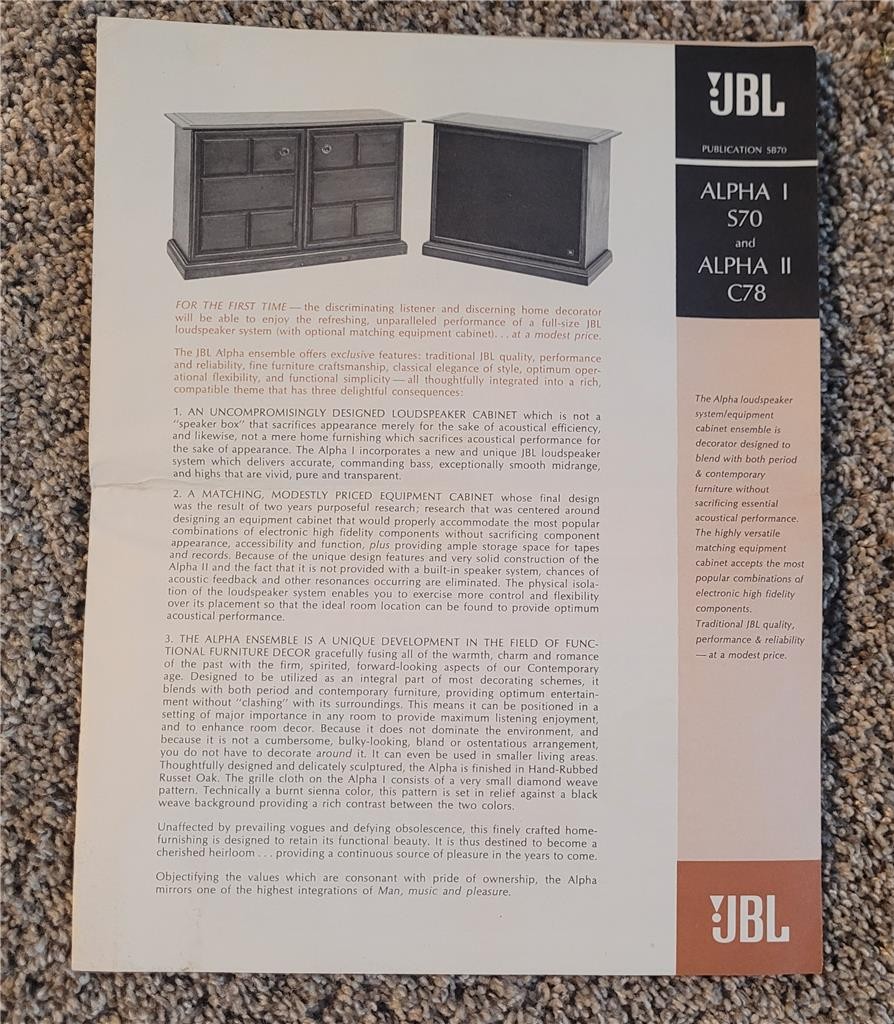
And yeah, they look the part. The S70 came standard in a rich walnut veneer, with a clean black baffle and those classic JBL script badges on the front. Some lucky souls found the rare rosewood version, which these days trades hands like contraband. The cabinet is massive—nearly 27 inches tall—but it’s not just for show. That size houses a dual-ported bass reflex design that lets the E120 woofer dig down to 35 Hz with real authority. You don’t just hear the bass—you feel it in the floorboards.
But here’s the thing: these speakers aren’t perfect. The T20 titanium tweeter? Lightning-fast and airy, sure, but it can get a little hot in the upper mids if you’re not careful with placement or pairing. And while the sensitivity is a generous 94 dB—making them easy to drive with almost any amp—they don’t forgive bad recordings or sloppy electronics. They’ll expose every flaw in your chain. But that’s part of the charm. The S70 doesn’t coddle you. It tells you exactly what’s on the tape.
Specifications
| Manufacturer | JBL |
| Type | 3-way, bass-reflex floor-standing speaker |
| Drivers | 12" E120 low-frequency, 5" M60 midrange, 1" T20 titanium dome tweeter |
| Crossover Frequency | 1.5 kHz (midrange to tweeter), 500 Hz (woofer to midrange) |
| Impedance | 8 ohms (nominal) |
| Sensitivity | 94 dB (1W/1m) |
| Frequency Response | 35 Hz – 20 kHz (±3 dB) |
| Recommended Amplifier Power | 20 – 200 watts per channel |
| Enclosure Type | Vented (bass reflex with dual ports) |
| Dimensions (H x W x D) | 26.5" x 14.5" x 15.5" (673 x 368 x 394 mm) |
| Weight | 68 lbs (30.8 kg) per speaker |
| Finish Options | Walnut veneer (standard), black ash, rosewood (rare, limited run) |
Key Features
Three-Way Driver Array with Pro DNA
The S70’s driver lineup wasn’t pulled from a consumer parts bin—it came straight from JBL’s professional monitor heritage. The 12-inch E120 woofer, with its doped cloth surround and hefty magnet, delivers deep, articulate bass that doesn’t flub out even at high volumes. Paired with the 5-inch M60 midrange—complete with phase plug for smooth dispersion—the vocal range is clear and present, almost confrontational in its honesty. And then there’s the T20 titanium dome tweeter, a hallmark of JBL’s high-end designs in the ’70s. It’s fast, extended, and incredibly detailed, though it can be a bit aggressive in reflective rooms or with bright source material. But if you like your highs crisp and alive, this tweeter delivers.
Dual Ported Bass Reflex Design
The rear panel features two large, flared ports that help extend bass response and reduce port noise. This wasn’t just about adding more boom—it was about control. The dual-port system allows for better tuning of the cabinet’s resonance, giving the woofer more headroom and reducing chuffing at high output levels. In practice, that means the S70 can fill a large room with bass that’s both deep and tight, not flabby or one-note.
Modular Construction for Serviceability
One of the smartest things JBL did with the S70 was stick to a modular driver design. The E120, M60, and T20 were all standardized across multiple models, which made replacements and repairs much easier—both for owners and technicians. If a surround fails or a tweeter goes south, you’re not hunting for a unicorn. This modularity is a big reason why so many S70s are still in working order today.
Hand-Finished Wood Veneer Cabinets
The cabinet is built from high-density particleboard and wrapped in real wood veneer. The standard finish was walnut, which ages beautifully, developing a warm patina over time. Black ash was also available, but the real grail is the rosewood version—a limited run that’s now highly sought after. These cabinets weren’t just about looks; the thick baffle and internal bracing helped reduce resonance, keeping the sound clean even at high volumes.
Historical Context
The S70 arrived in 1976, right when home audio was hitting its stride. Stereo systems were moving from luxury items to living room staples, and people wanted speakers that could handle the dynamic range of rock, jazz, and classical recordings. JBL, already a leader in studio and cinema sound, used that expertise to craft a speaker that could deliver concert-hall dynamics at home. The S70 was the flagship of the S-series, sitting above the S50 and S60, and it was built to impress. It didn’t just compete with other high-end speakers of the era—it aimed to dominate them.
Collectibility & Value
Today, the JBL S70 is a prized piece of vintage audio history. A well-maintained pair in walnut typically sells for $800 to $1,500, depending on condition and originality. Rosewood models, especially those with original grilles and documentation, can fetch $2,000 or more. But value hinges on more than just finish—original drivers, intact crossovers, and clean cabinets are critical. Replaced woofers or repainted enclosures can tank the price fast.
One thing collectors watch for: the original cloth surrounds on the E120 woofer. After 40+ years, they often degrade, leading to flapping or loss of bass. Re-coning with modern foam or butyl rubber is common, and while it restores performance, purists prefer original, unmodified units. The T20 tweeter is also sensitive—overdriving it can lead to failure, so clean amplification is a must. And while the crossovers are generally robust, the electrolytic capacitors can dry out over time. Replacing them with modern film caps can bring back clarity and balance, but again, originality matters to serious collectors.
Comfort isn’t a concern with these—they’re speakers, not headphones—but placement is. The S70 likes space. They need to breathe, so keep them away from walls and corners unless you want a bass-heavy mess. And while they’re easy to drive, they reward good electronics. Pair them with a solid tube amp, and you’ll hear a magic blend of warmth and precision that few vintage speakers can match.
eBay Listings


As an eBay Partner, we earn from qualifying purchases. This helps support our independent vintage technology research.
Related Models
- JBL 4310 (1970)
- JBL 4315 Control Monitor (1977)
- JBL L110A (1975)
- JBL 4311B (1975)
- JBL 4408 (1975)
- Akai AM-2850 (1975)
- Akai AP-206 (1975)
- Nakamichi BX-1 (1985)
- Acoustic Research research-ar-17 (1978)
- Acoustic Research AR-19 (1994)