JBL S106 Aquarius II
1970 - 1973
Introduction
The JBL S106 Aquarius II represents the second model in JBL's groundbreaking Aquarius series of non-directional speaker systems. As a more ambitious design than the Aquarius I, the Aquarius II featured rear-mounted slot-loaded drivers and a more complex diffraction system to achieve its goal of creating a wide, immersive soundfield independent of listener position. With its 12-inch woofer, dual midranges, and sophisticated dispersion technology, the Aquarius II was one of the most technically ambitious home speakers of its era—and one of the most challenging to produce consistently.
Overview & Specifications
| Specification | Details |
| Type | 3-way, 4-driver bass reflex non-directional floor/bookshelf |
| Woofer | 12" (30cm) 123A cone woofer (rear-mounted) |
| Midrange | Two 5" (12.7cm) LE5 cone midranges (rear-mounted) |
| Tweeter | 2" (5cm) LE20 cone tweeter (front-mounted) |
| Crossover Frequencies | 300 Hz, 1,000 Hz, 5,000 Hz (estimated) |
| Nominal Impedance | 8 Ω |
| Power Handling | 50-75W continuous program |
| Sensitivity | 90 dB/W/m (estimated) |
| Frequency Response | 40 Hz - 20 kHz |
| Dimensions (W×H×D) | Approximately 24" × 36" × 15" (specifics vary) |
| Weight | 55-65 lbs (25-30 kg) |
| Finish | Walnut veneer |
Driver Configuration
The Aquarius II employed a sophisticated driver array designed specifically for non-directional sound dispersion. The 123A woofer was a 12-inch professional-grade driver rear-mounted in the center of the enclosure. Spacers were placed radially around this driver, with a flat panel attached to create the slot loading that dispersed bass energy throughout the room.
The dual LE5 midranges were also rear-mounted near the top of the enclosure, each with its own loading plug mounted on the diffraction panel. These 5-inch hard-cone drivers operated through the diffraction panel, which limited their response above 5,000 Hz but created the wide dispersion pattern essential to the Aquarius concept.
The LE20 tweeter was front-mounted as a direct-radiating element to provide high-frequency localization and maintain stereo imaging. This 2-inch cone tweeter operated above the diffraction panel's frequency limit, ensuring detailed high-frequency reproduction.
The unique slot loading and diffraction system was the heart of the Aquarius II's design. The rear-mounted drivers fired into carefully engineered slots and diffraction panels that created a dense comb filter, maintaining reasonably flat power response at almost any listening position while creating the immersive, room-filling soundfield that defined the Aquarius series.
Design & History
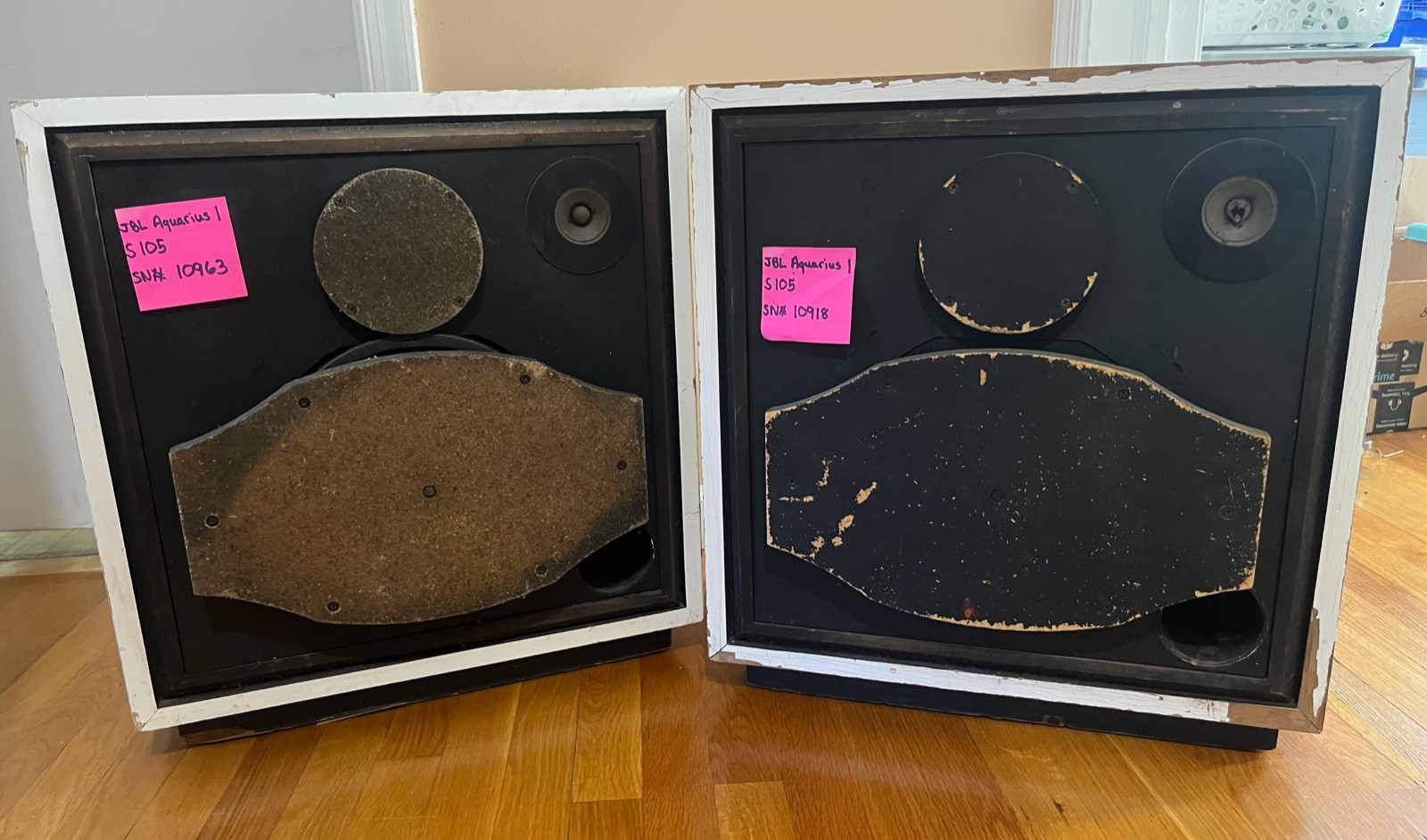
The Aquarius II was developed concurrently with the Aquarius I under the direction of Ed May, JBL's head of Product Development. While the Aquarius I used front-mounted drivers with elliptical diffraction panels, the Aquarius II employed a more complex rear-mounted design that Marketing believed would offer greater flexibility in cabinet design and potentially better coupling with room boundaries.
The original Aquarius II prototype was considered a sonic success, providing a wide, deep soundstage with remarkable consistency across the listening area. However, translating this prototype into a production system proved extraordinarily difficult. The design was notoriously sensitive to minor production variances in transducer and enclosure tolerances. Such variations could dramatically alter the sonic character, changing it from expansive and balanced to thin and nasal sounding.
Eventually, drivers had to be hand-picked and matched to extremely tight tolerances, significantly increasing production costs. This, combined with the complex cabinet construction required for the slot loading system, made the Aquarius II expensive to manufacture and contributed to its short production life.
The Aquarius II was part of JBL's response to a brief vogue for non-directional speakers that developed in the mid-1960s, championed by companies like Harman Kardon and Stewart Hegeman and particularly acclaimed in the New York audiophile market. JBL sought to bring its professional engineering expertise to this concept, resulting in the technically ambitious but commercially challenging Aquarius series.
Sound Character
The Aquarius II's sonic signature is best described as "expansive, immersive, and remarkably consistent throughout the listening space." When properly executed, the slot loading and diffraction system creates a soundfield that seems to emanate from the entire room rather than discrete speaker locations. This makes the Aquarius II particularly well-suited to social listening situations and rooms with challenging acoustics.
The bass response is full and well-extended, with the 12-inch 123A woofer providing substantial low-end authority. The rear slot loading couples effectively with room boundaries, creating a sense of bass presence that belies the speaker's physical size.
The dual LE5 midranges deliver transparent, natural vocals and instruments with the characteristic JBL clarity, but with a more diffuse presentation than conventional designs. The midrange seems to float in the soundfield rather than being anchored to the speaker cabinets.
The LE20 tweeter provides detailed highs while maintaining enough localization to preserve stereo imaging. The combination of direct-radiating highs with diffused mids and lows creates a unique sonic presentation that is both immersive and coherent.
When functioning correctly (with properly matched drivers and intact diffraction systems), the Aquarius II creates a listening experience that is less about analytical detail and more about musical envelopment. They excel with acoustic music, jazz ensembles, and orchestral recordings where a natural, room-filling presentation is desired.
Collector's Notes
The Aquarius II is among the rarest and most challenging JBL speakers to find in proper working condition, representing both the pinnacle and the limitations of 1970s non-directional speaker technology.
Finding an Aquarius II with all original components and intact diffraction systems is extremely rare. The 123A woofers generally require foam surround replacement. The LE5 midranges can suffer from hardened suspensions. The diffraction panels and slot loading systems are fragile and often damaged or modified. Cabinets may show wear from age and the complex construction.
As one of JBL's most unusual and technically ambitious designs, the Aquarius II commands premium prices when found in good condition. Complete, functional pairs are exceptionally rare and can command $2,000-4,000 or more. Incomplete or modified examples sell for significantly less. The extreme rarity makes market pricing highly variable.
Restoring Aquarius II speakers is a specialist task requiring particular attention to the diffraction and slot loading systems. These should never be altered from their original configuration. Driver matching is critical—the design's sensitivity to component variations means that replacement drivers must be carefully selected and tested. Crossover restoration should use high-quality components to maintain the original voicing.
The Aquarius II requires careful room placement to achieve its intended non-directional effect, typically needing some distance from rear walls to allow the slot loading to function properly. They work well with moderate-powered amplifiers (50-100 watts) and are particularly engaging with tube amplification. Their non-directional nature makes them less critical of precise listener positioning than conventional speakers.
The JBL S106 Aquarius II stands as a fascinating chapter in audio history—a technically ambitious design that pushed the boundaries of what was possible in home speaker technology, but whose production challenges ultimately limited its commercial success. For collectors seeking not just a speaker but a piece of audio engineering history, the Aquarius II represents both the promise and the perils of innovation in loudspeaker design.
Documentation
Factory Technical Documents
- HiFi Engine - S106 Aquarius II Manual - Factory technical manual
- Harman Technical Sheet (PDF) - Official specifications sheet
Service & Maintenance
- Service Manuals.net - S106 Aquarius II - Service manual with diagrams
- NoDevice - Service Manual - Technical service documentation
Historical Articles
- Audio Heritage - Aquarius Series - Historical profile of the Aquarius line
External Resources
- Lansing Heritage - JBL historical archives
eBay Listings


As an eBay Partner, we earn from qualifying purchases. This helps support our independent vintage technology research.
Related Models
- JBL 4310 (1970)
- JBL 4315 Control Monitor (1977)
- JBL L110A (1975)
- JBL 4311B (1975)
- JBL 4408 (1975)
- Akai AM-2850 (1975)
- Akai AP-206 (1975)
- Nakamichi BX-1 (1985)
- Acoustic Research research-ar-17 (1978)
- Acoustic Research AR-19 (1994)