JBL S105 Aquarius I
1971 - 1973
Introduction
The JBL S105 Aquarius I represents one of the most innovative and visually striking speaker designs in JBL's history. As the first model in the groundbreaking Aquarius series, this three-way non-directional speaker system broke from conventional audio design with its radical approach to sound dispersion. Featuring front-firing slot-loaded drivers and elliptical diffraction panels, the Aquarius I was designed to create a wide, immersive soundfield that remained consistent regardless of listener position—a true "noble experiment" in audio engineering.
Overview & Specifications
| Specification | Details |
| Type | 3-way, 3-driver bass reflex non-directional bookshelf |
| Woofer | 10" (25cm) LE10 cone woofer |
| Midrange | 5" (12.7cm) LE5 cone midrange |
| Tweeter | 2" (5cm) LE20-1 cone tweeter |
| Crossover Frequencies | 300 Hz, 1,000 Hz, 3,500 Hz |
| Nominal Impedance | 8 Ω |
| Power Handling | 50W continuous program |
| Sensitivity | 89 dB/W/m |
| Frequency Response | 45 Hz - 20 kHz |
| Dimensions (W×H×D) | 508 × 508 × 343 mm (20" × 20" × 13.5") |
| Weight | 21.25 kg (47 lbs) |
| Finish | Walnut or satin white veneer |
Driver Configuration
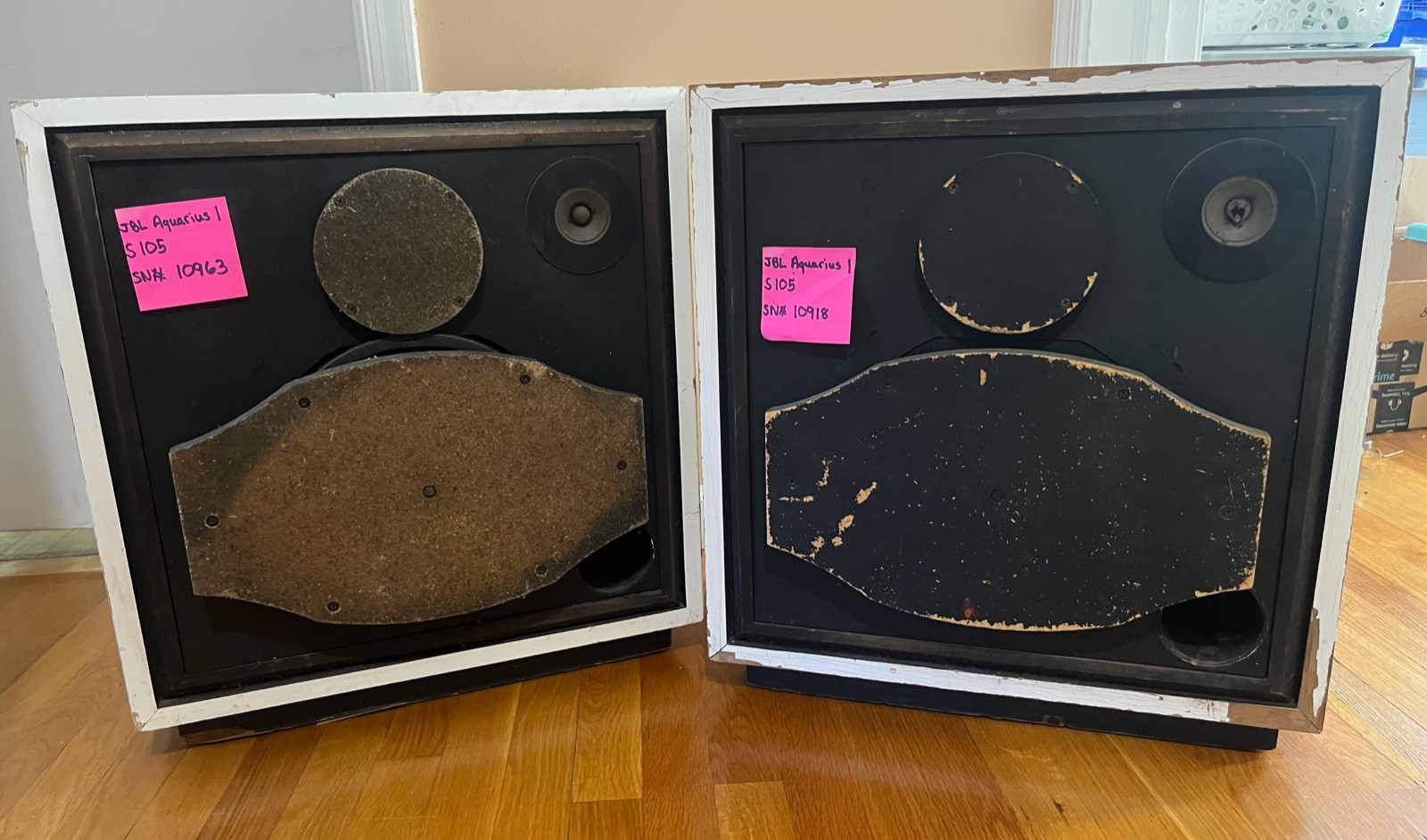
The Aquarius I's driver complement was borrowed from JBL's successful 4310 studio monitor and subsequent L100 home speaker. The LE10 woofer was a 10-inch design known for its excellent bass response and control. In the Aquarius I, this driver fired forward into an elliptical diffraction panel that created slot loading, dispersing bass energy widely throughout the room.
The LE5 midrange was JBL's acclaimed 5-inch hard-cone driver, renowned for its transparent, natural vocal reproduction. Like the woofer, it operated through its own elliptical diffraction panel, creating a dispersed midrange that contributed to the speaker's non-directional character.
The LE20-1 tweeter provided high-frequency reproduction, operating as a direct-radiating element to maintain some degree of image localization. This 2-inch cone tweeter delivered smooth, extended highs with the characteristic JBL clarity.
The unique three-way network with crossover points at 300 Hz, 1,000 Hz, and 3,500 Hz was specifically designed for the Aquarius I's non-directional approach, optimizing the interaction between the slot-loaded drivers and the direct-radiating tweeter.
Design & History
The Aquarius series was born from JBL's desire to create speakers with few limitations in room placement and a stereo soundfield largely independent of listener position. This concept had been pioneered in JBL's revolutionary Ranger designs (Paragon, Metregon, Minigon), but those required large, curved dispersion panels with unique enclosure geometries. The Aquarius series sought to achieve similar results through slot loading and diffraction panels.
Developed under the direction of Ed May, JBL's head of Product Development, the Aquarius I was based on the slot loading principle May had pioneered with Jack Frazier in the 1950s. The front-mounted drivers fired into elliptical diffraction panels that created a dense comb filter, maintaining reasonably flat power response at almost any listening location.
Interestingly, the Aquarius I proved to be the least prone to production variations in the Aquarius series and was arguably the best-sounding model. Its design evolved empirically, with the elliptical shapes of the diffraction panels determined through extensive testing rather than theoretical calculation.
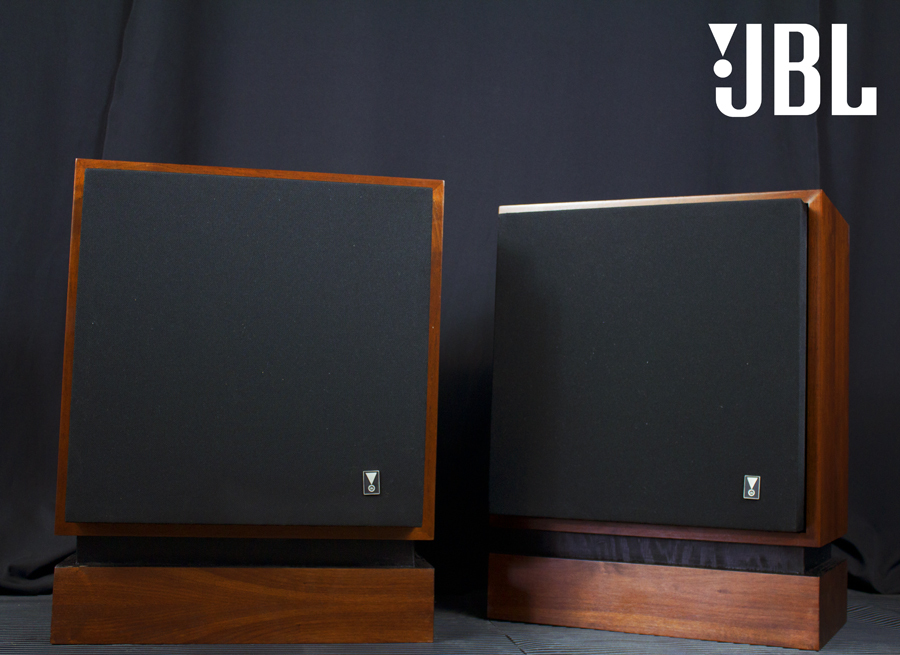
The Aquarius I was available in two color variations: traditional walnut veneer and contemporary satin white, reflecting the design trends of the early 1970s. An optional mounting base was sold separately for those who preferred floor placement.
Sound Character
The Aquarius I's sonic signature is best described as "spacious, immersive, and remarkably consistent throughout the listening area." The slot-loaded design creates a wide, deep soundstage that seems to emanate from the entire front wall rather than discrete speaker locations. This non-directional character makes the Aquarius I particularly well-suited to social listening situations where multiple listeners are positioned throughout the room.
The bass response is surprisingly full and extended for a speaker of its size, with the slot loading providing both dispersion and reinforcement. There's a sense of effortless low-end presence that belies the relatively modest 10-inch woofer.
The midrange is transparent and natural, with vocals and instruments appearing in the soundfield rather than being anchored to the speaker cabinets. The LE5 midrange delivers its characteristic clarity and detail, but with a more diffuse presentation than in conventional designs.
The high frequencies maintain good detail and air while contributing to the overall dispersed soundfield. The direct-radiating tweeter provides enough localization to maintain stereo imaging while still working within the non-directional concept.
When properly positioned (they work well on bookshelves, stands, or with the optional floor base), the Aquarius I creates a listening experience that is less about pinpoint imaging and more about immersive musical envelopment. They excel with acoustic music, jazz, and classical recordings where a natural, room-filling presentation is desired.
Collector's Notes
The Aquarius I is among the rarest and most collectible JBL speakers, representing a fascinating chapter in the company's history of audio innovation.
The LE10 woofers generally require foam surround replacement. The LE5 midranges are durable but can suffer from hardened suspensions. The LE20-1 tweeters are quite reliable. The elliptical diffraction panels are fragile and often damaged—intact originals are extremely rare. Cabinets in satin white finish are particularly scarce and desirable.
As one of JBL's most unusual and short-lived designs, the Aquarius I commands premium prices. Unrestored pairs typically sell for $1,500-2,500, while professionally restored examples with intact diffraction panels can reach $3,000-4,000. Complete sets with original boxes, documentation, and optional bases are museum pieces.
Restoring Aquarius I speakers requires particular care with the diffraction panels—these should never be removed or altered. The slot loading is critically dependent on the precise geometry of these panels. Crossover restoration should use high-quality components to maintain the original voicing. Cabinet restoration should preserve the original finish whenever possible.
The Aquarius I pairs well with moderate-powered amplifiers (30-100 watts) that can drive their 8-ohm load. They're particularly engaging with tube amplification, which complements their warm, spacious character. For sources, they work well with both analog and digital front ends, though their non-directional nature makes them less critical of precise setup than conventional speakers.
The JBL S105 Aquarius I stands as a testament to JBL's willingness to challenge audio conventions and pursue innovative solutions to listening room challenges. For collectors seeking not just a speaker but a piece of audio history—a "noble experiment" that pushed the boundaries of what was possible in home audio—the Aquarius I remains one of the most fascinating and desirable JBL designs ever created.
Documentation
Factory Technical Documents
- S105 Aquarius I Technical Manual (PDF) - Factory technical documentation
- Audio Heritage - S105 Technical Manual - Technical documentation
Service & Maintenance
- Servlib - S105 Aquarius I Service Manual - Service manual download
Historical Articles
- Audio Heritage - Aquarius Series Profile - Historical overview of Aquarius line
Product Catalogs
- Audio Database - Aquarius I Specifications - Detailed specifications
External Resources
- Lansing Heritage - JBL historical archives
eBay Listings


As an eBay Partner, we earn from qualifying purchases. This helps support our independent vintage technology research.
Related Models
- JBL 4310 (1970)
- JBL 4315 Control Monitor (1977)
- JBL L110A (1975)
- JBL 4311B (1975)
- JBL 4408 (1975)
- Akai AM-2850 (1975)
- Akai AP-206 (1975)
- Nakamichi BX-1 (1985)
- Acoustic Research research-ar-17 (1978)
- Acoustic Research AR-19 (1994)