JBL L55 Lancer
1971 - 1975
Overview
The JBL L55 Lancer made its debut in 1971 as a bold statement in mid-size floorstanding design, capturing the spirit of an era when audio equipment dared to be both visually striking and acoustically uncompromising. Named with martial confidence, the Lancer brought together JBL's professional transducer expertise and contemporary design sensibilities to create a speaker that served as both room anchor and conversation piece. For the discerning homeowner of the early 1970s, it offered a middle path between the bookshelf systems that struggled to fill spaces and the massive horn systems that dominated them.
Design Distinction
The L55's most immediately recognizable feature was its smoked glass top surface—a design flourish that elevated it from mere utility to interior design statement. This reflective cap caught ambient light, creating visual depth and sophistication that complemented the era's fascination with modern materials and clean lines. The glass top served practical purposes as well, protecting the cabinet from scratches and providing a surface for display objects, plants, or the occasional resting beverage during social gatherings.
The enclosure proportions—440mm wide by 620mm high by 330mm deep—established a presence that commanded attention without overwhelming typical living rooms. At 29kg, the L55 possessed the substantial feel that distinguished premium audio equipment from mass-market alternatives. The internal bracing and particleboard construction minimized unwanted resonance, ensuring that what emerged from the drivers was signal rather than cabinet coloration.
Two-Way Muscle
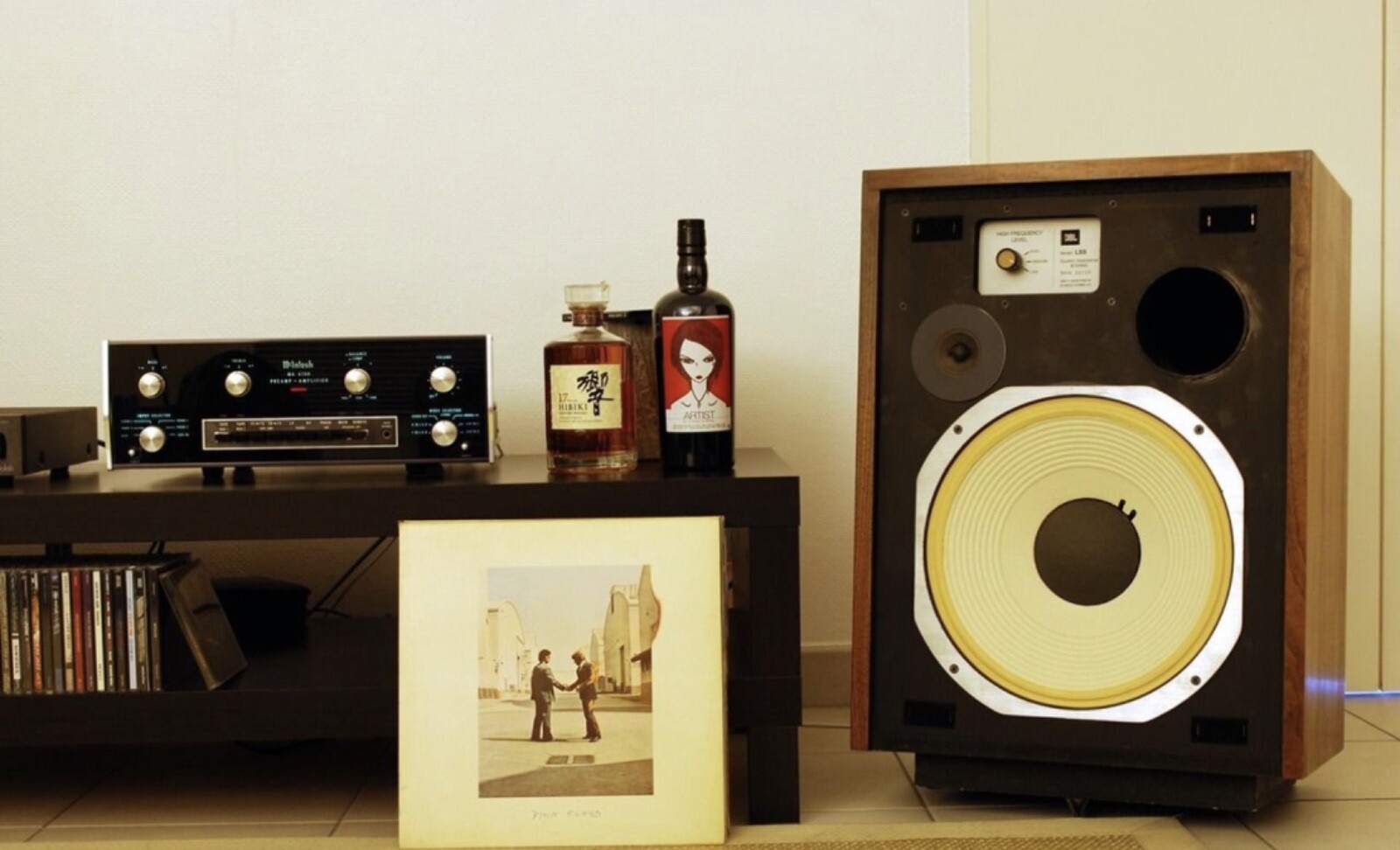
The L55 employed a straightforward but potent two-way configuration that prioritized dynamics and coherence. The low-frequency section featured the LE14A, a 36cm cone woofer equipped with a substantial 10cm voice coil. This was professional-grade hardware adapted for domestic duty—the same fundamental design that served in JBL's studio monitors and cinema systems. The large voice coil provided excellent heat dissipation and linear excursion, enabling the L55 to reproduce both the subtlety of acoustic bass and the impact of amplified music without strain.
The high-frequency section utilized the LE20-1, a 5cm cone tweeter that delivered the efficiency and dynamics necessary to keep pace with the substantial woofer. While not as extended as the dome tweeters that would dominate later designs, the LE20-1 offered the immediacy and transient response that characterized JBL's signature sound—present, articulate, and engaging.
The dedicated two-way crossover network integrated these drivers at 2kHz, a choice that maintained woofer directivity control while keeping the tweeter within its comfortable operating range.
Domestic Integration
The L55 arrived during a pivotal moment in home audio history. The 1970s saw audio systems migrate from basement rec rooms to main living spaces, and the L55's design acknowledged this transition. The smoked glass top and wood-grain finish harmonized with contemporary furniture, while the moderate footprint allowed placement in apartments, townhouses, and suburban homes alike.
The three available grille colors—coffee, mandarin, and indigo—allowed customization to interior palettes. Whether flanking a console stereo, anchoring a wall unit, or standing as independent sculptures, the L55 announced serious audio intent without the industrial aesthetic of studio monitors.
Living Room Performance
With 35-watt continuous power handling and 8-ohm impedance, the L55 was accessible to the receivers and integrated amplifiers that dominated mid-price hi-fi. The 2kHz crossover and large woofer meant that most vocal and instrumental fundamentals emanated from a single source, contributing to coherent imaging and natural soundstaging.
In the context of early 1970s music, the L55 excelled at the scale of reproduction appropriate for home listening. Rock's expanding sonic ambitions, jazz's acoustic subtleties, and classical's dynamic extremes all found suitable expression through the LE14A's capable motor system and the LE20-1's present treble character.
Social and Solitary Use
The L55 served dual purposes in 1970s households. During social gatherings, its efficient design filled rooms with music without requiring massive amplification—background jazz for dinner parties, rock for casual entertaining. For solitary listening sessions, the substantial woofer foundation and coherent two-way design revealed the detail and dynamics that serious enthusiasts sought.
Specifications
| Feature | Specification |
| Type | 2-way, 2-speaker, bass reflex, floor type |
| Woofer | 36cm cone type (LE14A) with 10cm voice coil |
| Tweeter | 5cm cone type (LE20-1) |
| Crossover Frequency | 2 kHz |
| Impedance | 8 Ω |
| Power Handling | 35W continuous program |
| Dimensions (W×H×D) | 440 × 620 × 330 mm |
| Weight | 29 kg |
| Grille Colors | Coffee, Mandarin, Indigo |
The L55 Lancer endures as a symbol of JBL's ability to balance professional performance with domestic acceptability—a speaker that delivered studio-derived capability without requiring studio-sized accommodations.
eBay Listings

As an eBay Partner, we earn from qualifying purchases. This helps support our independent vintage technology research.
See Also
Related Models
- JBL 4310 (1970)
- JBL 4315 Control Monitor (1977)
- JBL L110A (1975)
- JBL 4311B (1975)
- JBL 4408 (1975)
- Akai AM-2850 (1975)
- Akai AP-206 (1975)
- Nakamichi BX-1 (1985)
- Acoustic Research research-ar-17 (1978)
- Acoustic Research AR-19 (1994)