JBL L200 Studio Master: The Studio-Grade Legend That Defined Hi-Fi in the 1970s
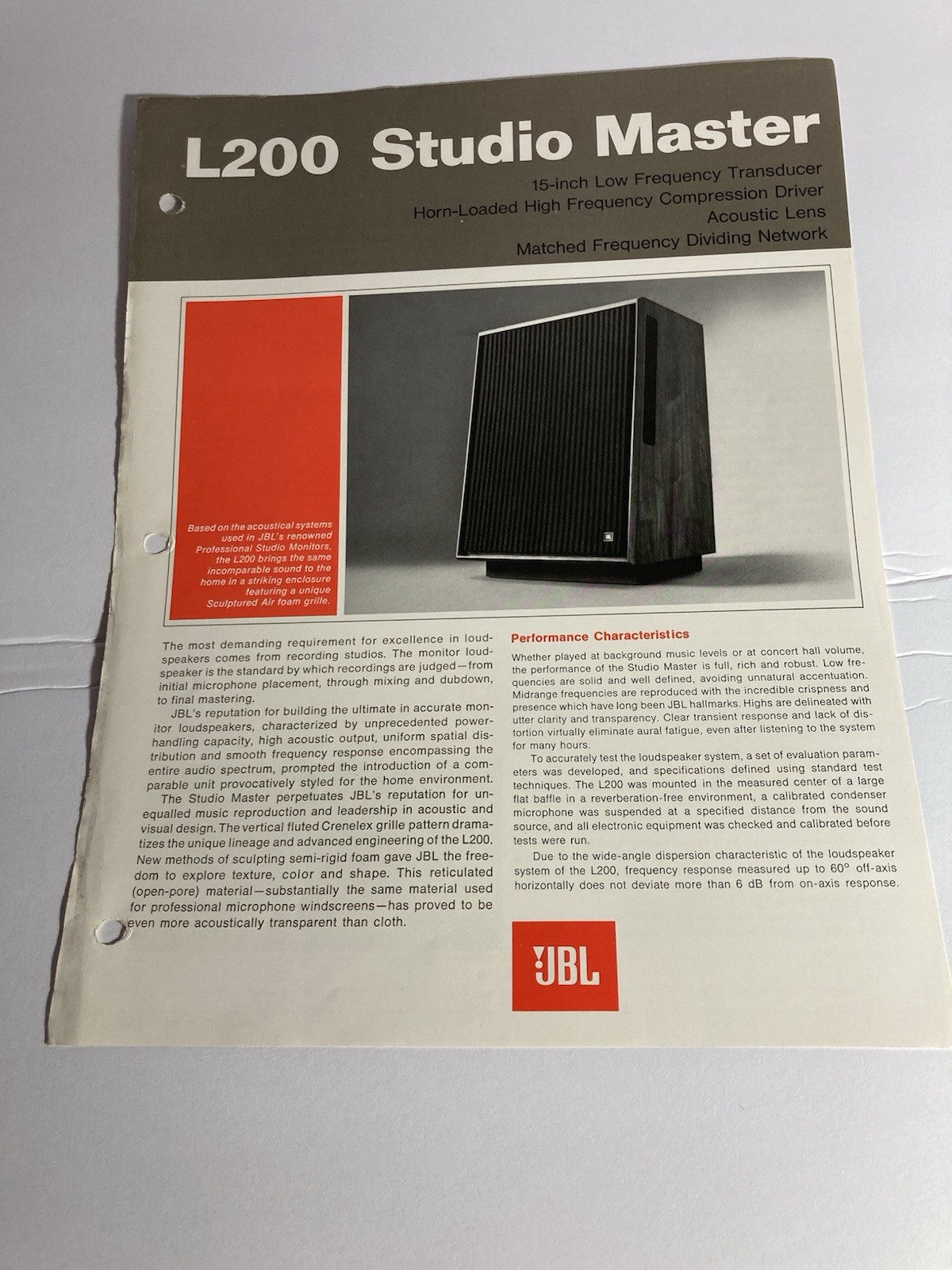
The JBL L200 Studio Master stands as one of the most iconic and revered loudspeakers of the 1970s, embodying the golden era of American high-fidelity audio. Introduced in 1972 by the legendary James B. Lansing Design (JBL), the L200 was not merely a consumer speaker—it was a direct descendant of professional studio monitors used in recording studios, bringing near-field accuracy and dynamic power to the home listening environment. Revered for its bold, energetic sound and rugged construction, the L200 Studio Master remains a sought-after classic among vintage audio collectors and analog enthusiasts.
Historical Context and Studio Heritage
Born during a transformative period in audio history, the L200 Studio Master emerged when the lines between professional and consumer audio began to blur. JBL, already a dominant force in studio monitoring with models like the 4310 and 4311, leveraged its engineering expertise to create a speaker that offered professional-grade performance at a more accessible price point. The L200 was marketed as a "studio monitor for the home," a bold claim that resonated with audiophiles seeking transparency and realism.
The L200 was part of JBL’s “Century” series, named for its intended lifespan and robust build quality. It was designed by a team led by JBL’s chief engineer, Keith Johnson (who later founded Audio Precision), and featured components derived directly from JBL’s professional line. Its development coincided with the rise of quadraphonic sound and the growing popularity of high-end stereo systems in American homes. The L200 quickly gained a reputation not only for its sound but also for its striking appearance—tall, trapezoidal cabinets with a distinctive black grille and gold-anodized trim.
Technical Specifications
| Specification | Detail |
| Model | L200 Studio Master |
| Type | 3-way, bass-reflex |
| Drivers | 12" woofer (JBL D130F), 3" midrange (JBL 2226), 1" compression driver (JBL 2406) |
| Crossover | 1500 Hz (2nd order) |
| Frequency Response | 45 Hz – 20 kHz |
| Sensitivity | 94 dB (1W/1m) |
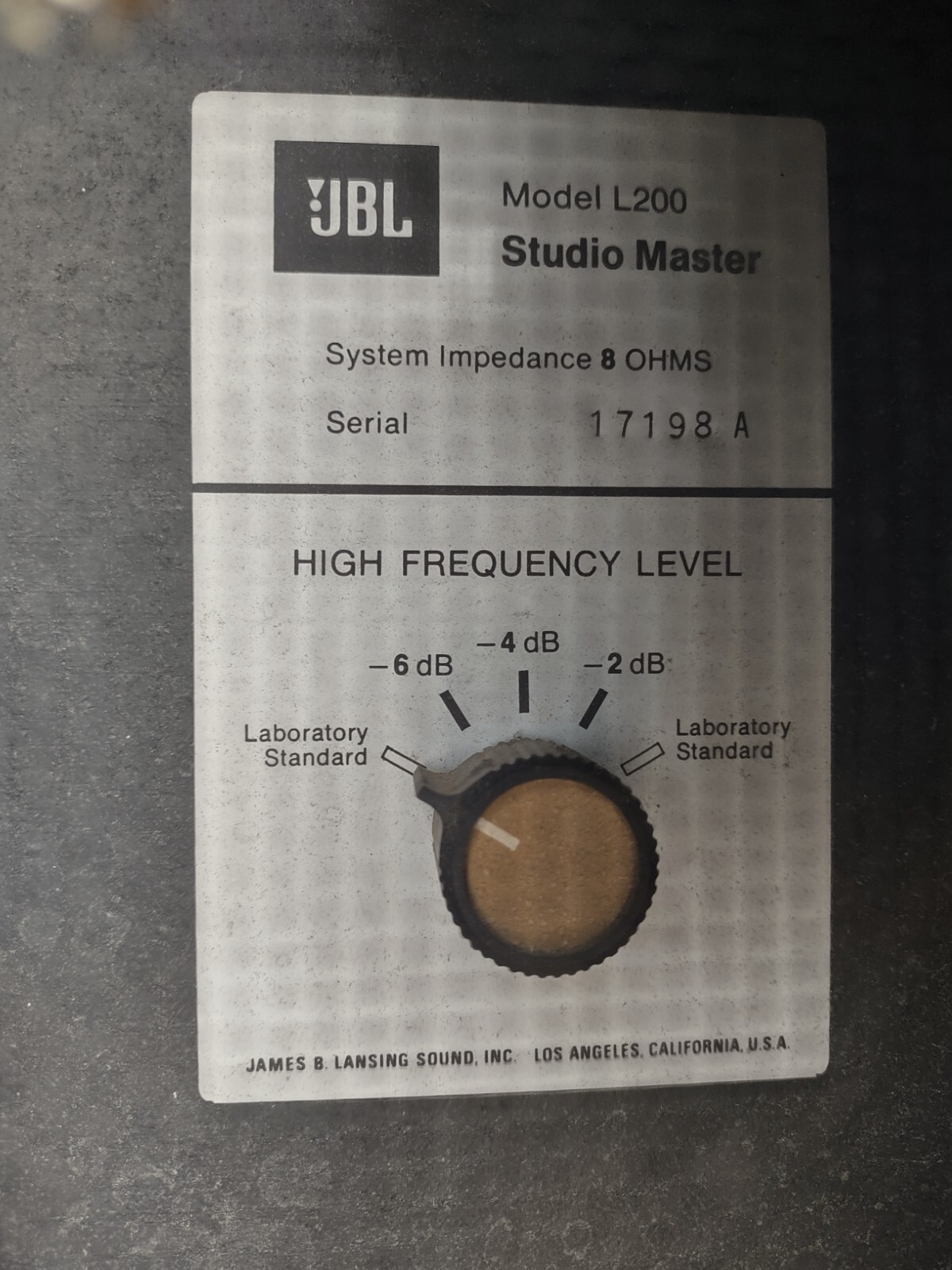
| Nominal Impedance | 8 ohms |
| Recommended Amp Power | 20 – 150 watts |
| Enclosure | Vented (ported), trapezoidal MDF cabinet |
| Dimensions (H x W x D) | 26" x 12" x 12" |
| Weight | 45 lbs per speaker |
| Finish Options | Walnut veneer, black ash (rare) |
| Grille | Black cloth with gold trim |
The L200’s driver complement was a hallmark of JBL’s engineering philosophy: durability, high efficiency, and wide dispersion. The 12-inch D130F woofer, a staple in JBL’s pro-audio lineup, delivered deep, punchy bass with excellent transient response. The 3-inch 2226 midrange ensured clear, articulate vocals and instrumental reproduction, while the 1-inch 2406 high-frequency driver—mounted on a LeCroy-designed horn—provided crisp, extended highs without harshness when properly broken in.
Sound Quality Characteristics
The L200 Studio Master is renowned for its dynamic, forward, and highly engaging sound signature. With a sensitivity of 94 dB, these speakers are extremely easy to drive, making them compatible with low-powered tube amplifiers as well as high-current solid-state receivers. Their sound is often described as “lively,” “rhythmic,” and “expansive,” with a strong midrange presence that brings vocals and lead instruments to the forefront.
Bass response is tight and impactful, though not overly deep—expect solid output down to 45 Hz, with room gain enhancing lower frequencies in typical listening environments. The horn-loaded tweeter delivers exceptional clarity and detail, though early examples can sound bright or aggressive if not properly aged or paired with warm electronics. Over time, the diaphragm in the 2406 driver softens, mellowing the high-frequency response into a more balanced tonality.
Stereo imaging is wide and well-defined, with a strong center image that benefits from careful placement. Due to their trapezoidal cabinet design, the L200s minimize internal standing waves and front-panel diffraction, contributing to a cleaner, more accurate soundstage.
Notable Features and Innovations
The L200 Studio Master introduced several innovations that set it apart from contemporaries:
- Studio-Derived Components: The use of the D130F woofer and 2406 tweeter—both found in JBL’s professional monitors—gave the L200 unmatched credibility in sound reproduction.
- Trapezoidal Cabinet: This design reduced internal resonances and front-baffle edge diffraction, improving clarity and imaging.
- High Sensitivity: At 94 dB, the L200 could achieve high sound pressure levels with minimal amplifier power, ideal for the lower-powered amps of the era.
- LeCroy Crossover Network: Named after Dr. Walter LeCroy (founder of LeCroy Corporation), this passive crossover used high-quality components for precise driver integration.
Market Value and Collectibility
Today, the JBL L200 Studio Master enjoys a strong following in the vintage audio community. Well-maintained pairs in original condition—especially those with walnut veneer and unblemished grilles—can fetch between $600 and $1,200 per pair, depending on condition, location, and provenance. Models with replaced or poorly refinished cabinets are significantly less valuable.
Collectibility is rated high, particularly among JBL enthusiasts and fans of 1970s American hi-fi. The L200 is often compared to the AR-3a, Klipsch Heresy, and Advent Large in vintage audio circles, but its studio pedigree gives it a unique appeal. Originality is key: speakers with restored or replaced drivers (especially the 2406 tweeter) lose value unless the work is professionally done with period-correct parts.
Common Issues and Maintenance
Like all vintage speakers, the L200 requires attention to maintain optimal performance:
- Tweeter Diaphragm Deterioration: The 2406’s aluminum diaphragm can become brittle or torn. Re-coning or replacement with a refurbished unit is common. Avoid speakers with “popping” or distorted highs.
- Woofer Surround Rot: The foam surrounds on the D130F can degrade over time. Re-foaming by a specialist restores bass performance.
- Crossover Component Aging: Capacitors and inductors in the crossover may drift in value. Replacing electrolytic capacitors and checking resistors can improve clarity and balance.
- Cabinet Scratches and Veneer Damage: Walnut veneer is prone to wear. Refinishing should be done carefully to preserve value.
Regular cleaning, proper placement away from humidity, and use with stable amplifiers help extend the life of these speakers.
Comparison to Similar Models
| Model | Key Differences |
| JBL L100 Classic | Smaller cabinet, 12" woofer in sealed enclosure, less bass extension, more common |
| KLH Model Eleven | Similar size, but lower sensitivity (86 dB), less dynamic, more neutral tonality |
| AR-3a | Acoustic suspension design, smoother bass, lower efficiency, more "polite" sound |
| Infinity SS-1 | More complex crossover, higher cost, smoother highs, less punchy bass |
While the L100 is more widely recognized, the L200 is often preferred by purists for its truer studio monitor character and superior transient response.
Conclusion
The JBL L200 Studio Master is more than a vintage speaker—it’s a piece of audio history. With its bold design, professional-grade components, and thrilling sound, it captures the spirit of 1970s high-fidelity at its most ambitious. For collectors, restorers, and music lovers seeking a dynamic, engaging listening experience, the L200 remains a compelling choice. When well-maintained, it delivers a sonic performance that rivals many modern speakers, proving that true engineering excellence never goes out of style.
eBay Listings


As an eBay Partner, we earn from qualifying purchases. This helps support our independent vintage technology research.
Related Models
- JBL 4310 (1970)
- JBL 4315 Control Monitor (1977)
- JBL L110A (1975)
- JBL 4311B (1975)
- JBL 4408 (1975)
- Akai AM-2850 (1975)
- Akai AP-206 (1975)
- Nakamichi BX-1 (1985)
- Acoustic Research research-ar-17 (1978)
- Acoustic Research AR-19 (1994)