JBL E150P (2004)
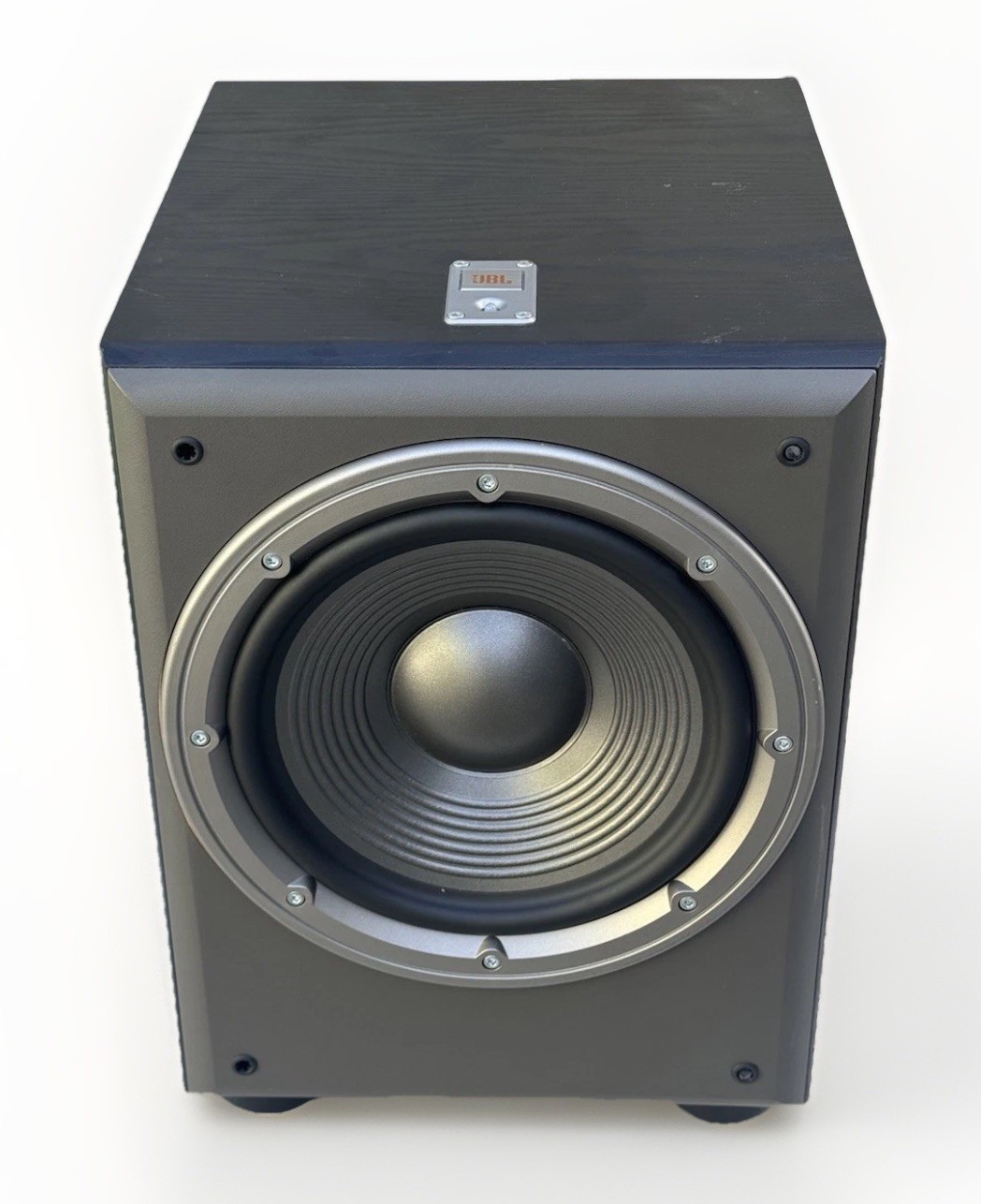
A 10-inch, 150-watt powered subwoofer from JBL's Northridge E Series — the kind of bass reinforcement that filled a room without demanding a second mortgage or a dedicated listening chair.
Overview
JBL's E150P is a powered subwoofer from the Northridge E Series, built in 2004 and sold as both a standalone component and part of the wider Northridge E-Series line. It is a single-driver, bass-reflex design: one 10-inch PolyPlas cone (254 mm, measured) firing into a ported enclosure, driven by a built-in amplifier rated at 150 watts RMS with 250 watts of peak dynamic power. According to available documentation, the E150P was manufactured in 2004. A JBL service manual revision marked "Rev2 2/2004" and a contemporaneous craigslist listing both confirm the date.
The design is old-school. There is no DSP, no room-correction microphone, no app. There is a woofer, an amplifier, a variable low-pass filter, a phase switch, and a set of inputs. That's the whole interface. Subwoofers used to be appliances, not computers.
Frequency response is listed as approximately 27 Hz to 150 Hz, with the low-pass filter adjustable from 50 Hz to 150 Hz. The 150 Hz ceiling means the E150P can be crossed over high enough to blend with small satellite speakers that roll off early, which was the whole point of a subwoofer like this in 2004. The 27 Hz bottom figure is the more interesting number. A 10-inch driver in a modest ported box reaching into the high twenties is respectable, though output at that frequency will be well down from the passband. Expect useful reinforcement in the 35-40 Hz region rather than true subsonic extension.
The driver is a PolyPlas cone, JBL's proprietary coated-polymer material. PolyPlas cones were JBL's workhorse driver material across the Northridge line, and they're known for being stiff enough to resist breakup at higher frequencies while remaining light enough to move quickly. The acoustic radiation pattern is monopolar - a standard forward-firing configuration, not a down-firing or bipolar arrangement.
The E150P was sold in at least two voltage variants: a 120-volt version for North America and an E150P/230 designation for 230-volt markets. The "/230" suffix appears on European listings and is the version most commonly seen on the secondhand market outside the United States. At least one example carries a "made in Mexico" origin marking.
Key Features
150-Watt Amplifier with 250 Watts Peak Dynamic
The built-in amplifier is rated at 150 W RMS with a 250 W peak dynamic rating. That's a fairly conservative burst-test methodology, and it suggests the 250 W number reflects real short-term capability.
For a 10-inch subwoofer in a box this size, 150 watts RMS is a sensible match. It's enough power to drive the driver to its mechanical limits in a typical room, but not so much that the amplifier is constantly fighting the woofer's excursion ceiling. The E150P was never intended to pressurize a home theater the size of a small cinema. It was designed to add weight and foundation to a modest two-channel or entry-level surround system.
Adjustable Crossover and Phase Control
The rear panel offers a continuously variable low-pass filter spanning 50 Hz to 150 Hz, plus a phase control. The low-pass adjustment is the more useful of the two. Setting it low, say 60-80 Hz, lets the main speakers handle the upper bass while the subwoofer fills in the bottom octave. Setting it high, 120-150 Hz, is the right call when the main speakers are small satellites that can't produce meaningful output below 100 Hz. The phase control helps integrate the subwoofer with the mains. Get it wrong and you get a suckout in the crossover region that no amount of level adjustment will fix.
Line-Level and Speaker-Level Inputs with Gold-Plated Binding Posts
The E150P accepts both line-level and speaker-level inputs, and the speaker terminals are gold-plated binding posts. The speaker-level inputs are useful for an older analog receiver or integrated amplifier that lacks a dedicated subwoofer output or a volume-controlled preamp output.
10-Inch PolyPlas Woofer in a Bass-Reflex Enclosure
The single driver is a 10-inch (254 mm) PolyPlas cone in a bass-reflex cabinet. The ported design extends low-frequency output compared to a sealed box of the same volume, at the cost of a sharper roll-off below the tuning frequency and some group-delay penalty. For a subwoofer of this class, that's the right trade-off. The E150P is meant to deliver audible bass in a normal room, not to satisfy an anechoic measurement. The cabinet measures 17-3/4" × 12-1/4" × 14-1/2" (451 × 311 × 368 mm) and weighs 33.5 lb / 15.2 kg, according to the service documentation and multiple listings. One continental listing reports 12 kg, which appears to be an error. The 15.2 kg figure is corroborated by both the JBL service manual and a second listing.
eBay Listings



As an eBay Partner, we earn from qualifying purchases. This helps support our independent vintage technology research.
Collectibility & Market
The E150P is not a high-value collectible in the way JBL's studio monitors or large-format home speakers are. It's a mass-market subwoofer from the mid-2000s, and the secondhand market reflects that. Recent listings observed across European classifieds range from €60 for a bare unit in Germany to €105 for one with its front grille in Poland. A Swiss listing asked CHF 100, and a Hungarian seller listed one at HUF 81,000. These are not aspirational prices — they're the prices of a working subwoofer that someone wants to move. That's good news for buyers: the E150P is one of the cheaper ways to add genuine JBL bass to a system.
Condition varies. Another craigslist listing described the subwoofer as in "Great condition."
Owner opinion is mixed but generally positive. A Russian forum user who acquired an E150P/230 wrote that it "satisfies almost everything," while noting that "the web responds to it differently: some praise it, some criticize it." That's a fair summary of a subwoofer that does its job without excelling at any one thing. It won't plumb the depths of a dedicated home theater sub, and it won't match the output of JBL's larger professional models. But for a modest system in a modest room, it delivers the kind of balanced, easy-to-listen-to bass that makes music more enjoyable without calling attention to itself.