JBL D130 (1948–1980s)
That shimmering silver dome in the middle of a Fender cab isn’t just a badge of honor—it’s the heart of a speaker that rewired how we heard music, from living rooms to rock festivals.
Overview
You don’t so much hear a JBL D130 as feel it settle into your bones—the way it punches through a mix with a clarity that borders on clinical, yet somehow still sings with soul. It’s not warm like a Jensen, not woolly like a Celestion; it’s bright, articulate, and unapologetically present, like someone turned up the resolution on reality. When you crank a vintage amp loaded with a pair of these, the sound doesn’t bloom—it *launches*, slicing through reverb and distortion with a high-mid snap that made surf guitarists drool and studio engineers take notice. That signature aluminum center dome isn’t just for show; it’s a functional high-frequency radiator, part of a design so ahead of its time that it stayed in production, with refinements, for over three decades.
Introduced in 1948, the D130 wasn’t just another woofer—it was a declaration. At a time when most 15-inch drivers were sluggish, narrow-range workhorses, the D130 delivered a frequency response that flirted with full-range performance, especially in the upper mids and lower treble. Its 4-inch voice coil, wound from flat aluminum ribbon wire, was revolutionary. That massive coil sat in a magnetic gap so tight—just 0.05 inches—that assembling it required precision unheard of in the late 1940s. The payoff? Exceptional power handling for its era, minimal compression under load, and a sensitivity rating that hovered around 103 dB, making it one of the loudest speakers you could buy without stepping into horn territory.
It didn’t take long for the D130 to escape the hi-fi cabinet. By the late 1950s, guitarists were tearing open their Fenders and replacing stock speakers with JBLs, drawn by the promise of clean headroom and cutting presence. Leo Fender noticed. By 1959, JBL D130s and D130Fs became factory options on Showman and Twin amps, and the rest is tone history. This wasn’t just a speaker swap—it was a sonic upgrade path that defined an era of American guitar sound. From Dick Dale’s reverb-drenched staccato to Jerry Garcia’s soaring leads, the D130 was the unsung engine under the hood.
And then there was the Grateful Dead’s “Wall of Sound”—a towering, speaker-laden beast that used no less than 588 JBL D130s alongside horns and tweeters. It wasn’t just loud; it was *clear*, a radical concept in an age of muddy PA systems. The D130’s ability to stay clean at volume made it the backbone of that system, proving it could scale from a single guitar cab to a concert-wide array without losing its voice.
Specifications
| Manufacturer | JBL (James B. Lansing Sound) |
| Production Years | 1948 – late 1980s (as E130 successor) |
| Original Price | $102.00 USD (1964) |
| Driver Size | 15 inch (38.1 cm) |
| Type | Full-range cone driver |
| Impedance | 8 Ω, 12 Ω, 16 Ω (varies by version) |
| Power Handling | 25–60 W (continuous program) |
| Power Handling (Peak) | 100 W (some reconed versions) |
| Frequency Response | Not specified in research, but noted for extended high-end for a 15" woofer |
| Sensitivity | 103 dB (1 kHz, 1 W/1 m) |
| Voice Coil Diameter | 4 inch (10.2 cm), aluminum ribbon wire, edge-wound |
| Magnet Type | Alnico V |
| Magnet Weight | 5.4 kg |
| Magnetic Flux Density | 12,000 gauss |
| Frame Material | Aluminum die-cast |
| Cone Material | Lightweight paper, curvilinear profile |
| Dust Cap | 4-inch aluminum center dome (functions as high-frequency radiator) |
| Mounting Depth | 5.5625 inch (141 mm) |
| Overall Diameter | 15.25 inch (387 mm) |
| Weight | 22.5 lbs (10.2 kg) |
| Recommended Enclosure Volume | 114–338 liters |
| Directional | 90° |
Key Features
The 4-Inch Flat Wire Voice Coil
The D130’s most radical innovation was its 4-inch voice coil—massive for the late 1940s and still impressive today. Unlike conventional round-wire coils, JBL used a flat aluminum ribbon, edge-wound to maximize surface area and packing density. This wasn’t just about brute size; the geometry allowed more copper (well, aluminum) in the magnetic gap with fewer turns, reducing inductance and improving transient response. The large diameter also spread heat over a greater surface, delaying thermal compression and letting the speaker handle more power before distorting. It was a design that prioritized efficiency and durability, and it worked: the D130 could take abuse that would melt lesser coils. But that tight 0.05-inch gap meant zero tolerance for misalignment—any warping or debris could cause rubbing, a common failure point in neglected units.
Alnico V Magnet and Die-Cast Frame
While many manufacturers stuck with ceramic magnets or weaker Alnicos, JBL went all-in on Alnico V, a costly but high-performance alloy that delivered a dense, stable magnetic field. The 5.4 kg magnet structure produced 12,000 gauss—less than James Lansing originally wanted, but still formidable. Paired with a rigid aluminum die-cast frame, the entire motor system was overbuilt by contemporary standards. That cast frame didn’t just look industrial; it minimized resonance and kept the voice coil perfectly centered. It also made the D130 heavier than most competitors, but that mass contributed to its rock-solid performance under load.
The Aluminum Center Dome: More Than a Logo
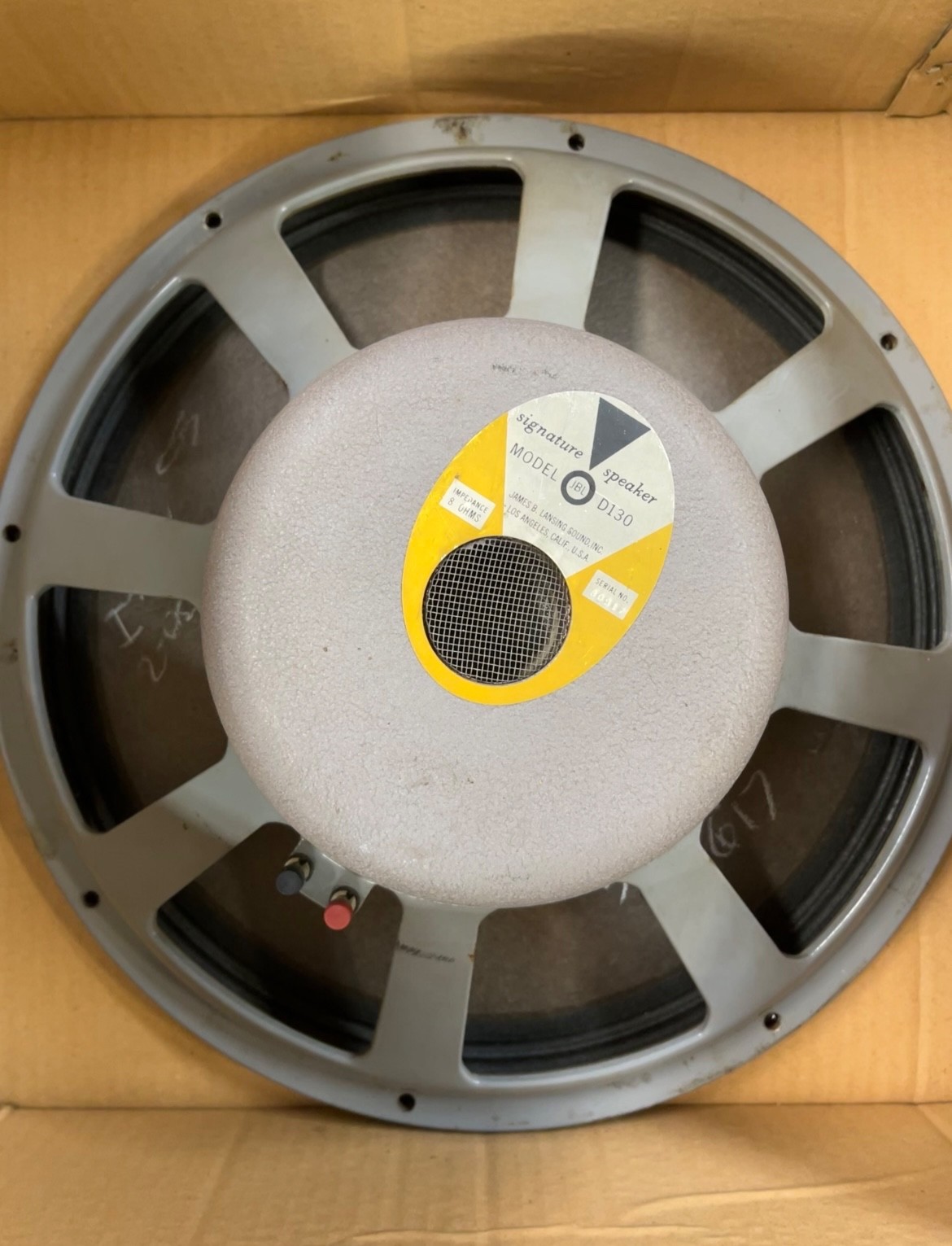
That shiny silver disc in the middle? It’s not a badge—it’s part of the sound. Instead of a paper or plastic dust cap, the D130 used a 4-inch aluminum dome that acted as a passive high-frequency radiator. While not a true tweeter, it extended the speaker’s output into the upper mids, giving it a presence boost that cut through dense mixes. This is why a D130-loaded amp sounds “open” even without a dedicated high-frequency driver. The dome also reinforced the cone’s structural integrity, reducing breakup modes. Later recone kits sometimes replaced it with a standard cap, robbing the speaker of its signature sparkle—owners restoring originals often hunt specifically for NOS domes to preserve the authentic sound.
Historical Context
The D130 emerged at a pivotal moment. Postwar America was hungry for better sound—both at home and on stage. Hi-fi was becoming a middle-class aspiration, and JBL positioned the D130 as the premium choice for discerning listeners. It found its way into countless component systems, often paired with horns or tweeters to cover the full spectrum. But its real cultural impact came through music. When guitarists discovered that swapping in a D130 gave them cleaner headroom and more bite, a grassroots modding movement began. Fender, ever attuned to player demand, partnered with JBL to offer factory-installed versions, leading to the D130F—slightly modified for musical instrument use, with a beefier suspension and sometimes a painted orange frame.
The 1960s cemented the D130’s status. It became the go-to speaker for touring acts needing reliability and clarity. At Woodstock, the festival’s main PA relied heavily on JBL drivers, including the D130, ensuring that even in the mud and chaos, the music stayed intelligible. In the studio, engineers valued its consistency—what you heard on a D130 monitor was likely what the record would sound like on consumer systems. By the 1970s, it was the backbone of the Grateful Dead’s Wall of Sound, a system so vast and clear it eliminated the need for stage monitors. That the D130 could scale from a single guitar amp to a 50,000-watt array speaks to its versatility and robust design.
Collectibility & Value
Today, a working original JBL D130 in good condition is a prized find, especially if it’s a pre-1970s Alnico V model. Prices vary wildly based on provenance, originality, and whether it’s been reconed. A pair of unmodified D130Fs from a vintage Fender Showman can fetch $400–$800, while NOS (new old stock) units with original packaging and documentation might break $1,000. However, many D130s on the market have been reconed—sometimes with K130 or E130 kits—which changes their character and value. A reconed D130 with a modern cone and voice coil might handle more power (up to 100 watts in some hybrid builds), but it loses some of the original’s dynamic nuance and high-end sparkle.
The biggest threat to longevity is foam rot and voice coil failure. While the Alnico magnet rarely degrades, the original foam surrounds dry out and crumble, especially in dry climates. Re-coning is common, but quality varies—cheap kits use paper or rubber surrounds that don’t replicate the original compliance. Service technicians observe that original D130s with factory-issued lifetime warranty repairs (reworked by JBL in the late 1970s) often have better longevity, as JBL used improved materials during those refurbishments.
When buying, check for cone warping, spider misalignment, and magnet strength. A multimeter test should show 6–8 ohms for an 8-ohm model; significantly higher resistance suggests a failing coil. Also, verify the frame stamp—early units have a “73” prefix followed by year and week codes (e.g., “736345” for week 45 of 1963). Orange-frame D130Fs are particularly sought after, though not always sonically different from black versions.
Restoration costs can add up: a professional re-cone with authentic materials runs $120–$180 per speaker, and sourcing original parts like the aluminum dome or nameplate may require scavenging from donor units. Still, for purists, it’s worth it—the D130 isn’t just a speaker, it’s a time capsule of American audio innovation.
eBay Listings



As an eBay Partner, we earn from qualifying purchases. This helps support our independent vintage technology research.
Related Models
- JBL 4310 (1970)
- JBL 4315 Control Monitor (1977)
- JBL L110A (1975)
- JBL 4311B (1975)
- JBL 4408 (1975)
- Akai AM-2850 (1975)
- Akai AP-206 (1975)
- Nakamichi BX-1 (1985)
- Acoustic Research research-ar-17 (1978)
- Acoustic Research AR-19 (1994)