JBL 7510
A slim, 18-kilogram tower that proves JBL's pro-monitor discipline could live in a domestic two-way.
Overview
At 843 mm tall and just 175 mm deep, the JBL 7510 cuts a deliberately narrow figure — a floorstander that doesn't demand a warehouse to breathe. It's a 2-way bass reflex design, and depending on which manual you trust, it answers to "JBL 7510," "L7510," or the "7510X" variant that hifi-wiki groups alongside it. The naming inconsistency is classic JBL from this period, but the engineering intent is consistent: a speaker that behaves itself in a room, not just in a listening lab.
The 7510X, the variant with documented dates, arrived in 1990 and left the catalog in 1992, priced at approximately 1,100 DM. That positioning put it in the serious-budget tier of JBL's domestic range — not entry-level, not flagship, but the kind of speaker you bought when you wanted JBL's studio credibility without the studio footprint. The base 7510's production window isn't documented in available sources, so collectors should treat the 1990–1992 span as applying specifically to the X version.
What makes the 7510 interesting is how it translates JBL's professional monitor philosophy into a slim tower. The rated 89 dB sensitivity (1 W/1 m) means it doesn't need a monster amplifier to get moving — a decent 50-watt integrated will drive it to satisfying levels. The nominal 8-ohm impedance keeps it friendly to virtually any receiver from the era. This is a speaker designed to work with what you already own, not to demand a separate amp purchase.
Key Features
2-Way Bass Reflex Loading
The 7510's enclosure is a straightforward bass reflex design — a ported cabinet that extracts low-end output from a relatively compact column. The bass driver for the 7510X is a 170 mm unit, paired with a 25 mm tweeter. That's a modest woofer for a floorstander, but the reflex tuning extends the perceived reach. The frequency response figures vary by source — 50–20,000 Hz per HiFi Engine, 45–20,000 Hz per the hifi-class.net manual, and 48–20,000 Hz for the 7510X per hifi-wiki — which suggests some production tolerance or measurement-condition variance. The crossover sits at 3000 Hz, a sensible point that keeps the tweeter well clear of the voice range.
Power Handling That Flexes
Here's where the spec sheets disagree, and collectors should know it. HiFi Engine and the hifi-class.net manual both cite 150 W rated power handling, with the latter adding a 220 W music capacity — the short-burst headroom for transients. The hifi-wiki entry for the 7510X, however, lists 100 W nominal and 150 W maximum. The real-world takeaway: this speaker is comfortable with amplifiers in the 50–150 W range, and it won't flinch at the occasional peak. The 89 dB sensitivity means you'll rarely need anywhere near the top of that window anyway.
Slim Tower Geometry
The cabinet measures 843 × 295 × 175 mm (H × W × D) and tips the scales at 18 kg. That's a manageable weight for one person to position, and the narrow baffle is a genuine advantage — reduced diffraction effects around the tweeter and better off-axis behavior in typical living rooms. The 175 mm depth means the 7510 can sit closer to a wall than many boxier floorstanders, though bass reflex ports always appreciate a little breathing room. The 8-ohm nominal impedance, confirmed across two sources, makes it an easy load for amplifiers old and new.
Placement and System Matching
Given the 89 dB sensitivity, the 7510 rewards clean low-power amplification — a good 30-watt class-A design will sound more musical than a 200-watt budget receiver pushed hard. The 8-ohm load keeps things simple; no current-hungry dips to worry about. Owners should experiment with port proximity to the rear wall, as the bass reflex alignment will interact with room boundaries — a bit of distance tightens the low end, while closer placement adds weight. The slim baffle means toe-in matters more than on wider designs; a slight angle toward the listening position sharpens the imaging that the 3000 Hz crossover and 25 mm tweeter are clearly capable of.
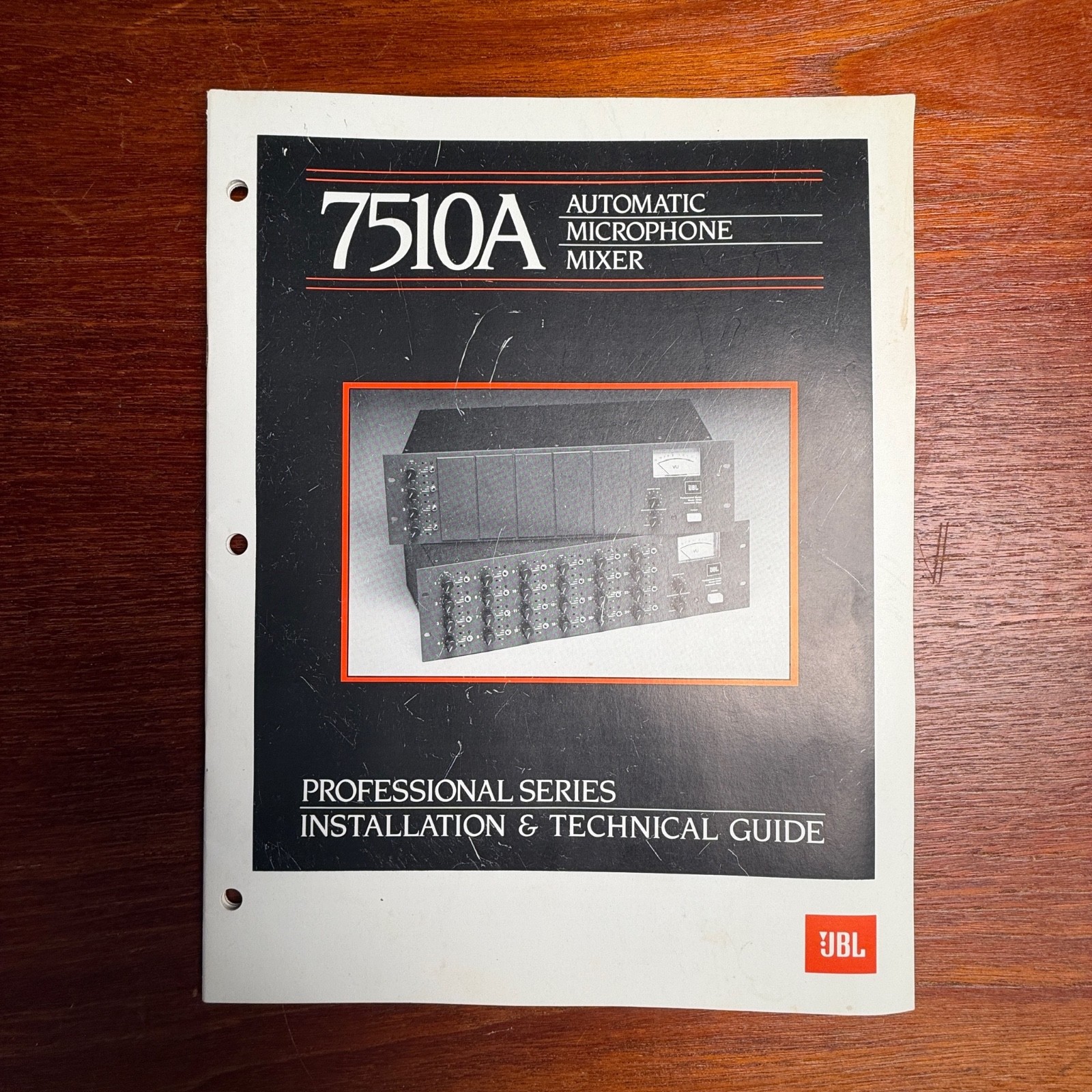
Modern-Recording (February 1980, p.38) covered the 7510's sibling, the automatic microphone mixer of the same model number, noting JBL's "broad range of professional applications" — evidence that the 7510 designation carried pro-audio weight in the JBL lineup even as the loudspeaker version targeted domestic listeners. The speaker's own credentials stand on the driver engineering and the reflex tuning, both of which reflect JBL's monitor heritage without requiring a mixing console to appreciate.
Final Thoughts
The JBL 7510 is a speaker that rewards patient setup and honest amplification. It's not the last word in low-end extension — the 45–50 Hz region is where it starts rolling off, depending on which spec you trust — but it delivers clean, articulate bass within its range, and the 89 dB sensitivity means dynamics come easy. The 1990–1992 production window for the 7510X makes it a relatively late analog-era JBL, built when the company was transitioning its pro expertise into more accessible domestic formats.
For collectors, the 7510 represents a pragmatic entry point into JBL floorstanders — less coveted than the studio monitors, but built to the same engineering standards. The naming confusion between 7510, L7510, and 7510X is worth understanding before buying, as is the spec variance between sources. But as a listening proposition, it delivers what JBL promised: honest, efficient, room-friendly sound from a cabinet that doesn't dominate the space. At 18 kg and 843 mm tall, it's a manageable vintage speaker that still makes sense in a modern room.
eBay Listings

As an eBay Partner, we earn from qualifying purchases. This helps support our independent vintage technology research.